Review
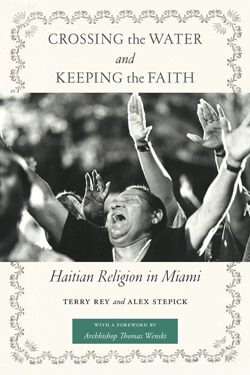
In Crossing the Water and Keeping the Faith, sociologists Terry Rey and Alex Stepick map the vibrant diasporic religious cultures of Miami, the site of the largest Haitian-descended population outside Haiti itself. Well aware that prevailing academic and popular narratives ascribe Vodou practice to all Haitian citizens and expatriates, Rey and Stepick offer a meticulous historical and ethnographic account of Miami’s religious landscape that evolves at the crossroads of Catholic, Protestant, and Vodouist praxes.
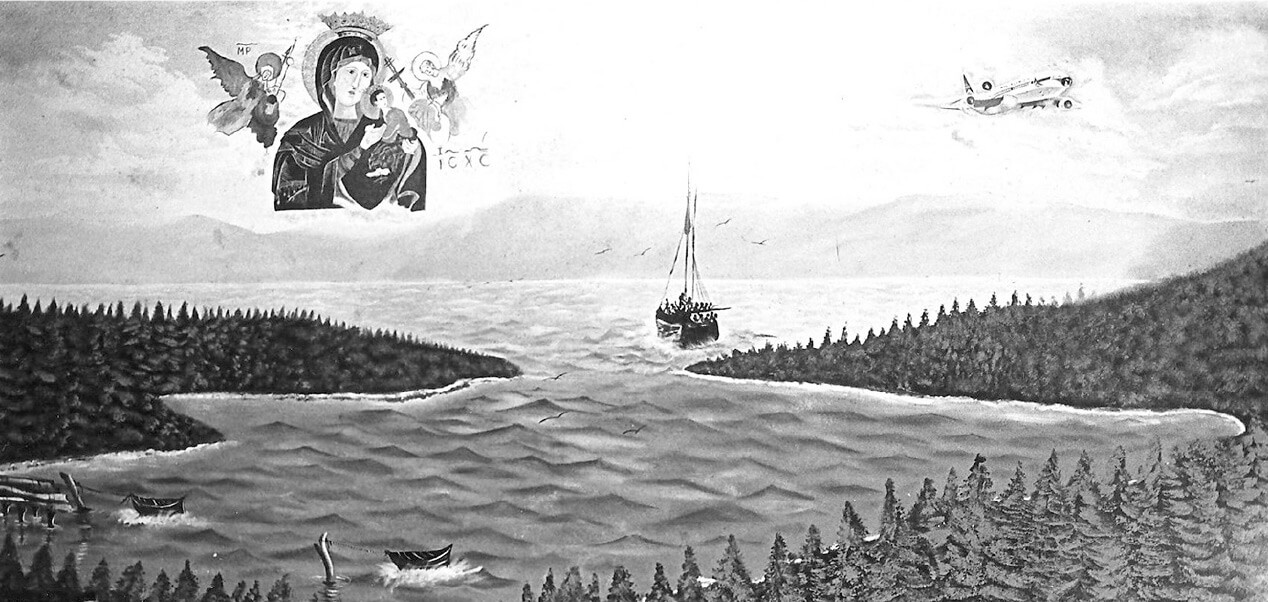 |
| Crossing the Water, Notre Dame d’Haiti Catholic Church, Little Haiti, Miami. Mural by Alex Jean Altidor. Photo by Jerry Berndt. Courtesy of New York University Press. |
Crossing the Water and Keeing the Faith opens with a vivid description of Alex Jean Altidor’s prominent mural at Notre Dame d’Haiti Catholic Church, “the leading cultural and religious institution in Haitian Miami and one of the most significant ‘ethnic parishes’ in American Catholic history” (35). This colorful mural depicts Haitians traveling by passenger jet and wooden boat to Miami, framing Rey and Stepick’s emphasis on religious exchange and serving as a devotional reminder of the journeys between these two sites. One interpretation of this painting asserts that Haitian émigrés employ a singular Catholic theology of migration. However, Rey and Stepick reveal multiple dimensions of the Haitian American religioscape in Miami that preserve and theologize a complex lifesystem. Our Lady of Perpetual Help, a central figure in the mural who guards over the emigrants’ journeys, serves as a polyreligious national symbol, taking on significant meaning in the three religious trajectories that Crossing the Water and Keeping the Faith describes. Rey and Stepick argue that religion facilitates the successful migration, assimilation, and flourishing of immigrant communities. As the mural’s motifs testify, and Rey and Stepick illuminate, experiences of immigration shape Haitian American religiosity in Miami.
 |
| Forest of Artists Haitian Cross, Artisan Project of Port-de-Paix, Haiti, sister diocese to the Archdiocese of Miami. Notre Dame d’Haiti Cathedral, Miami, Florida, February 1, 2014. Photo by Monica Lauzurique. Courtesy of the Archdiocese of Miami. |
In characterizing “the transnational Haitian religious field”—some 690 miles between Miami and Haiti—Crossing the Water and Keeping the Faith advances a “Haitian religious collusio,” defined as “a generally shared substratum of features that runs beneath [Haitian religious] diversity and animosity” (5, 8). The authors understand Pierre Bourdieu‘s term collusio as an extension of his more commonly cited habitus, “the ‘matrix of perception’ through which one makes sense of the world and the seat or generator of one’s dispositions, inclinations, and tastes” (7–8).1For an extended discussion of the relationship between habitus and collusio, see Pierre Bourdieu, “The Production of Belief,” Media, Culture, and Society 2 (July 1980): 261–293. A Haitian religious collusio encompasses a worldview “inhabited by invisible, supernatural forces that are to be served and which can be called upon and operationalized toward healing ills, mitigating plight, enhancing luck, and achieving goals” (10). Rey and Stepick are clear: Vodou2Vodou is an indigenous Haitian religion, closely related to West African Vodun, that draws from multiple West African religions, in addition to Roman Catholicism, European mysticism, and freemasonery. Most practitioners of Vodou reference themselves as “servants of the spirits,” and understand the religion as a worldview. See Karen McCarthy Brown, Mama Lola: A Vodou Priestess in Brooklyn (Berkeley: University of California Press, 1991); David Cosentino, Ed., Sacred Arts of Haitian Vodou (Los Angeles: UCLA Fowler Musuem of Cultural History, 1995); and Patrick Bellegard-Smith and Claudine Michel, Eds., Vodou in Haitian Life and Culture: Invisible Powers (New York: Palgrave Macmillan, 2006). binds together disparate Haitian religious orientations that can otherwise be viewed as antagonistic and oppositional. Crossing the Water and Keeping the Faith examines how a particular Latin American religious collusio manifests in Miami.
Importantly, Rey and Stepick foreground how religion informs classism among Miami’s Haitian Christian population. In Chapter Two, “Immigrant Faith and Class Distinctions: Haitian Catholics beyond Little Haiti,” they explore how the religiosity of middle- and upper-class Haitian Americans reifies their class standing. The economic differences between the mural’s airplane and boat suggest parallel devotional differences between Miami’s mostly lower-class “Little Haiti” and various middle- and upper-class suburban enclaves. Haitians in middle- and upper-class neighborhoods outside of Miami (such as West Kendall and Perrine), participate in more overtly “sacramental rites” at a Traditionalist Catholic shrine in Little Havana (the Shrine of St. Philomena),3The Traditionalist Catholic movement performs sacraments in accordance with church teachings prior to the Second Vatican Council (1962–1966). Vatican II made noteworthy changes to sacramental rituals. For example, the altar is closer to laypersons, and much of the liturgy is spoken in local languages rather than in Latin (63). at Our Lady of Lourdes Catholic Church in Kendall, and at Christ the King Catholic Church in Perrine (59, 63). Highlighting important class markers, such as Latin or French masses as contrasted with those in Haitian Creole, Rey and Stepick posit that well-off Haitian Americans pursue upward mobility while maintaining “Old World” separations between themselves and lower-class Haitian Americans.
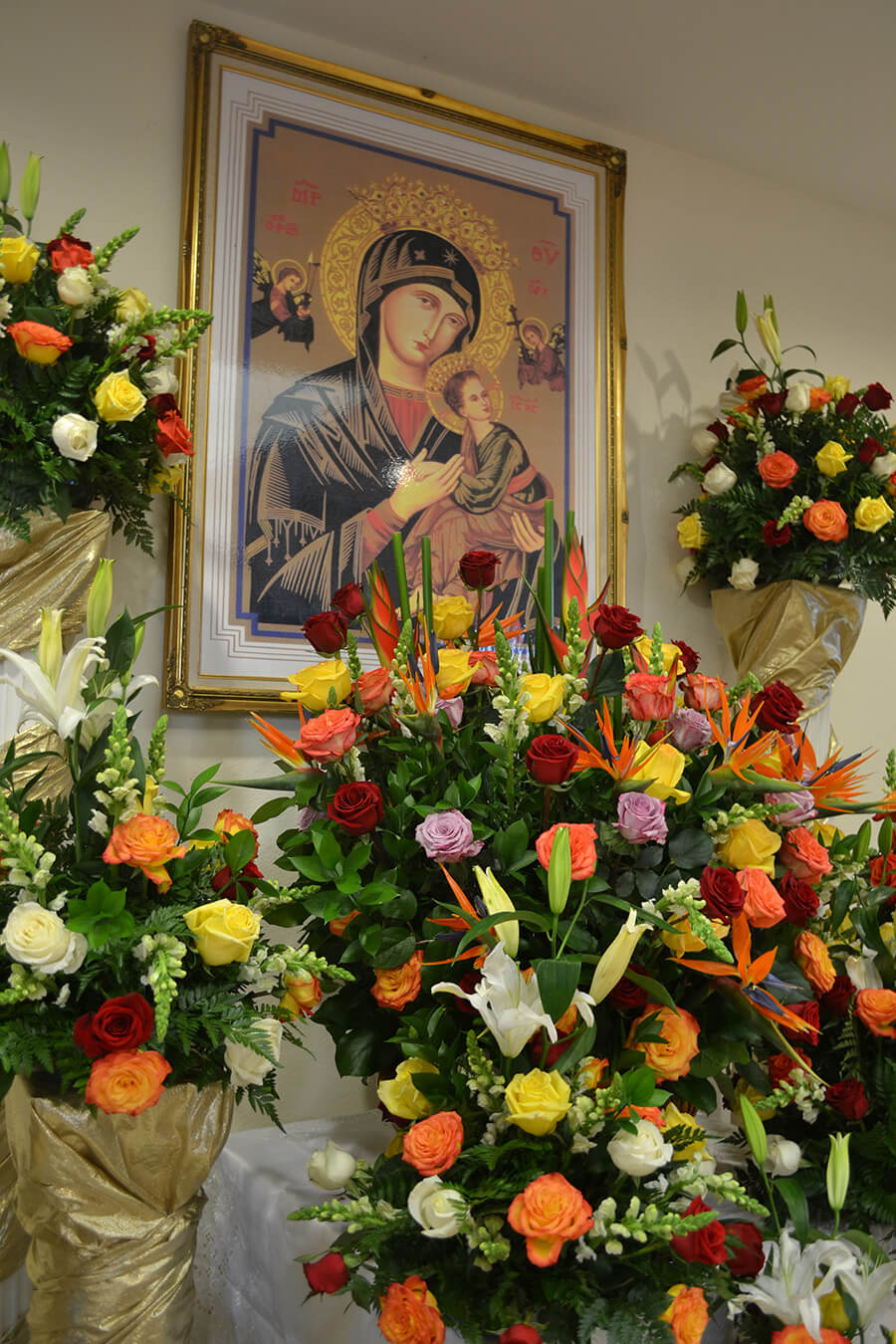 |
| Our Lady of Perpetual Help, Marian Shrine at the Notre Dame d’Haiti Catholic Church, Miami, Florida, February 1, 2014. Photo by Ana Rodriguez-Soto. Courtesy of the Archdiocese of Miami. |
Although Mary is a venerated figure across global Catholic devotion, Rey and Stepick posit a “Marian collusio” among Haitian Catholics across time and space.4For more on Haitian Marian devotion, see Terry Rey, Our Lady of Class Struggle: The Cult of the Virgin Mary in Haiti (Trenton: Africa World Press, 1999). They assert that
on the Catholic side of the Haitian religious triangle of forces, the supernatural being who is believed to be most involved in the lives of believers and the history of their nation and its diaspora is the Virgin Mary. . . . Even as Haitian Catholicism changes over generations and as it has been carried across seas, this is its most enduring feature, devotion to the Virgin Mary who fought for Haitian independence, who inspired the toppling of dictators, and who maternally guided thousands of Haitian immigrants in their crossing to and thriving in Miami. (81)
In addition to exploring subaltern spaces and practices, Stepick and Rey note the active participation of middle- and upper-class Haitians in the Catholic Charismatic Renewal (CCR), a Pentecostal movement that has heavily influenced the Catholic Church in Haiti.5The Catholic Charismatic Renewal, a direct result of Catholic encounter with Protestant Pentecostalism dates to the 1960s and is found in over two-hundred countries. In gatherings outside of Mass, members of CCR participate in prophecy, faith healing, and glossolalia. It reflects a larger Neo-Pentecostal movement of persons and groups experiencing “charismatic” worship and choosing to stay in their familiar Catholic faith tradition, as opposed to aligning with Pentecostal congregations. See Paul Josef Cordes, Call to Holiness: Reflections on the Catholic Charismatic Renewal (Collegeville: Michael Glazier, 1997) and Susan A. Maurer, The Spirit of Enthusiasm: A History of the Catholic Charismatic Movement, 1967–2000 (Lanham: University Press of America, 2010). They highlight the movement’s 2002 national convention in Haiti, drawing several thousand attendees and “[r]epresenting all social classes of the Haitian diaspora” (74). For Rey and Stepick, Neo-Pentecostal movements such as CCR have the ability to implode class boundaries (76). Though Haitian class tensions manifest in urban and suburban Miami, the realities engendered by migration can challenge or shore up social structures.
The Haitian diaspora evades easy categorization (78). In Crossing the Water and Keeping the Faith, collusio serves as a theoretical orientation for Haitian American religious identity spanning class identities. Members of various religious groups “believe strongly that faith is a source of healing and of matchless protection against destructive supernatural powers and against the fallout from sin—a source of salvation goods” (80).
Rey and Stepick understand religion as mitigating the discrimination that Miami Haitian Americans experience.6For an example, see Regine O. Jackson, “After the Exodus: The New Catholics in Boston’s Old Ethnic Neighborhoods,” Religion and American Culture 17.2 (2007): 204. Jackson argues that religion sometimes become a lowest common denominator amongst co-ethnics. Religious institutions and weekly practice offer immigrants “…a way to recreate social ties and generate narratives of self-worth despite structural challenges to individual and collective mobility.” The cornerstone of the collusio—harnessing and directing supernatural power—responds to life’s realities:
[W]e have argued that for many Haitian immigrants in Miami religious practice is a source of worthiness, a form of salvation goods that such practice accrues for believers. . . . For Haitians in Miami and elsewhere in the diaspora, the religious capital possessed by churches, temples, priests, pastors, botanicas, oungan, and manbo generates a wide array of salvation goods that believers pursue, the most obvious being sacraments, luck, magic, and healing. Less obvious, though equally important, especially for poor immigrants, is worthiness: a sense of being worthy of a place in American society; a sense that one’s gifts from Haiti are making an important contribution to both the American social fabric and the Haitian; a sense of dignity and respect that transforms boat people into people; beasts into gods. (201)
“Symbolic capital” and “salvation goods” take on a particular meaning in Haiti’s material-based religious cultures and affect what Rey and Stepick identify as Haitian religion’s ultimate concern: healing (14–15). On a more everyday level, “worth”—invisibly and materially—furnishes an individual and communal currency to leverage toward efficacy, power, and self-confidence.
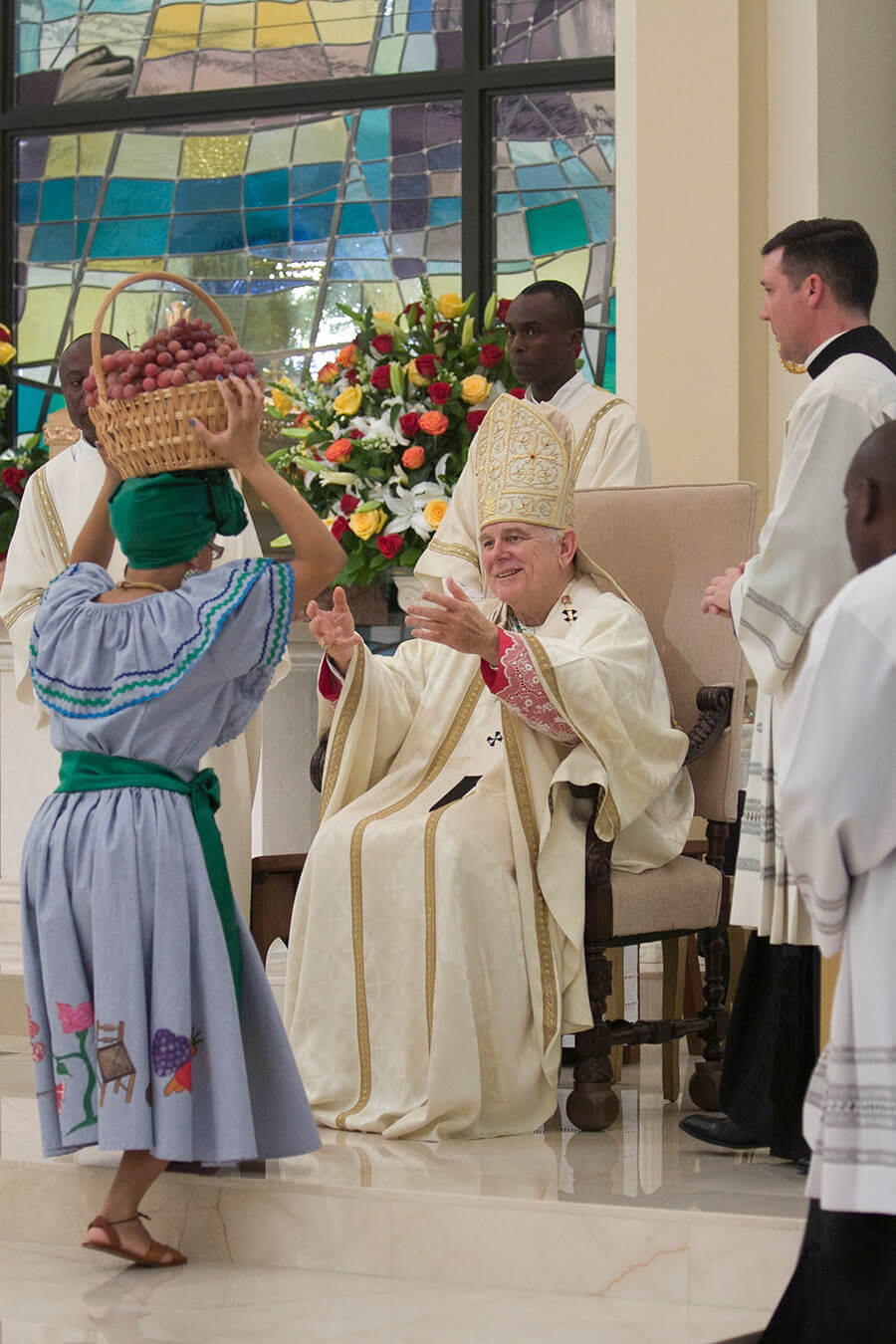
Rey and Stepick suggest that the collusio is at work in all Haitian American religious spaces. From Catholicism’s political advocacy and feast days to evangelical Protestantism‘s storefront churches, Crossing the Water and Keeping the Faith‘s diverse representation of Haitian Christianity constitutes its primary intervention. Emphasizing that Christians comprise a majority within the Haitian diaspora, the authors repeatedly connect immigration with Christian conversion, theorized as an act of spiritual thanksgiving and religio-social assimilation. Archbishop Thomas Wenski‘s (former activist priest at Notre Dame d’Haiti Catholic Church) foreword and the church-centered descriptions of Vodou practice evince Rey and Stepick’s casting of Haitian American religion as predominately Christian.
 |
 |
|
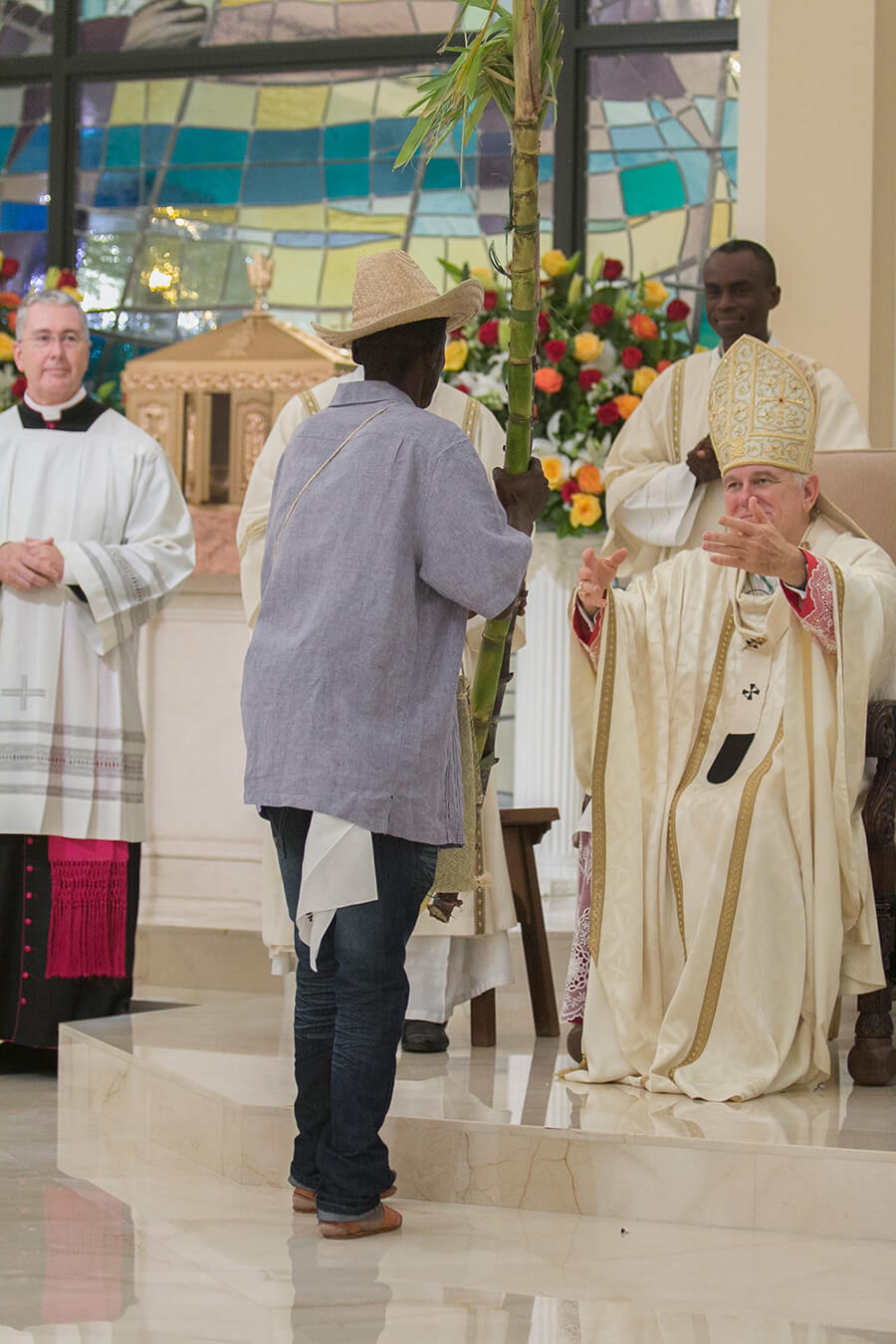
| Archbishop Thomas Wenski receiving offertory gifts of fruits and native plants from parishioners, Notre Dame d’Haiti Catholic Church dedication service, Miami, Florida, February 1, 2015. Photo by Ana Rodriguez-Soto. Courtesy of the Archdiocese of Miami. | ||
This assessment hinges on contested etic religious categories and foregrounds boundaries between the three faith systems that do not correspond with the broad Africana epistemology championed by theologian Dianne M. Stewart and religious historian Tracey R. Hucks. Synthesizing the work of social scientists, religious and secular historians, theologians, and ethicists to provide a thorough historiography of Africana religious studies in the Americas over the last century, Stewart and Hucks challenge entrenched notions of Christian influence and religious syncretism that impact representations of African and Africana religions. With the exception of Cuban Santería and Palo Monte practitioners in Miami, Rey and Stepick do not engage Haitian American religiosity comparatively within this larger Africana religious milieu.7See Tracey E. Hucks and Dianne Stewart Diakité, “Africana Religious Studies: Toward a Transdisciplinary Agenda in an Emerging Field,” Journal of Africana Religions 1.1 (2013): 39. In contrast to Rey and Stepick’s emphasis on Christianity as the religious vocabulary through which Haitian Americans identify, understand, and live out their polyreligious collusio, the fluidity of the “crossed” water depicted in Crossing the Water and Keeping the Faith‘s opening mural may more accurately represent multiple and disparate ways that Haitian Americans mobilize various religious technologies. Rey and Stepick depart from other contemporary ethnographic explorations of the Haitian diaspora in Miami and urban America. In comparison with scholarly works that connect Vodou practice and migration as parallel processes—such as Karen McCarthy Brown’s oft-cited Mama Lola: A Vodou Priestess in Brooklyn, Elizabeth McAlister’s Rara! Vodou, Power, and Performance in Haiti and its Diaspora, or Karen Richman’s Migration and Vodou—Rey and Stepick reimagine the Haitian American religious landscape as predominantly Christian.
 |
The sole chapter in Crossing the Water and Keeping the Faith dealing with African-derived religious culture of Haiti, “Vodou in the Magic City: Serving the Spirits across the Sea,” demonstrates a broad understanding of religious syncretism in Miami.8In an ethnography of the Tobagonian Spiritual Baptist faith, anthropologist Maarit Laitinen offers an impressive intellectual genealogy of “syncretism” between African and European religious cultures. Laitinen advances a textured theory that “does not downplay the agency of people living in creole societies, but presents them as active, creative participants in the reproduction of change and religion within particular socio-historical circumstances.” Though Laitinen is one of many theorists who articulate a novel theory of religious encounter in the Caribbean, her scholar-practitioner identity is particularly concerned with “bridg[ing] the conceptual gap, often hierarchically valued, between creole cultures and ‘cultures of origin'” (61). Laitinen’s perspective helpfully elucidates the Caribbean religious landscape from which Vodou emerges and, by implication, problematizes “syncretism” as a primary interpretive lens of Caribbean religions. See Maarit Laitinen, Marching to Zion: Creolisation in Spiritual Baptist Rituals and Cosmology (Helsinki: Helsinki University Press, 2002). Although it underscores gross misperceptions of Vodou practice, it offers only scant engagement with the phenomenon in the United States. Instead, Rey and Stepick emphasize four stages of Vodou practice in the Miami diaspora: its transformations along the Haitian-Miami corridor; the role of Catholic churches and shrines in sustaining practices; challenges that practices pose to local judiciary; and the transnational characteristics of Miami neighborhoods practicing Vodou (118). Despite contemporary scholarship that illumines Africana religions and categories, Rey and Stepick depict Vodou as a historical undercurrent for waves of Haitian American Christian growth. To their credit, they mention Vodou practitioners’ reticence to engage fully with ethnographers and thereby betray questions of access to the tradition the authors describe as declining.9There are numerous reasons for Vodou practitioners to withhold their religious identities and practices from outsiders, including academic misrepresentation, social stigma, and political persecution. See Benjamin Blue, “They Fought the Lwa and the Lwa Won: Persecution of Haitian Vodou,” The Journal of the Vodou Archive (Spring 2013): 2–7. While Rey and Stepick return to the Catholic, Protestant, and Vodouist legs of the Haitian collusio, their analysis of Vodou’s contribution remains limited.
An Africana religious framework would benefit Crossing the Water and Keeping the Faith, ensuring a consideration of the coterminous beliefs and practices issued from multiple religious heritages. Anthropologist Stephen Glazier‘s theory of religious juxtaposition in the Spiritual Baptist tradition would also extend Rey and Stepick’s collusio framework. Glazier suggests that rites from disparate religions, though sometimes separated by time and space, can find ritual homes in the same bodies and places. Multiple religious traditions are juxtaposed in a ritual altar display, or on ceremonial vestments, rather than being absorbed, ignored, or obliterated.10Stephen Glazier, “Syncretism and Separation: Ritual Change in Afro-Caribbean Faith,” The Journal of American Folklore 98.387 (January-March 1985): 49–62. While Rey and Stepick make similar claims about Vodou practice and “Haitian religion” writ large, their perspective obscures Vodou’s pivotal influences. By retaining Bourdieu’s collusio throughout Crossing the Water and Keeping the Faith—designating what constitutes a Catholic, Protestant, or Vodou initiate without a sustained discussion of persons inhabiting multiple religious identities—Rey and Stepick miss opportunities to engage Africana-centered theories that represent dialogical relationships between African and Christian practices. The mantle of one faith need not elide the presence of another. The authors’ indexing Haitian American religious ways along a Christian continuum over-simplifies the dynamic religious orientation that emerges in the diasporic movement.
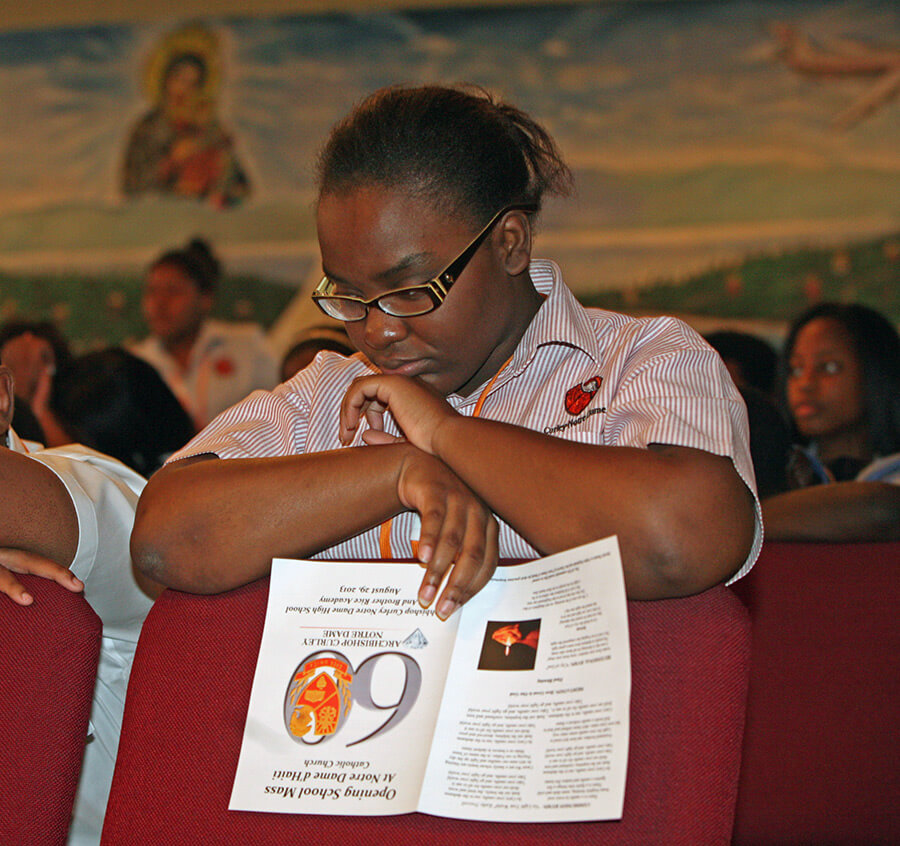 |
| Student kneeling in front of Alex Jean Altidor’s mural, former Notre Dame Academy for Girls, Miami, Florida, August 29, 2013. Photo by Ana Rodriguez-Soto. Courtesy of the Archdiocese of Miami. |
Crossing the Water and Keeping the Faith successfully locates Catholic, Protestant, and Vodouist religious identities in Haitian Miami and illustrates the diversity of religious places in the diaspora. Rey and Stepick’s extensive fieldwork yields vivid anecdotes of faithful persons, sensitive considerations of immigrant struggle and resilience and, to date, the most comprehensive theory of Haitian American religious lives. Exploring how religious cultures mobilize and sustain themselves and their adherents, Crossing the Water and Keeping the Faith extends popular and scholarly understandings of Haitian religiosity in the United States. In their debatable adoption of Christianity as the dominant epistempology for Haitian religious practice, Rey and Stepick illuminate the need for critical interrogation of the radical encounters of diaspora, pointing to the project of extending their theoretical framework of collusio into broader, Africana frameworks.