Introduction
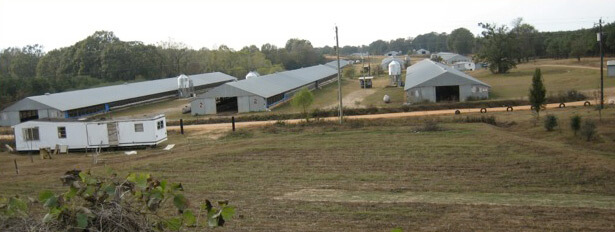 |
| Scott County chicken farm, Mississippi, 2005. Photograph by Angela Stuesse. Courtesy of Angela Stuesse. |
It’s dusk, and the putrid odor of chickens heading to and from slaughter floats through the warm evening air, just as it has all summer. It is July 2005 and Pablo Armenta, a father of four from Veracruz, Mexico, sits on the makeshift porch of a decaying trailer as he recounts the story of how he came to Mississippi:
Mississippi . . . I think God put it in my path. I was in Florida picking oranges. One afternoon I went to a Cuban store . . . and when I was walking home, a van pulled over, [and this guy says to me,] “Hey, do you want to work in Mississippi?” And I told him, “Well, that depends.” So he explained what it was about, a chicken plant, a factory where they process chicken, the work is like this, they pay this much. They were offering housing and everything . . . so yeah, it sounded good to me.1Pablo Armenta, interview with Angela Stuesse, July 7, 2005, Scott County, Mississippi. In this article we protect most research participants’ confidentiality by omitting names or using pseudonyms. In cases where we quote industry representatives and other public or historical figures, we use their real names. Unless otherwise indicated, all quotations from present-day residents and workers in Scott County are from Helton’s fieldnotes, June–July 2003, or Stuesse’s fieldnotes, June 2002–June 2008.
Stuesse, absorbed in the story from her rusted metal chair a few feet away, is incredulous: “So they just stopped you on the side of the road and you said yes?!” Armenta chuckles . . .
Yes! So then they said, “Tomorrow we’ll come get you around this time.” So I told them where I lived, and I talked with my two brothers, and we decided to do it. [The next day] I left. We went in one of those vans you can use to rent furniture, all piled up on top of one another. [I arrived,] worked one week, received my first paycheck, it seemed good to me, and I brought them all here to join me.
The migration that Armenta describes, originating in the mid-1990s, has changed many rural southern communities. Over half a million “Hispanics” moved to the South in that decade, making it home to the fastest growing Latino population in the country at the turn of the millennium. In Mississippi, the “Hispanic” population in poultry industry locales grew by over 1000 percent in the 1990s.2
US Bureau of the Census, “Scott County, Mississippi, General Population and Housing Characteristics: 1990,” 1990, accessed on October 13, 2002, http://factfinder.census.gov/servlet/BasicFactsTable?_lang=en&_vt_name=DEC_1990_STF1_DP1&_geo_id=05000US28123; US Bureau of the Census, “Scott County, Mississippi, Census 2000 population, demographic, and housing information: General Demographic Characteristics,” 2000, accessed October 13, 2002, http://quickfacts.census.gov/qfd/states/28/28123.html.
Driven by the industry’s recruitment of foreign-born labor, by the early 2000s immigration had made Scott County, at the center of this state, home to Cubans, Dominicans, Hondurans, Guatemalans, Mexicans, Peruvians, Argentines, and other Latin Americans. These newcomers joined a society structured by deeply entrenched racial hierarchies and an industry known for some of the lowest paid and most dangerous jobs in the country.3For more on the poultry industry see Donald D. Stull and Michael J. Broadway, Slaughterhouse Blues: The Meat and Poultry Industry in North America (Belmont, CA: Wadsworth, 2004); Steve Striffler, Chicken: The Dangerous Transformation of America’s Favorite Food (New Haven, CT: Yale University Press, 2005); Kathleen Crowley Schwartzman, The Chicken Trail: Following Workers, Migrants, and Corporations across the Americas (Ithaca, NY: ILR Press of Cornell University Press, 2013). Parallel trends have diversified the demographic composition of other towns across the US South.
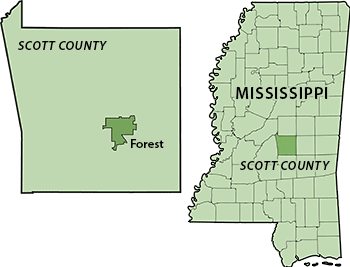 |
| Scott County, Mississippi. Data from Wikimedia Commons. Map courtesy of Southern Spaces. |
In Scott County‘s seat of Forest, population six thousand, there are five large-scale poultry processing plants dominating local industry. Local high school football teams compete for the “Golden Chicken” trophy.4Chris Allen Baker, “Battle for Golden Chicken Enters Its 80th Year,” Scott County Times, October 21, 2009, accessed November 6, 2013, http://www.sctonline.net/news/article_2e8efddf-5c83-5935-9ea3-eac434b9b7cf.html. Typical for poultry-producing areas, many of Scott County’s residents struggle to make ends meet, and nearly half of Forest’s households earn less than $25,000 per year. Just under 50 percent of Forest’s population is African American, approximately 30 percent is white, and almost 25 percent self-identifies as “Hispanic.”5US Bureau of the Census, “Forest City, Mississippi, Profile of General Population and Housing Characteristics, 2010,” accessed December 23, 2013, http://factfinder2.census.gov/faces/tableservices/jsf/pages/productview.xhtml?pid=DEC_10_DP_DPDP1. Scott County, then, differs from some areas of the US South that have attracted large numbers of Latin American immigrants in the past twenty years. Here, these new arrivals have joined workplaces and communities where the largest demographic group is African American rather than white. This compels us to think about the ways in which immigration history in the South is intertwined with the parallel history of African American struggles for equal economic opportunity—particularly how industrial restructuring as well as state and federal agricultural and development policies since World War II have affected these struggles.
Nuevo New South? The Long History of Contemporary Immigration
Since the early 2000s, scholars have increasingly turned their attention to Latino migration to the US South.6Arthur D. Murphy, Colleen Blanchard, and Jennifer A. Hill, eds., Latino Workers in the Contemporary South (Athens: University of Georgia Press, 2001); Barbara Ellen Smith, “The New Latino South: An Introduction,” Across Races and Nations: Building New Communities in the US South (Memphis, TN: Center for Research on Women at the University of Memphis, Highlander Research and Education Center, and Southern Regional Council, 2001), http://www.memphis.edu/crow/pdfs/new_latino_south.pdf; Raymond A. Mohl, “Latinization in the Heart of Dixie: Hispanics in Late-Twentieth-Century Alabama,” Alabama Review 55, no. 4 (October 2002): 243–274; Sandy Smith-Nonini, “Back to The Jungle: Processing Migrants in North Carolina Meatpacking Plants” (paper presented at the annual meeting of the American Anthropological Association, New Orleans, LA, November 20–24, 2002); Leon Fink, The Maya of Morganton: Work and Community in the Nuevo New South (Chapel Hill: University of North Carolina Press, 2003); Jamie Winders, “Changing Politics of Race and Region: Latino Migration to the US South,” Progress in Human Geography 29, no. 6 (December 2005): 683–699; Paula D. McClain, et al., “Racial Distancing in a Southern City: Latino Immigrants’ Views of Black Americans,” Journal of Politics 68, no. 3 (July 2006): 571–584; Heather A. Smith and Owen J. Furuseth, eds., Latinos in the New South: Transformations of Place (Aldershot, England: Ashgate, 2006); Víctor Zúñiga and Rubén Hernández-León, eds., New Destinations: Mexican Immigration in the United States (New York: Russell Sage Foundation, 2005); Mary E. Odem and Elaine Lacy, eds., Latino Immigrants and the Transformation of the US South (Athens: University of Georgia Press, 2009); Ricardo B. Contreras, “The Nuevo South Action Research Collaborative: A Model of Community Engagement and Service-learning in Eastern North Carolina (Towards a New Type of University-Community Collaboration),” June 10, 2010, accessed October 29, 2013, http://www.ecu.edu/cs-cas/anth/nuevosouth/upload/The-Nuevo-South-Action-Research-Collaborative.pdf; Hannah E. Gill, The Latino Migration Experience in North Carolina: New Roots in the Old North State (Chapel Hill: University of North Carolina Press, 2010); Laura López-Sanders, “Is Brown the New Black?: Immigrant Incorporation and the Dynamics of Ethnic Replacement in New Destinations” (PhD dissertation, Stanford University, 2011); and Helen B. Marrow, New Destination Dreaming: Immigration, Race, and Legal Status in the Rural American South (Stanford, CA: Stanford University Press, 2011). Emphasizing the novelty of the new immigrant stream where a black-white binary had long dominated local understandings of race, some scholars dubbed the phenomenon the “Nuevo New South.”7Fink, The Maya of Morganton; Mohl, “Latinization in the Heart of Dixie”; Natalia Deeb-Sossa and Jennifer Bickham Mendez, “Enforcing Borders in the Nuevo South: Gender and Migration in Williamsburg, Virginia, and the Research Triangle, North Carolina,” Gender and Society 22, no. 5 (October 2008): 613–638; Smith and Furuseth, Latinos in the New South; and Irene Browne and Mary Odem, “Understanding the Diversity of Atlanta’s Latino Population: Intersections of Race, Ethnicity and Class” (paper presented at Immigration to the US Southeast: Defining Problems, Finding Solutions Conference, Kennesaw State University, Kennesaw, GA, October 30, 2010). Early descriptive work, by recognizing the significance of ongoing demographic shifts and documenting the challenges faced by new immigrants, laid the foundation for what has become a robust interdisciplinary field of study.8For a detailed accounting of the development of this field, see, for example, Winders, “Changing Politics of Race and Region”; Marrow, New Destination Dreaming; and Jamie Winders, Nashville in the New Millennium: Immigrant Settlement, Urban Transformation, and Social Belonging (New York: Russell Sage Foundation, 2013). More recent work has moved away from an emphasis on novelty by demonstrating a longer history of Latinos in the Deep South9Julie M. Weise, Corazon de Dixie: Mexico and Mexicans in the US South since 1910 (Chapel Hill: University of North Carolina Press, forthcoming). and by situating long-term residents’ reception of recent immigrants within their memories and understanding of local histories, particularly of recent racial struggles like school busing.10Winders, Nashville in the New Millennium.
Our work corroborates this more sustained critical engagement with history in order to comprehend the complexities of the transnational present. In this essay we seek to contextualize recent immigrant recruitment to Mississippi’s chicken processing region within the area’s relations of race, industry, work, and labor organizing. We bring together the perspective of Julie Weise and Jamie Winders with work on industrial restructuring and workplace conditions in the contemporary poultry industry. While scholars have often described immigrant recruitment in terms of a split labor market—in which workforce division augments management’s labor control11Significant works in this field include Edna Bonachich, “A Theory of Ethnic Antagonism: The Split Labor Market,” American Sociological Review 37, no. 5 (October 1972): 547–559; Eric Wolf, Europe and the People Without History (Berkeley: University of California Press, 1982); and Gustavo Lins Ribeiro, Transnational Capitalism and Hydropolitics in Argentina: The Yacyretá High Dam (Gainesville: University Press of Florida, 1994).—we demonstrate how local poultry companies relied on racialized strategies to ensure low-cost labor long before turning to immigrant recruitment. We also show how, at least in central Mississippi, the industry’s earliest experiments with hiring transnational workers were linked to African American workers’ organized struggles for economic opportunity. Our research thus treats immigration as neither entirely new, nor peripheral, to experiences of race and labor in the Deep South.
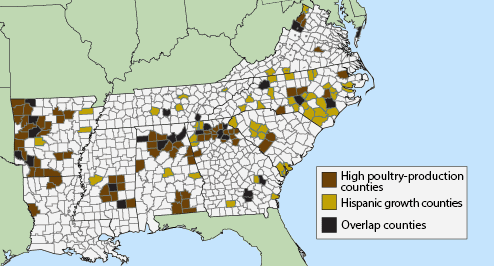 |
| Rapid Hispanic growth counties. United States Department of Agriculture, Economic Research Service. 1987, 1992, 1997 Census of Agriculture and 1990, 2000 Census of Population. Map courtesy of Southern Spaces. |
We chart how new immigration to the US South intersects in complicated and sometimes surprising ways with the history of the long civil rights movement, particularly in the late 1960s to early 1980s.12On the long civil rights movement, see Jacqueline Dowd Hall, “The Long Civil Rights Movement and the Political Uses of the Past,” Journal of American History 91, no. 4 (March 2005): 1233–1253. A key strand of literature on the black civil rights movement has discussed its intersection with labor histories. A small sampling includes: Jacqueline Jones, Labor of Love, Labor of Sorrow: Black Women, Work, and the Family, from Slavery to the Present (New York: Basic Books, 1985); Michael K. Honey, Southern Labor and Black Civil Rights: Organizing Memphis Workers (Urbana: University of Illinois Press, 1993); Beth Tompkins Bates, Pullman Porters and the Rise of Protest Politics in Black America, 1925–1945 (Chapel Hill: University of North Carolina Press, 2001); Robert Korstad, Civil Rights Unionism: Tobacco Workers and the Struggle for Democracy in the Mid-Twentieth-Century South (Chapel Hill: University of North Carolina Press, 2003); John A. Salmond, Southern Struggles: The Southern Labor Movement and the Civil Rights Movement (Gainesville: University Press of Florida, 2004); and Trevor Griffey and David Goldberg, Black Power at Work: Community Control, Affirmative Action, and the Construction Industry (Ithaca, NY: Cornell University Press, 2010). To challenge the way in which contemporary discourses of “labor shortage” and “work ethic” can mask these intertwined histories, and to better interpret the present situation, we examine the longer story of Latino migration to central Mississippi—dating to the 1970s, rather than to the 1990s as often assumed—along with local memories and archival evidence of African American workplace struggles.13A note on methodology: The authors met in 2003 in Scott County, Mississippi, as participants in the Poultry Worker Justice Research Project, an endeavor coordinated by Stuesse and colleagues at the University of Texas at Austin. The project laid the groundwork for Stuesse’s doctoral research in anthropology, in which she studied how black, white, and new Latino Mississippians are experiencing the changes neoliberal globalization brings to their communities and workplaces, and the implications these have for building worker power in the poultry industry, see Angela Stuesse, “Globalization Southern-Style: Immigration, Race, and Work in the U.S. South” (unpublished manuscript, October 18, 2013), Microsoft Word file. Integral to this work conducted between 2002 and 2008, Stuesse was a founding collaborator of the Mississippi Poultry Workers’ Center (MPOWER), see Angela Stuesse “Anthropology for Whom?: Challenges and Prospects of Activist Scholarship,” in Public Anthropology in a Borderless World, ed. Sam Beck and Carl A. Maida (New York: Berghahn Books, forthcoming). Helton conducted research focused on the responses of black and white longtime residents of Scott County to immigration, see Laura E. Helton, “Three Hundred Strangers Next Door: Native Mississippians Respond to Immigration, A Report of the Poultry Worker Justice Research Project,” Inter-American Policy Studies Occasional Papers, no. 4 (Austin, TX: Inter-American Policy Studies Program, Lyndon B. Johnson School of Public Affairs: Teresa Lozano Long Institute of Latin American Studies, The University of Texas at Austin, 2003). The following year she moved to the state capitol of Jackson, where for two years she worked as a field archivist for the Mississippi Digital Library, a collaboration between six archival repositories to increase access to civil rights-related collections across the state. These intersecting research projects resulted in a coauthored paper presented at the Southern Labor Studies Conference, see Laura E. Helton and Angela Stuesse, “Race, Low-wage Legacies and the Politics of Poultry Processing: Intersections of Contemporary Immigration and African American Labor Histories in Central Mississippi” (paper presented at the Southern Labor Studies Conference, Moving Workers: Migration and the South, April 15–17, 2004). The collaboration also inspired Stuesse to recognize the importance of the area’s history in shaping current race and industrial relations, which has since become a central feature of her work. See, for example, Stuesse, “Globalization Southern-Style” and Angela Stuesse, “When Silences Beckon: The Sovereignty Commission’s Chokehold on Civil Rights Histories in Central Mississippi, 1956–1973” (unpublished manuscript, June 12, 2013), Microsoft Word file.
What follows is an examination of three interconnected moments in Scott County’s history. First, we discuss the conditions and struggles surrounding the incorporation of African American workers into the previously all-white chicken plant workforce in the 1960s. Second, we outline the contours of worker organizing and its suppression in Scott County’s poultry plants in the 1970s. Third, we consider efforts to recruit Latin American migrant labor into the plants, first in the 1970s—a little-known but significant moment of transnational labor in central Mississippi—and again in the mid-1990s, when the most recent wave of immigration began. These periods are linked through their relationships to racialized inequality, industrial exploitation, and labor organizing.
Analysis of these moments makes clear how the industry has creatively relied upon exploitable classes of workers to increase profits; established a hierarchy of work in the plants; relegated workers of color in each generation to the worst available jobs; and strategically wielded workers’ racial, gender, and other identity categories to limit their collective bargaining power. In particular, the historical denigration of blackness as a social category continues to justify industry practices. This practice of denigration operates through discourses around immigration and work, in recent decades relying upon tropes of the “immigrant work ethic,” racially-coded language about “lazy” workers, and the socio-economic category of “labor shortages.” We conclude by considering how a deeper understanding of the industry’s past might help Mississippi’s present-day poultry workers organize for more just and humane working conditions.14We base our analysis on research carried out between 2002 and 2008 (with the bulk between 2003 and 2005) that included extensive ethnographic fieldwork; oral history interviews; and archival research at the Mississippi Department of Archives and History, the Forest Public Library, and limited private corporate holdings. This project presents significant archival challenges. Rural towns of this size are not regularly covered in major metropolitan and state newspapers (and as discussed in this piece, the county newspaper was under the control of a well-known white supremacist and excluded nearly all coverage of local civil rights struggles). In addition, there are no established municipal archives in these towns, which are only sparsely represented in the collections of the state archives. Finally, corporate archives are often notoriously guarded. While the records of local, family-owned businesses are often lost, we did encounter one family member who kept artifacts of his family’s poultry business. The most valuable archival sources we located were the subject files and scrapbooks compiled by local public librarians in Forest and Morton.
“The chicken plant replaced the cotton field”: Poultry Plant Desegregation in the 1960s
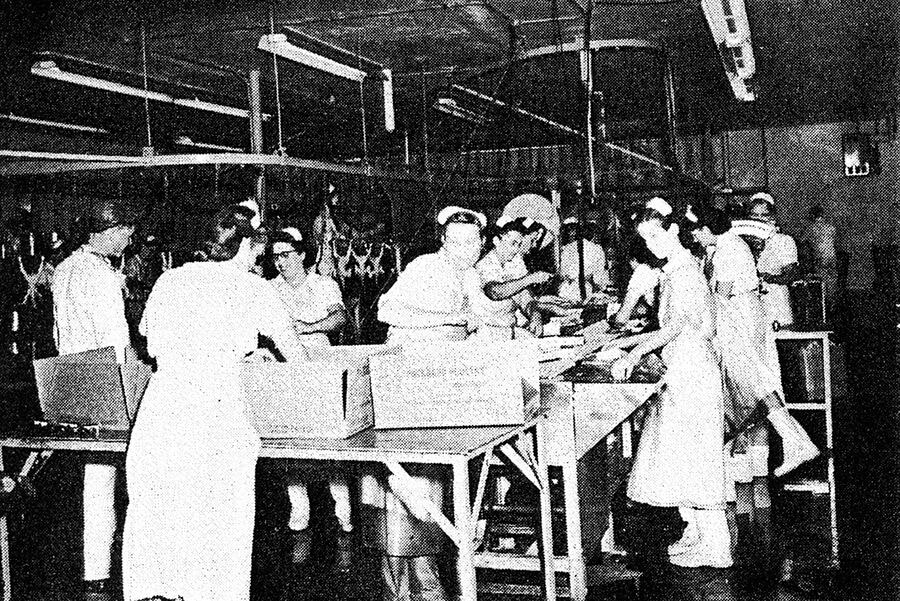 |
| Poultry plant workers, 1963. Photograph by Mississippi Poultry Commission. Courtesy of Forest Public Library. |
The racial integration of the Scott County poultry industry has received little attention. We base our narrative largely on recollections of former plant employees and longtime residents. As late as the early 1960s most Mississippi chicken plants would not hire African Americans. One white woman who spent time in the plants during those early years explained: “Blacks couldn’t work anywhere. Not even the chicken plants.”15Interview with chicken plant worker, February 2, 2006, Scott County, Mississippi. Managers staffed production lines almost entirely with white women, a fact that points not only to the long history of racial division in the poultry industry, but also to its gendered contours. While black men found a few jobs—usually heavy, outdoor labor—in poultry, black women were excluded from poultry processing lines (where chickens are gutted, cut, and sliced) that were staffed largely by white women. As becomes clear in discussions of worker organizing, the local industry’s racial desegregation revolves largely around African American women.
Telling the story of African Americans’ eventual entry into Scott County poultry plants requires that we consider three broad trends in the 1950s and 1960s. First, the industrialization of agriculture and early efforts at vertical integration in the poultry industry led to the mechanizing, standardizing, deskilling, and speeding up of farming and factory work, creating “push” and “pull” factors that led black workers to chicken plants.16Steve Striffler describes vertical integration as the process “whereby previously independent facets of the emerging industry were brought under the control of a single entity.” Striffler, Chicken, 39. For more on the histories of black farmers in the US South, see Gail Myers, “Rhythms of the Land: Africa Came to America,” 2013, accessed November 6, 2013, http://rhythmsoftheland.com. In the 1940s, the US poultry industry remained a decentralized operation, founded on household production of eggs and chickens sold in the open marketplace. Since then it has become one of the most highly specialized agricultural sectors, slaughtering more than one hundred million birds every week.17For more insight into the industrialization of poultry, see David Craig Griffith, Jones’s Minimal: Low-Wage Labor in the United States (Albany: State University of New York Press, 1993); Donald Stull, Michael Broadway, and David Griffith, eds., Any Way You Cut It: Meat Processing and Small-Town America (Lawrence: University Press of Kansas, 1995); William Boyd and Michael Watts, “Agro-Industrial Just-In-Time: The Chicken Industry and Postwar American Capitalism,” in Globalising Food: Agrarian Questions and Global Restructuring, ed. David Goodman and Michael Watts (London: Routledge, 1997), 192–225; Cedric Chatterley, Alicia J. Rouverol, and Stephen Cole, I Was Content and Not Content: The Story of Linda Lord and the Closing of Penobscot Poultry (Carbondale: Southern Illinois University Press, 2000); Stull and Broadway, Slaughterhouse Blues; Kathleen C. Schwartzman, The Chicken Trail: Following Workers, Migrants, and Corporations across the Americas (Ithaca: ILR Press of Cornell University Press, 2013). Many labor scholars have discussed these technological changes in the industry, but they have less often connected this history to the civil rights and post-civil rights experience of local African Americans, who came to dominate the industry’s workforce following these transformations. While the detailed history of Mississippi processors’ vertical integration is beyond the scope of this article, these developments facilitated the industry’s exponential growth in production capacity, its declining wage rates (in real terms), and its incorporation of increasingly marginalized populations of workers doing more and more dangerous labor.18For a more detailed account of the development of Mississippi poultry, see Stuesse, “Globalization Southern-Style.”
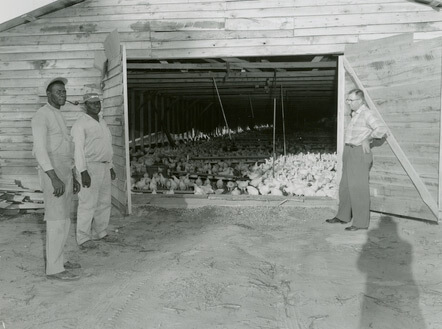 |
| Jones Co-op, Jones County, Mississippi, 1958. Photograph from Mississippi Farm Bureau Federation Collection PI/2010.0002. Series 2, Image 977. Courtesy of Mississippi Department of Archives and History. |
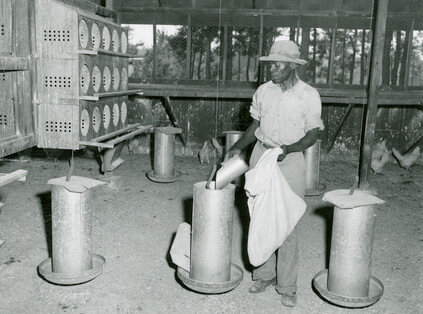 |
| Poultry farm scene with unidentified man, Clarke County, Mississippi, 1956. Photograph from Mississippi Farm Bureau Federation Collection PI/2010.0002. Series 2, Image 276. Courtesy of Mississippi Department of Archives and History. |
By the 1960s federal agricultural policy, with the goal of increasing demand for cotton, had created an incentive to keep cotton fields in central Mississippi fallow. Many individuals we spoke with suggested that this policy disproportionately hurt small black farmers, making it increasingly hard for them to make a living. This policy, combined with the rising prominence of the mechanical cotton picker, gave many local African Americans no choice but to trade the fields for the factories. “The chicken plant replaced the cotton field,” said a Scott County civil rights veteran. “You have to have work and earn a living, so you have to go wherever the job’s at.”19Interview with civil rights veteran, January 31, 2006, Scott County, Mississippi.
A second phenomenon contributing to the racial desegregation of Scott County’s chicken plants was the state’s Balance Agriculture with Industry Plan (BAWI). Passed by the Mississippi legislature in 1944, BAWI allowed cities and counties to issue voter-approved bonds that would finance the growth of industry using taxpayer dollars. Throughout the 1950s and 1960s, elected officials relied on BAWI to lure new industries to Scott County, including furniture plants, garment and textile factories, electric parts manufacturers, chemical companies, defense contractors, paper processors, frozen pastry producers, and others.20S. K. Richmond, “Garment Company Plans to Locate Plant at Carthage,” Jackson Daily News, March 1, 1951, accessed at Mississippi Department of Archives and History, Jackson, Mississippi, Subject file: Carthage; “Bond Issues in Canton Favored by Big Margin,” Jackson Daily News, March 26, 1955, accessed at Mississippi Department of Archives and History, Jackson, Mississippi, Subject file: Canton; “Sunbeam Clocks Made in Forest,” Scott County Times, June, 1970, accessed at the Forest Public Library, Vertical file: Forest; Jack N. Stuart, A Story to Tell, A Farm to Sell: Live the Good Life in Mississippi (Morton, MS: Jack N. Stuart, 1975), accessed at the Mississippi Department of Archives and History; “New, Current Industries Honored at Program,” Scott County Times, June 7, 1978, accessed on microfilm at the Mississippi Department of Archives and History. One of the more successful cases was the opening of a subsidiary of Sunbeam Corporation in 1962, which produced clocks, electric knives, and electric ice crushers.21”Sunbeam Clocks Made in Forest.” A BAWI bond of nearly one million dollars facilitated construction of a state-of-the-art, air-conditioned Sunbeam factory, which provided jobs to mostly white Scott County residents for over twenty years. BAWI is crucial to our story because, in bringing increasing industrial development to the area, it created an expanded universe of job prospects for white working women and men, providing them with a greater array of economic options beyond chicken plant work. Local chicken processors also benefited from BAWI, which helped them continue to grow. In the 1960s, with the support of BAWI bonds worth nearly $500,000, R&R Packing Company in nearby Carthage built “one of the most modern and efficient plants in the United States.”22C. T. Ramzy, “Leake County Produce Company,” in The History of Leake County, Mississippi: Its People and Places, eds. Mac and Louise Spence (Dallas, TX: Curtis Media Corporation, 1984), 179–180. Meanwhile, back in Forest, a 1963 industrial survey reported that two poultry companies were helping to pay off the city’s bonded indebtedness of over one half-million dollars.23”Industrial Survey of Forest, Mississippi, Especially Prepared for Forest Chamber of Commerce,” New Industries Department, Mississippi Poultry Commission, Forest Vertical File, Forest Public Library, Forest, Mississippi, 1963. With processing facilities expanding, production and profit steadily increased. B.C. Rogers, a Scott County plant and the second oldest chicken processor in the country, opened a second shift in this period, increasing its yield to nearly 800,000 chickens per week.24Anita Grabowski, “La Pollera: Latin American Poultry Workers in Morton, Mississippi” (master’s thesis, University of Texas at Austin, 2003); Anita Grabowski, “Organizing for Change: Labor Organizers and Latin American Poultry Workers, A Report of the Poultry Worker Justice Research Project,” Inter-American Policy Studies Occasional Papers, no. 3 (Austin, TX: Inter-American Policy Studies Program, Lyndon B. Johnson School of Public Affairs: Teresa Lozano Long Institute of Latin American Studies, The University of Texas at Austin, 2004). At the same moment that white workers increasingly found new opportunities elsewhere, chicken plants faced an ever mounting need for cheap labor.
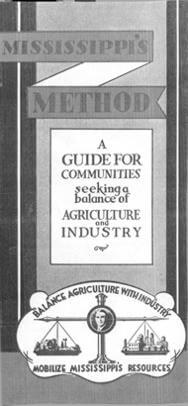 |
| Mississipi’s method, pamphlet, n.d. Courtesy of the Mississippi Department of Archives and History. |
A third factor leading to the desegregation of Scott County’s chicken plants was the burgeoning Mississippi freedom struggle, in which African Americans from across the state (and beyond) were inspired to speak and act out against educational, political, and economic inequalities enshrined in the system of white supremacy. The historical record is relatively silent on their activities in Scott County, but it produces evidence of considerable organizing activity in neighboring Leake, Neshoba, and Madison counties.25Anne Moody, Coming of Age in Mississippi (New York: Dell Publishing Company, 1968); John Dittmer, Local People: The Struggle for Civil Rights in Mississippi (Urbana: University of Illinois Press, 1994); Charles M. Payne, I’ve Got the Light of Freedom: The Organizing Tradition and the Mississippi Freedom Struggle (Berkeley: University of California Press, 1996); Susie Erenrich, Freedom is a Constant Struggle: An Anthology of the Mississippi Civil Rights Movement (Washington, DC: Center for Cultural Change, 1999); Winson Hudson and Constance Curry, Mississippi Harmony: Memoirs of a Freedom Fighter (New York: Palgrave MacMillan, 2002); Elizabeth Sutherland Martínez, Letters from Mississippi (Brookline, MA: Zephyr Press, 2002). In nearby Canton, for example, where 80 percent of residents were African American, an economic boycott commenced in 1964 that encouraged black residents and sympathetic whites to avoid buying from stores and businesses until they agreed to hire black sales clerks, treat black customers with respect, and desegregate their facilities.26”Don’t Buy at These Stores,” Madison County Movement, newsletter, Madison County Committee on Selective Buying, n.d., Sovereignty Commission Digital Archives, Mississippi Department of Archives and History, SCR ID # 10-55-9-56-1-1-1; Angela Stuesse, “Globalization Southern-Style.” Continuing on and off for over five years, the campaign—which specifically targeted the local chicken plant, among other manufacturers and retailers—resulted in the closure of many white businesses that proved unsympathetic to the ideals of racial equality.27”Report on Canton,” Council of Federated Organizations, Madison Country, Mississippi, February 26, 1964, Sovereignty Commission Digital Archives, Mississippi Department of Archives and History, SCR ID # 2-24-2-47-1-1-1; “Selective Buying Campaign,” Madison County Movement, newsletter, Canton, Mississippi,1964, Sovereignty Commission Digital Archives, Mississippi Department of Archives and History, SCR ID #2-24-3-78-1-1-1; “Selective Buying Starts Again!,” Madison County Movement, newsletter, Canton, Mississippi, 1965, Sovereignty Commission Digital Archives, Mississippi Department of Archives and History, SCR ID # 10-55-9-56-1-1-1; “Memo to: File, Subject: Canton Boycott,” Mississippi State Sovereignty Commission, September 1, 1966, Sovereignty Commission Digital Archives, Mississippi Department of Archives and History, SCR ID #2-24-4-41-1-1-1; “Memo to: File, Subject: Racial Matters and Boycott, Canton, Mississippi,” Mississippi State Sovereignty Commission, December 2, 1968, Sovereignty Commission Digital Archives, Mississippi Department of Archives and History, SCR ID #2-24-4-65-1-1-1.
In Scott County, our research uncovered a more muted approach in which intrepid black residents and their progressive white allies united in voter registration efforts.28Stuesse, “Globalization Southern-Style.” Elsewhere, Stuesse has argued that civil rights activism was less publicized—and likely much more circumscribed—in Scott County in large part because of the political power of Erle Johnston, a local businessman who invested in poultry processing and ancillary industries, owned the local newspaper for over forty years and eventually became mayor of Forest. A self-proclaimed “practical segregationist,” Johnston was one of the key architects of white Mississippi’s segregation movement during the 1960s, first as Public Relations Chair and then as Director of the Sovereignty Commission, the state’s official weapon against the Civil Rights Movement. The Sovereignty Commission’s investigators colluded with local officials to intimidate “race agitators” across the state, and archival evidence shows that they were active in Scott County as early as 1960. Stuesse, “When Silences Beckon.” Nearby efforts such as the Madison County Movement’s boycott, however, reverberated throughout central Mississippi and, combined with the increased labor opportunities for white workers proffered by BAWI, resulted in some local industries opening the shop floor to African Americans beginning in the 1960s. Still often relegated to the heaviest, most difficult, most dangerous work, African Americans increasingly found work inside on the line instead of being entirely outdoors.
Many of the new manufacturers continued to employ only white workers, whether due to management preference or community pressure. When Sunbeam hired “two colored males for positions formerly held by white personnel” in its Scott County facility in 1965, protestors burned crosses in front of the factory and in the general manager’s yard.29”Memo to: File, Subject: Cross Burnings in Forest,” Mississippi State Sovereignty Commission, May 7, 1965, Sovereignty Commission Digital Archives, Mississippi Department of Archives and History, SCR ID #2-128-0-32-1-1-1. The company reverted to an all-white workforce for many years. One elderly black resident recalls, “A long time they didn’t have nothing up there but white folk. And they used to tell you had to have a high school education. But I found out that a bunch of white [sic] didn’t have no high school working there.”30Interview with Scott County resident, February 9, 2006, Scott County, Mississippi.
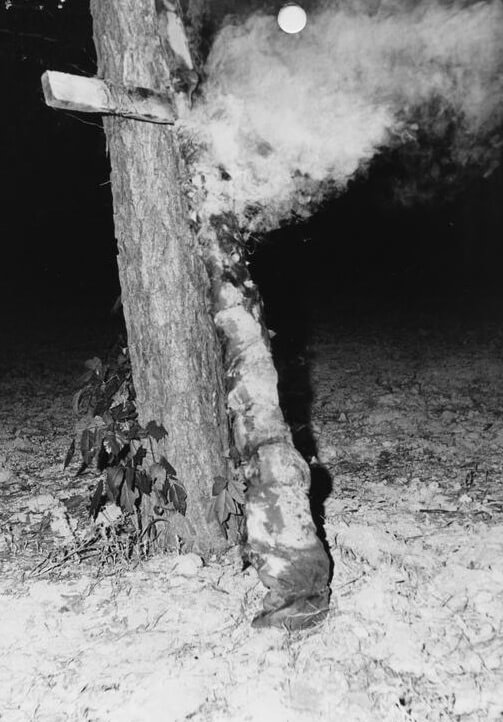 |
| Sunbeam cross burning, Scott County, Mississippi, 1965. Mississippi Department of Archives and History Digital Collections, Sovereignty Commission Papers, Mississippi State Sovereignty Commission. Courtesy of the Mississippi Department of Archives and History. |
Despite acts of violence like the cross-burning at Sunbeam, by the mid-1960s practices of workplace segregation had begun to break down. The poultry industry’s expansion, the deskilling and intensification of its labor, the increasing availability of new manufacturing jobs to white workers, the waning of opportunities for small black farmers, and increasing pressure from African Americans for equal opportunities in the workplace led to the racial integration of processing lines, to which employers had been adamantly opposed.31”Industrial Survey of Forest, Mississippi”; “Sunbeam Clocks Made in Forest”; J. Rogers, “The Legacy of B.C. Rogers,” Rogers Report 3 (Fall 1989), accessed at Morton Public Library, Morton, Mississippi.
One of the first African Americans to integrate Southeastern Poultry recalls that “the whites had a walk-out, so they called the blacks in.”32Interview with former chicken plant worker, July 28, 2003, Morton, Mississippi. The way she remembers it, African American workers received slightly less pay than whites and had to stand while other workers sat. These jobs in poultry processing paid more than agricultural, sanitation, or domestic work, a fact companies likely exploited by introducing African Americans as a wedge against potential grievances from white workers. We were unable to uncover additional evidence of growing demands from white workers at this time, but many labor scholars have documented the entrance of black workers into industries precisely when white workers began to organize.33Griffith, Jones’s Minimal; Stull and Broadway, eds. Any Way You Cut It; Boyd and Watts, “Agro-Industrial Just-In-Time”; Chatterley, Rouverol, and Cole, I Was Content and Not Content; Stull and Schlosser, Slaughterhouse Blues. Furthermore, nearly every African American we interviewed who had integrated the chicken plants believed they were paid a lower wage than white workers. Because they received their paychecks in sealed envelopes, they were never able to prove their suspicions.
Women made up the majority of black workers desegregating Scott County’s chicken plants in the 1960s. They recall having the more difficult jobs, compared with their white counterparts. Frequently this entailed “cutting buttonholes,” which required carefully inserting a knife just under the bird’s tail in order to pull out the entrails:
It was white and black folk working along together, but you know, we [black folk] had it rough. You know, some of the peoples quit. I used to stand there and cut oil bags, and the ladies next to me had they hands in there pulling chicken guts out. But nowadays, they tell me they got those machine to do all of that. I would like to go inside of a plant now to see. [The line] was going fast [back then], but they tell me now it go faster. I said, “I don’t see how it could!”34Interview with former chicken plant worker, February 9, 2006, Scott County, Mississippi.
Another former plant employee remembered how hard she worked for her weekly $75 paycheck: “Your fingers was sore and your arms and shoulders. And I come home, and lotta nights, I would be so tired. But I held in there. I stayed there and worked.”35Interview with former chicken plant worker, January 31, 2006, Scott County, Mississippi.
Before long, there were fewer and fewer white women in the plants with whom to compare salaries or workloads. In the case of Southeastern Poultry, within the first week of opening the plant’s doors to African Americans, white flight was so severe that the plant temporarily shut down. One black woman hired the following week says, “They quit because they didn’t wanna work with blacks. [So many white workers left,] they couldn’t even run the line. But the more walked out, the more blacks they was hiring.”36Interview with former chicken plant worker, February 9, 2006, Scott County, Mississippi. Slowly, she and others corroborate, some white workers came back to the plants, but the workforce became, and stayed, majority African American and largely female—a result of a combination of white flight, continued occupational mobility for white women, and increasing black migration from farms to towns in Scott County. With the exception of B.C. Rogers Poultry, which resisted hiring black workers until the 1970s, by the end of the 1960s most of Mississippi’s chicken plants were run by white management, overseen by white supervisors, and staffed by line workers who were almost entirely African American.
“It just basically broke the backs of the people”: Worker Organizing in the 1970s
In the seventies, social progressives around the country were hoping to harvest the political, economic, and social fruits of the struggle for civil rights. The energy of the civil rights movement increasingly had turned to economic priorities, driven by the understanding that newly-won access to the electoral process granted by the 1965 Voting Rights Act would be meaningful only in the context of adequate job opportunities, wages, and education. These concerns increasingly resonated among Scott County poultry workers. By 1972, they began to organize formally for the first time. The Southern Conference Educational Fund (SCEF) had established its Grass Roots Organizing Work (GROW) Project, an anti-racist organizing initiative that sought to help black and white workers improve their economic conditions.37Bob Zellner, The Wrong Side of Murder Creek: A White Southerner in the Freedom Movement (Montgomery, AL: New South Books, 2008); Robert Analavage, GROW: A New Movement in the White South (New Orleans: Grass Roots Organizing Work, 1967), accessed at Mississippi Department of Archives and History; “Memorandum on the GROW Educational Center,” Box 4, Folder 42, Z 1738.000 S, Campbell (Clarice T.) Papers, Mississippi Department of Archives and History. Led by Bob Zellner, formerly of the Student Nonviolent Coordinating Committee (SNCC), GROW had been organizing pulpwood haulers and wood cutters since the late 1960s. One of its chapters was located in Forest, and many of the haulers’ and cutters’ family members worked in poultry. Encouraged by the organizing efforts of their husbands and brothers and fed up with management’s refusal to provide breaks after one woman working the line urinated on herself, black women at Southeastern Poultry walked off the job in 1972. GROW sent two organizers to Forest to support the poultry worker mobilization, and that year they, along with local workers, formed the independent Mississippi Poultry Workers’ Union (MPWU).
Tonny Algood, a white Mississippian and recent college graduate, was one of the MPWU organizers in Forest. Nearly all local workers and organizers involved in the MPWU had moved or passed away by the time we conducted this research in the early 2000s, but Algood shared his memories in an interview. The first year his position was funded through a grant of the Greater Jackson Area Committee, but by year two, he was dismembering chickens at Gaddis Packing Company to pay his bills while helping the area’s poultry workers organize. By year three, Fred Gaddis, the corporation’s owner and Forest’s mayor for nearly forty years, knew who he was: “They ended up laying me off after they tried to work me to death,”38Tonny Algood, interview with Angela Stuesse, February 28, 2006, Mobile, Alabama. he recollects. The MPWU won National Labor Relations Board (NLRB) elections at both Southeastern Poultry and at Poultry Packers, and it was in the process of organizing Gaddis Packing Company when the plant’s ownership changed hands.
Organizing poultry workers proved difficult for many reasons: the state’s “Right to Work” laws weakened unions; poultry tycoons and white segregationists dominated local politics and weren’t afraid to use violence and intimidation to maintain their power; the rural landscape meant people lived and worked over a relatively large geographic area; no core group of workers had union experience; and companies were in the midst of constant transitions and mergers.39The federal Taft-Hartley Act of 1947, for which southern business interests lobbied intensively, weakened labor protections under the National Labor Relations Board, which was initially established by the Wagner Act in 1935. This new legislation empowered states to determine if employees at unionized workplaces would be required to join the union. Under “Right to Work” legislation, currently enacted in twenty-two states in the South and West, every individual worker can choose whether or not to pay union dues and become a member. In such “open shops,” while all workers are protected by the collective bargaining agreement and unions are required to represent all workers equally, often only a fraction of these workers are dues-paying members. As a result, unions in “Right to Work” states typically have fewer resources, crippling their ability to sustainably organize and represent workers. Ida Leachman, “Black Women and Labor Unions in the South: From the 1970s to the 1990s,” in Frontline Feminisms: Women, War, and Resistance, ed. Marguerite Waller and Jennifer Rycenga (New York: Routledge, 2000), 385–394. Where workers did successfully organize, plant management resisted contract negotiations.
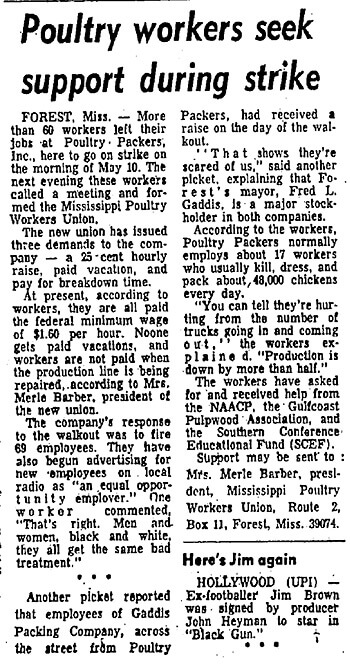
Soon, employees at Poultry Packers went on strike in hopes of forcing their employer to the bargaining table. They sought support for the strike by reaching out to activists:
 |
| Poultry workers seek support during strike, Baltimore Afro-American, May 27, 1972. Courtesy of the Baltimore Afro-American. |
The Mississippi Poultry Processing Industry saw its first strike this month in Forest, where 72 of 200 $1.60 an hour workers demanded a 15 cent raise, collective bargaining, pay during breakdowns and two week paid vacations. The plant is 80% Black. Poultry Packers, Inc., the second largest employer in the county, promptly fired all the strikers. Food and checks may be sent to Ms. Merle Barber, c/o Mississippi Poultry Workers’ Union, Rt. 2, Box 11, Forest, Miss.40”Delta Ministry Report,” May 1972, Charles Horwitz Papers, Tougaloo College Civil Rights Collection, T/014, Mississippi Department of Archives and History.
According to Algood, the plant’s white workers did not strike. In fact, new white workers came on as strikebreakers to cross the picket line. Mississippi’s engrained divisions made it impossible for the union to organize across race.
“I think a lot of ’em were just afraid to speak out at all,” recalls Algood. “You know, it was still a very hostile environment at that time, and I think a lot of it was fear. For years and years you had the whites who were in leadership, telling the poor whites that they were better off than the blacks. And there were certain privileges allowed to them that were not allowed to blacks in Mississippi. [So they just] weren’t willing or were unable to see how they would benefit or what they had in common with black workers.”41Algood, interview. In Algood’s analysis the white workers, with slightly better jobs on the line and with racial privilege, perceived they had more to lose by striking (and by standing in solidarity with people of color) than did the newer black workforce.
He recalls an incident on the picket line in which a driver hauling chickens tried to run over a striking worker while pulling out of the plant’s gate, and she was forced to dive into a ditch to avoid getting hit. Later that day, the same driver mumbled something at Algood and then “slung gravel all on me” on his way into the plant. The next thing Algood knew, the 250-pound driver had knocked Algood’s slight frame to the ground and was towering over him. At least two police officers witnessed the incident. “I looked up and the police officers had their shotguns out,” Algood says, “and they had ’em trained not on the guy, but on the strikers, just threatening ’em to go ahead and take one move and they would empty their shotguns off.”42Algood, interview.
Algood and other strikers went to the police station to make a report, where an officer threatened to beat him up. The police chief told him, “We’re getting some calls saying they gonna get that white boy. I don’t know who they are, but I know they’re real rough people.” He told Algood that no one would be able to recognize him by the time they got through with him.43Algood, interview. Like so many civil rights organizers in Mississippi who came before him, Algood began sleeping on the floor of his home and obtained a gun permit.
With state-sanctioned violence and strike-breaking tactics, by 1974 Poultry Packers successfully forced workers back into the plant without a contract. The company hired Kullman, Lang, Inman and Bee, a New Orleans law firm with a reputation for dragging out contract negotiations and beating its opponents by attrition. A young lawyer took the Mississippi Poultry Workers’ Union as her very first client upon moving to Mississippi in the early 1970s. She represented the MPWU and participated in the contract negotiations with Poultry Packers. The contract negotiations were “very painful,” she remembers:
This guy would come up from New Orleans, we’d sit in a room, and the workers would present proposals. They would describe circumstances that justified why they needed better break policies or why they needed better pay and safety conditions—all of that. And it was just a total stonewall. I mean, the guy is just sitting there saying, “Uh-huh. Uh-huh.” Their strategy was just to sit there and wait us out. It was such a depressing experience, ’cause it was so clear that they weren’t gonna agree to anything.44Interview with lawyer who represented the MPWU, December 16, 2005, Jackson, Mississippi.
The employer and its law firm never budged. They offered only the status quo, and the workers refused to sign a contract on those terms. “It just basically broke the backs of the people,” says Algood. “[They] couldn’t afford to continue just staying out. There was no real strike fund.”45Algood, interview. The MPWU continued to negotiate after the workers returned, but the workers never got a union contract. After the incident on the picket line, Algood couldn’t get hired anywhere in Forest. By late 1974 he moved away. The first organizing effort in Mississippi poultry, and quite possibly the most radical to date, was over by 1975.
In the decade that followed, numerous union organizing attempts failed at plants in Morton, Hazlehurst, Laurel, Jackson, and other poultry towns. Sanderson Farms in Laurel, a processing stronghold one hundred miles to the south of Scott County, stands out as an exception. There, the largely black female workforce self-organized, and a prolonged strike garnered the support of the AFL-CIO, leading to affiliation with the International Chemical Workers Union (ICWU).46”Striking Poultry Workers Seek Change in State Law,” Clarion-Ledger, June 17, 1979; “Striking Truckers Shut Down Mississippi Poultry Plant,” Clarion-Ledger, June 17, 1979, 1A; David Moberg, “Puttin’ Down Ol’ Massa: Laurel, Mississippi,” in Working Lives: The Southern Exposure History of Labor in the South, ed. Marc S. Miller (New York: Pantheon Books, 1980), 291–301; Christine Lutz, “The Sanderson Strike” (paper presented at Southern Labor Studies Conference, Birmingham, Alabama, April 15–17, 2004). Their efforts did result in a contract, albeit a weak one that received little sustained support from its international union. These events received considerable national attention.47Pamela Smith, “Black Women’s Struggle Against Sanderson Farms Far From Over,” Philadelphia Tribune, September 18, 1981, 11; “Little Town of Laurel Hosts Historic March,” New Journal and Guide (Norfolk, Virginia), June 11, 1980, 9; Colman McCarthy, “Striking a Blow for Unions in the South,” Washington Post, May 18, 1980, H2; William Serrin, “200 Mississippi Women Carry On a Lonely, Bitter Strike,” New York Times, February 17, 1980, A12; Warren Brown, “Unions Take Up Where Marchers Ended,” Los Angeles Times, December 13, 1979, L18. Companies around the state spent large amounts of time and energy to undercut growing labor unrest, aiming to keep the union out at all costs.
Organizing by African American poultry workers in the 1970s grew from the seeds planted by the Mississippi freedom struggle. Companies defeated these organizing attempts though a careful blend of racialized social control developed over Mississippi’s history and the newly emerging sensibilities of neoliberalism. The industry’s management employed intimidation, threats, bribes, and lies to instill fear in workers and defeat most NLRB elections over the next two decades. Pitting black and white workers against one another, as happened at Poultry Packers in Forest, became central to economic restructuring.48Thomas C. Holt, The Problem of Race in the Twenty-First Century (Cambridge: Harvard University Press, 2002). This rising economic, political, and cultural logic soon led to Mississippi poultry’s recruitment of immigrant labor as a form of labor control.
“Our Hispanic Project”: Migrant Recruitment in the 1970s and 1990s
In 1977, Scott County’s B.C. Rogers poultry plant began to recruit Mexican workers from El Paso. Company officials defended this initiative by arguing, “There was no labor available to us here.”49”Morton Plant Gets Workers from El Paso,” Scott County Times, September 21, 1977, accessed on microfilm at the Mississippi Department of Archives and History. Presaging sentiments and tropes still common today, a former manager offered further explanation in our interview: “People didn’t want to work,” he reasoned. There was a lot of “absenteeism and welfare,” and there “just wasn’t enough people.”50Interview with former poultry plant manager, June 16, 2003, Morton, Mississippi. However, B.C. Rogers had trouble retaining the migrant workers it recruited in the 1970s and stopped its efforts after a few years. Perhaps this experiment failed because management “didn’t understand the changes for [workers they brought to Mississippi],” as a different manager from that era suggested. “More or less they were left on their own when they came. They weren’t accustomed to this culture and society, so most of them left. It was very, very hard for them.”51Interview with former poultry plant manager, January 24, 2006, Scott County, Mississippi.
The defeat of a union organizing attempt at B.C. Rogers in 1980 meant that the company managed to maintain enough power over its workforce to continue reaping profits without the expense of migrant labor recruitment, at least for the time being. One of the former managers we interviewed credited early welfare reform efforts, however, not tighter labor control, as key to the industry’s success. When asked why the company stopped recruiting migrant workers, he replied, “The labor got better; the government got better about making people work.”52Interview with former poultry plant manager, June 16, 2003, Morton, Mississippi. Though B.C. Rogers’ experiment with migrant labor in the 1970s was short-lived, this episode, now thirty-five years in the past, represents an early attempt at leveraging new opportunities for labor control just as neoliberal globalization began to take hold. It also helps us to contextualize the conditions that led to the most recent wave of immigration.
By the early 1990s, B.C. Rogers had acquired three new processing plants and expanded its production to a night shift, upping working hours to sixteen per day. It exported 54 million pounds of chicken annually to Russia, the Middle East, and the Caribbean.53J. Rogers, “B.C. Rogers’ Exports Cover A Lot of Ground,” Rogers Report 6 (2 Summer 1992), 1, 2, 8, accessed at Morton Public Library, Morton, Mississippi. The economy was growing, but wages and opportunities in poultry remained stagnant, and management faced problems filling vacancies. The plant began busing in around 450 workers a day from surrounding counties. The local paper ran a series of stories about the area’s low unemployment rate and reported that it had become difficult for local poultry producers to staff late shifts because of labor shortages.54See, for example, “Getting Along: Importation of Labor is a Sign of the Time,” Scott County Times, April 20, 1994, accessed on microfilm at the Mississippi Department of Archives and History. The term “labor shortage” is also used by industry executives reflecting on that era; they cite 90 percent turnover rates, 50 percent absenteeism on the night shift, and three hundred employment vacancies on any given day. Nearly twenty years after its initial experiment with migrant labor, these concerns led B.C. Rogers to South Texas in search of new workers.
In 1993, B.C. Rogers manager Luis Cartagena was charged with recruiting workers from South Texas.55The remainder of this section on immigrant recruitment into Scott County and surrounding poultry towns is borrowed from Stuesse’s book manuscript, where it is featured in greater depth. Stuesse, “Globalization Southern-Style.” He recalls:
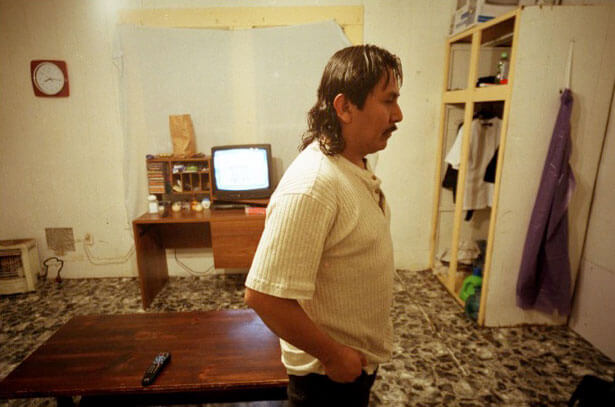
I would go by plane to Brownsville. I would arrive on a Tuesday. I would go to the Employment Commission of Texas and on Wednesday I would just interview. A lot of people. And just like that, I decided right then and there. “You go, you go,” like that. And I had chartered a bus. [I would tell them], “Tomorrow the bus leaves for Mississippi.” Thursday. Then on Thursday I would fly back to Mississippi. On Friday I was here waiting for them with money, housing, everything.56Luis Cartagena, interview with Angela Stuesse, January 31, 2006, Scott County, Mississippi.
 |
| At home after a long day of work, Scott County, Mississippi, 2004. Photograph by John Fiege. Courtesy of John Fiege. |
Cartagena says he brought between seven and eight hundred workers from South Texas over a period of six months, but few stayed. He reasons that the deal was too sweet, as the company initially offered two weeks of housing, rent free, plus ten dollars a day for meals. People came but would leave after two weeks. Turnover continued to soar, and management couldn’t figure out how to get it down.
B.C. Rogers refocused its recruitment efforts elsewhere—in Miami. A former CFO remembers that it was a television program that sparked the idea that would forever change the landscape of Mississippi poultry. He recalled:
John [Rogers, owner of B.C. Rogers] was [watching a] program [one Sunday] about immigrants and Hispanics in Miami, which didn’t have enough work . . . because there were so many and not enough jobs. [So] he asked me to go to Miami and see what I could do to bring them. . . . And that’s what started it! . . . We had a Cuban friend that owned a business there, so I set up an office in his company, and we would advertise in the local newspaper. It worked great, because after only one week, being there, we brought a Greyhound bus full of Hispanics. And we’d bring them every week, fifty-something a week. . . . [And this was the beginning of what] we called our Hispanic Project.57Interview with former B.C. Rogers CFO, January 24, 2006, Scott County, Mississippi.
Pablo Armenta, whose story opens this essay, became a Mississippian thanks to the Hispanic Project, as did thousands of other migrants from across the Americas.
Providing jobs was not a problem, but providing for workers’ basic needs, starting with housing, proved more difficult. Rental properties are in short supply in the rural South, and in the early 1990s most landlords did not want immigrant tenants, refusing to rent to B.C. Rogers. The company began to purchase housing, and within a few years it owned 166 trailers and houses in the areas around its plants. While Cartagena states that he typically housed two people to a room, for an average of six people per house, workers who remember the “early years” recall regularly sharing a one-bathroom trailer with nearly a dozen people. The company charged each employee $25 a week for housing, plus $20 for transportation to and from work, plus $12 for its optional weekend transportation service that taxied people to the supermarket, laundromat, and church. Earning wages of approximately $6.50 an hour, workers’ take-home pay after these paycheck deductions was typically under $200 a week. A union organizer at another poultry plant that adopted similar practices after B.C. Rogers set the precedent remembers, “The [workers] would make they money, but . . . when [the plant] just was taking it out for this, that, and the other, when they’d get they check sometime . . . they didn’t have nothing left.”58Interview with union organizer, May 10, 2005, Scott County, Mississippi. Interviews with workers, advocates, and former executives suggest that the Hispanic Project earned up to $1,000 per month from each rental property.
 |
| Ready for the night shift, Scott County, Mississippi, 2004. Photograph by John Fiege. Courtesy of John Fiege. |
By 1998, B.C. Rogers had changed hands, putting an end to the formal Hispanic Project. In its roughly four years of operation, the Project had recruited nearly five thousand workers to two neighboring towns with a combined population of under ten thousand. Approximately 80 percent of workers brought under this program were Cuban. The other 20 percent were mostly Central American. Most did not stay, but some did. More importantly, migrants kept coming. The company’s new human resources manager, a Mexican American, re-initiated recruitment from South Texas, and Mexicans—from the newer sending areas of Mexico’s southeast—began arriving in greater numbers by the turn of the millennium. Recruitment from Florida continued, now through a third-party contractor paid by the head to transport workers to Mississippi.
In addition, most other Mississippi poultry operations in the area began their own recruitment efforts in Florida and Texas. One plant offered to pay $600 to any employee who recruited a new worker for a minimum of three months. An entrepreneurial Peruvian capitalized on the opportunity. He advertised in a newspaper in his hometown of Arequipa. If you had a tourist visa to enter the US, money to purchase a plane ticket, and a desire to work in poultry processing, he would bring you to Miami, then to Mississippi, and guarantee you a job. Today agronomists, engineers, librarians, and psychologists from Arequipa are working in Mississippi poultry.
 |
| Family members collect remittances, Comitancillo, Guatemala, 2006. Photograph by Angela Stuesse. Courtesy of Angela Stuesse. |
By 2000, most of Mississippi’s chicken plants were operating around the clock. The vast majority of workers coming from Florida were no longer Cuban; they were from Argentina, Uruguay, and other South American countries. Economic decline and political unrest in their home countries, coupled with the lack of steady work in Miami, led these visa-overstayers to piece-rate work in chicken processing. In early 2002, however, the US State Department realized that a disproportionate percentage of Argentine tourists were not returning home, and it revoked Argentina’s (and soon after, Uruguay’s) participation in the “Visa Waiver Program.”59United States Department of Justice, “Department of Justice Terminates Argentina’s Participation in Visa Waiver Program,” http://www.justice.gov/opa/pr/2002/February/02_ins_090.htm, accessed February 4, 2014. The “Visa Waiver Program” is an agreement between the United States and select countries that allows nationals from those countries to enter the United States without applying for a visa. They simply fill out entry paperwork on the airplane and present it to immigration authorities upon arrival, and they typically have permission to visit the United States as a tourist for up to six months. By the end of that year, South American migration from Miami to Mississippi had screeched to a halt. Many migrants had come with families, however, and deeming Scott County a safe place to raise children, have stayed.
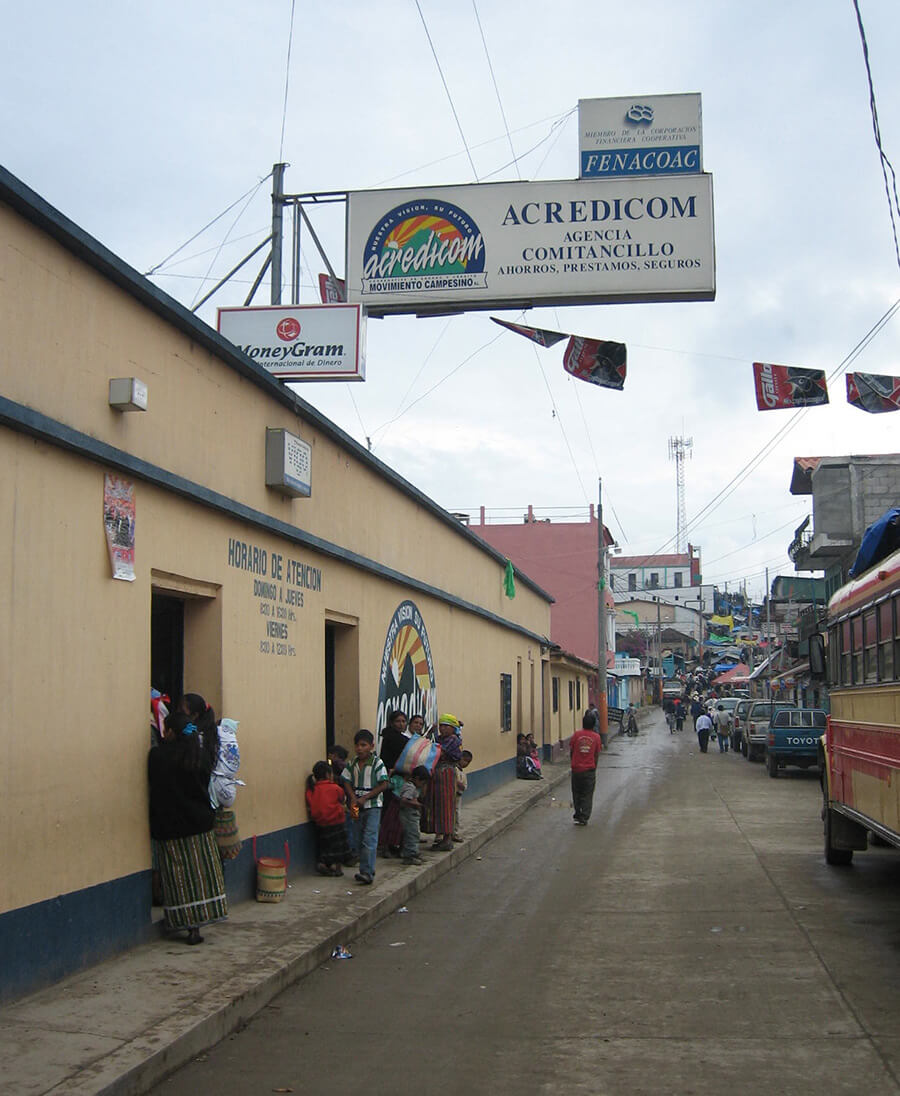
In the years that followed, the majority of new migration into the chicken plants came from Comitancillo, a small municipality in the highlands of Guatemala. The first to arrive in town left farmwork for chicken processing, attracted to the indoor and year-round work. They saved money and sent it to family members to make the journey across Mexico, through the desert, and ultimately to Mississippi. By 2005 this practice increased the size of the migrant population in Carthage, just north of Forest, to over one thousand. In subsequent years they began dispersing to Scott County, Canton, and other nearby areas.
Today Mississippi’s poultry workers are Americans from nearly every part of the continent. They are black, brown, and occasionally white; men and women; campesinos and former blue- and even white-collar workers; speakers of English, Spanish, and a handful of indigenous languages. Vastly different histories, cultures, and experiences have created both tensions and alliances within and between groups.60Angela Stuesse, “Race, Migration, and Labor Control: Neoliberal Challenges to Organizing Mississippi’s Poultry Workers” in Latino Immigrants and the Transformation of the US South, ed. Odem and Lacey, 91–111.
“The labor’s here but the jobs don’t want to pay”: Why This History Matters in the Present
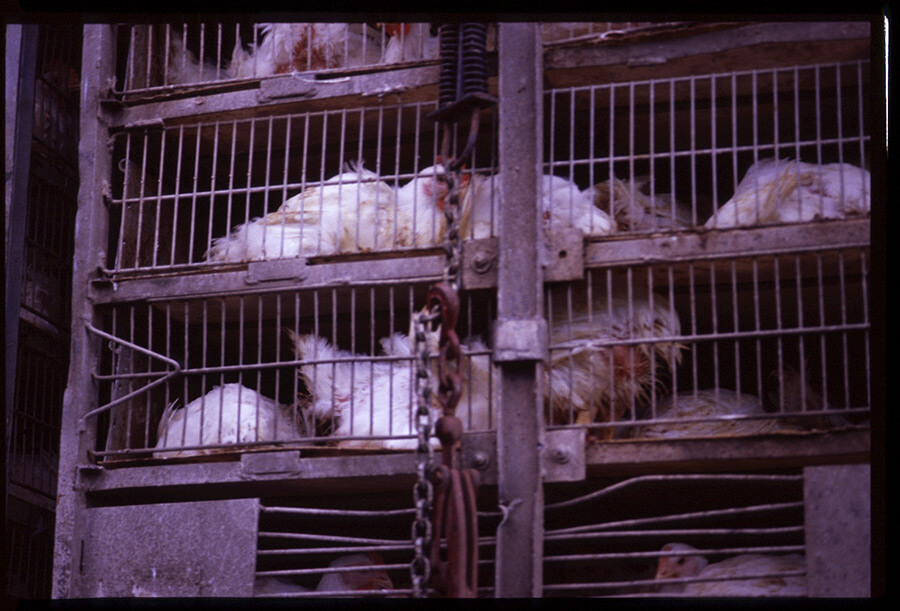
Consider the visceral realities of chicken plant jobs. Poultry slaughter, dismemberment, and packaging represent some of the country’s lowest paid and most dangerous work. Over the years, companies have “deskilled” plants and sped up production through technological advances. The average worker now repeats the same movement up to 30,000 times per day. The deboning of a chicken thigh that used to take three cuts of a knife, requires just one. It’s not any easier, especially with a dull knife; just faster. Virtually every worker who has labored in a chicken plant ten years or more can vouch for untreated repetitive motion injuries and can show permanent deformities caused by the work.61Sarah A. Quandt et al, “Illnesses and Injuries Reported by Latino Poultry Workers in Western North Carolina,” American Journal of Industrial Medicine 49 (2006), 393–351; Ames Alexander, Kerry Hall, and Franco Ordonez, “The Cruelest Cuts: The Human Cost of Bringing Poultry to Your Table,” Charlotte Observer, February 10–15, 2008, accessed February 17, 2008, http://www.charlotteobserver.com/poultry/. Plants are often out of compliance with federal safety and health regulations, and the government agency charged with oversight of these laws, the Occupational Safety and Health Administration (OSHA), is under-resourced and ineffective.62Marc Linder, “Playing Chicken with People: The Occupational Safety and Health Consequences of Throughput Uber Alles,” International Journal of Health Services 25, no. 4 (1995): 633–665; Marc Linder, “‘I Gave My Employer a Chicken that Had No Bone’: Joint Firm-State Responsibility for Line-Speed-Related Occupational Injuries,” Case Western Law Review 46, no. 1 (1995): 33–143; Stephen Labaton, “OSHA Leaves Worker Safety in Hands of Industry,” New York Times, April 25, 2007, http://www.nytimes.com/2007/04/25/washington/25osha.html. Stuesse spent many days in Mississippi translating in hospitals and doctors’ offices for workers with lacerations, amputations, and crippling back injuries. Workers describe being cheated out of pay, verbally abused by supervisors, and denied bathroom breaks—of being forced to relieve themselves in their clothes while on the line.63For detailed testimony and analysis of the health, legal, and labor organizing consequences of denied bathroom breaks, see, for example, Marc Linder and Ingrid Nagaard, Void Where Prohibited: Rest Breaks and the Right to Urinate on Company Time (Ithaca, NY: Cornell University Press, 1998); Anne Lewis, Morristown: In the Air and Sun. (Appalshop documentary, 2007); Fran Ansley, “Talking Union in Two Languages: Labor Rights and Immigrant Workers in East Tennessee,” in Transforming Places: Lessons from Appalachia, ed. Stephen L. Fisher and Barbara Ellen Smith (Chicago: University of Illinois Press, 2012), 164–179; Stuesse, “Globalization Southern-Style.” Aside from being the only major employer in many rural towns, poultry companies give their workers virtually no incentive to stay.
 |
| Hauling chickens to slaughter, Scott County, Mississippi, 2004. Photograph by John Fiege. Courtesy of John Fiege. |
Given what’s at stake for people who spend much of their daily lives in chicken plants, in what ways does the history of Scott County’s poultry industry allow us to better understand the social problems of the present? First, it demonstrates a pattern in which the industry has repeatedly sought out the most vulnerable workers and has exploited them for monetary gain. In each moment, poultry plant work has represented an improved work opportunity—a “step up” for the newest class of workers: white women; black women and men; Latin American immigrants—which has allowed processors to pay them less and work them more than the group they joined or replaced. Second, the new class of workers faces the least desirable work the plant has to offer—from “cutting buttonholes” in the 1960s to “deboning” today. Plant management has historically organized the production line according to race, gender, and other forms of difference and has skillfully encouraged and exploited these real and perceived distinctions in order to limit workers’ affinities toward one another. Third, earlier moments illustrate that when these “new” classes of workers have organized for higher pay and improved working conditions, or even for dignity and respect in the workplace, employers have aggressively silenced their efforts. While outside the scope of this article, Stuesse has documented similar opposition to and destruction of labor organizing among the largely immigrant workforce in Mississippi poultry’s present.64Stuesse, “What’s ‘Justice and Dignity’ Got to Do with It? Migrant Vulnerability, Corporate Complicity, and the State,” Human Organization 69, no. 1 (2010), 19–30; Stuesse, “Globalization Southern-Style.” Fourth, understood historically, the exploitation of poultry workers operates at its most fundamental level upon the denigration of blackness as a social category. It is to this final point that our analysis now turns.
In the industry’s early years, blackness was used as the rationale for excluding an entire class of workers. By the 1960s, it led to workers with darker-hued skin being relegated to the most difficult and least desirable jobs. During desegregation efforts, workers’ blackness served as the excuse for white supremacists to terrorize African Americans and their allies, as with the cross burning that followed a short-lived attempt at racial integration at Sunbeam. Once efforts to integrate the plants succeeded, white women workers fled to new racially-segregated work opportunities, and a workforce comprised of a majority of black women received lower pay in exchange for greater production. When these workers tired of their treatment at work and sought to organize, local whites, backed by state power, again terrorized them. But in the current moment in which recent Latin American immigrants are the newest exploited class of poultry workers, why does blackness matter? The answer has to do with the relationships between immigration, race, and work in popular discourse.
 |
| Injured worker, Madison County, Mississippi, 2004. Photograph by John Fiege. Courtesy of John Fiege. |
Scott Countians of all persuasions are unanimous on one front: they all agree that “one thing about ‘Mexicans’ is that they will work.”65Interview with Scott County resident, July 1, 2003, Forest, Mississippi. Some residents, however, couple this characterization with a harsh critique of US-born workers, without acknowledging that immigrant and American-born workers have different motivations to work in the plants. “Well, it wasn’t exactly a labor shortage,” one local official reported, “What you have is some people who would rather stay home than work.”66Interview with Scott County official, July 18, 2003, Forest, Mississippi. Descriptions of immigrants as “hard workers” are often accompanied by references to native-born workers—who are mostly black and often women—as “lazy.” “[The immigrants] have been so much more workable and willing than blacks,” one white woman explained, “They are much more humble and don’t feel like the world owes them something.”67Intreview with Scott County resident, June 20, 2003. These comments echo local poultry companies’ linking of labor shortages and welfare in the late seventies, which reflected a growing national discussion about the “black underclass”68Michael B. Katz, “The Urban ‘Underclass’ as a Metaphor of Social Transformation,” in The “Underclass” Debate, Views from History, ed. Michael B. Katz (Princeton: Princeton University Press, 1993), 3–23. and failed to recognize that black workers across the state had real grievances against the poultry industry. Moreover, allegations of black worker laziness reflect the gendered nature of popular tropes such as that of the “welfare queen,” which presume black women’s sexual licentiousness and desire to stay home and “make babies” rather than “work.”69Robin D. G. Kelley, Yo’ Mama’s DisFUNKtional!: Fighting the Culture Wars in Urban America (Boston: Beacon Press, 1997); Dorothy Roberts, Killing the Black Body: Race, Reproduction, and the Meaning of Liberty (New York: Pantheon Books, 1997); Kenneth Neubeck and Noel Cazenave, Welfare Racism: Playing the Race Card Against America’s Poor (New York: Routledge, 2001).
Indeed, many African American residents have suggested that it is necessary to ask why more local workers do not seek jobs in chicken plants. Unlike most local middle-class whites, the majority of African Americans of any class in Scott County have worked in processing plants, had a family member working on poultry lines, or faced the prospect of plant work at some point in their lives, even if only for a few days. They possess more knowledge of the industry’s practices, and from their perspective, “labor shortage” is shorthand for the industry’s refusal to adjust working conditions and wages to retain employees. As one woman put it, “If they were paying ten or twelve [dollars] an hour, people would be coming from all over the county for those jobs.”70Interview with Scott County resident, July 1, 2003, Forest, Mississippi. A black elected official echoed this sentiment: “[Immigrants] were brought in for cheap labor, not a shortage. The labor’s here but the jobs don’t want to pay.”71Interview with Scott County elected official, July 28, 2003, Morton, Mississippi. For many black residents, then, “labor shortage” is not merely a race-neutral economic term for a period of low unemployment, but is instead a pejorative way to talk about the available labor pool. It delegitimizes individuals’ reasons for avoiding dangerous conditions and poverty-level wages in the plants while disregarding the industry’s violations of federal labor law, health and safety regulations, and human rights.
But where did black workers go when Latin Americans entered Mississippi’s chicken plants? While it is impossible to quantify answers to this question, anecdotal evidence provided by local residents suggests that the increased use of immigrant labor has both tightened poultry plants’ control over native-born workers and driven these workers toward other opportunities within Mississippi’s continually changing industrial and service economies. As Americans’ appetite for white meat grew in the 1990s, the poultry industry expanded in Mississippi, as it did in other areas of the country. This expansion increased the number of low-wage jobs in chicken plants for native-born and immigrant workers alike, and it suggests that Scott County’s African American population may not have experienced the sorts of displacement that populations in other industries and elsewhere in the country have reported.72This conclusion is supported by Jamie Winders, whose monograph Nashville in the New Millennium documents that “the general economic context of immigrant reception was relatively good in new destinations in the South” (21). More generally, scholars disagree over the extent to which immigration has resulted in African American displacement from the labor force. For a richly cited account of the debate, see Angela Stuesse, Cheryl Staats, and Andrew Grant-Thomas, “As Others Pluck Fruit Off the Tree of Opportunity: Immigration, Racial Hierarchies, and Intergroup Relations Efforts in the United States” (unpublished manuscript, July 16, 2013), Microsoft Word file. Barbara Ellen Smith argues that the debate itself is flawed in its neoliberal acceptance of a zero-sum competition, its failure to account for unequal power dynamics between employers and workers, and the often quite nuanced analyses of workers themselves. Barbara Ellen Smith, “Market Rivals or Class Allies? Relations between African American and Latino Immigrant Workers in Memphis” in Global Connections and Local Receptions: New Latino Immigration to the Southeastern United States, ed. Fran Ansley and Jon Shefner (Knoxville: University of Tennessee Press, 2009), 299–317. In addition, as southern localities—in competition to offer generous incentives to prospective employers—have successfully attracted automobile manufacturing to non-union rural areas, new kinds of opportunities have appeared in Scott County. Although not large enough to sustain the vast plant that Nissan opened in nearby Canton in 2003, Scott County has seen the appearance of small-scale parts manufacturers operating on subcontracts with or as subsidiaries of Nissan and other automakers. We met some African American former poultry workers who found employment on these small shop floors, not for substantially higher wages but in less dangerous conditions. And finally, new fast food franchises and a Super Wal-Mart came to Forest in the mid-2000s, and these, too, represented more desirable work—if, again, not higher paid work—than poultry processing.
For US-born workers who remained in the poultry industry, the arrival of immigrant labor seems to have restricted their strategies for coping with harsh plant conditions and lack of benefits such as vacation or paid sick leave. According to local residents, back when poultry plants were struggling to fill production lines, it was relatively easy for a worker to quit a job one day and then find work—at the same or a different plant—whenever she or he was ready to return.73Interview with Scott county resident, July 29, 2003, Forest Mississippi. This flexibility, which gave individual workers some modicum of control over their working lives in an industry that otherwise thwarted workers’ efforts to collectively participate in determining their working conditions and benefits, disappeared with the arrival of fully-staffed production lines.
For most US-born poultry workers in the region, chicken plant work is just one iteration of a string of low-paying jobs in canneries, catfish, nursing homes, timber, assembly plants, housekeeping, and retail. The typical immigrant worker in Mississippi poultry is undocumented, unfamiliar with workplace rights, and often supporting family members abroad. As the industry knows, while US-born workers might be more likely to refuse speed-ups, join a union, walk off the job, or report grievances, they may also have difficulty communicating their perspectives to Spanish-speaking colleagues. As a result of these differences in workers’ experiences, mutual misperceptions emerge. “Hispanics are too willing to work for low wages, and they’re taking our jobs and forcing us to work harder,” is a typical comment Stuesse has heard in discussions with black poultry workers. Without an understanding of the structural constraints impeding the economic mobility of people of color in the US, immigrants find it difficult to empathize with black workers’ complaints and “everyday acts of resistance”74Maria Patricia Fernández-Kelley, For We Are Sold, I and My People: Women and Industry on Mexico’s Frontier (Albany: State University of New York Press, 1983); James C. Scott, Weapons of the Weak: Everyday Forms of Peasant Resistance (New Haven: Yale University Press, 1985). to workplace problems. “Blacks can take long breaks and are not disciplined when they come to work late,” was a common complaint Stuesse heard in her interviews with Latin American immigrants.
These different perspectives illustrate that the phrase “labor shortage” is as socially-constructed as it is economic. Rooted in tropes of individualism and personal responsibility, the discourse that praises the “hard working immigrant” reverberates with that which critiques African American workers for a lack of “work ethic.” Placing the industry’s present in dialogue with its past, the case of Scott County, Mississippi, enables us to see more clearly how the ongoing denigration of blackness—in other words, the persistence of white supremacy—continues to shape prospects for working class people of color today.
Conclusion: Understanding Immigration through Local Histories of Race
 |
| “Welcome to Forest” sign, Forest, Mississippi, 1963. Photograph by Hugh Shankle. Mississippi Department of Archives and History, Hugh Shankle Collection, PI/COL/1981.0066. Courtesy of the Mississippi Department of Archives and History. |
In our research, we have found that when Scott Countians—immigrant or native, black or white—talk about immigration, they often talk in terms of race. One white resident explained, “You know, if the blacks had worked harder in the first place, they never would have had to bring the immigrants in.”75Interview with Scott County resident, June 20, 2003, Forest, Mississippi. Suggesting a counter-history, an African American resident recalled “the whites left for more money, so they brought in blacks. Then when blacks wanted more money, they brought immigrants.”76Interview with Scott County resident, July 28, 2003; Helton, “Three Hundred Strangers Next Door,” 18. As these comments suggest, and as Winders'77Winders, Nashville in the New Millenium. work in Nashville attests, people do not discuss immigration in isolation, but in the context of their experiences of a broader set of racial, economic, and political issues in their everyday lives. Whether described explicitly in racial terms or in coded phrases such as “labor shortage” and “work ethic,” these responses underscore the need to examine changing demographics of populations in terms of local histories of race and workplace organizing. Since Scott County’s most recent “labor shortage” in the mid-1990s, the degree of new immigrants’ acceptance by Mississippians has been shaped in large part by the history of change and struggle among local whites and blacks, companies and workers.
Examining key moments in Mississippi poultry’s recent past demonstrates that it is not sufficient to explain migration by pointing to the “pulls” of economic expansion and industrial restructuring. By overlaying the history of transnational labor recruitment in the poultry industry with the history of African Americans’ experiences in the chicken plants—from the types of jobs they were first assigned, to their efforts at unionization in the 1970s—we begin to see what is hardly new about the Nuevo New South. As Weise argues, new immigration or tropes of cosmopolitanism should not facilitate “historical amnesia.”78Julie Weise, “Dispatches from the ‘Viejo’ New South: Historicizing Recent Latino Migrations,” Latino Studies 10, nos. 1–2 (2012): 54.
Demographic shifts in Mississippi’s poultry plants have not happened accidentally. To the contrary, they were propelled by specific state policies, driven by deliberate corporate practices, and fuelled by public discourses around race, work, and deservingness. When workers began to organize, the industry sought new horizons—first locally, then internationally—to maintain a large and expendable pool of disempowered low-wage workers. These racialized practices of labor control have served the industry well, dividing workers, weakening prospects for collective bargaining across difference, and keeping labor costs down.
 |
| Live hang, 2005. Cartoon by Mike Konopacki. Courtesy of Huck/Konopacki Labor Cartoons. |
As labor leaders in Mississippi began to recognize a decade ago, the successful future of their ongoing efforts for social and workplace justice may hinge upon alliances with the newest minorities.79Stuesse, “Race, Migration, and Labor Control.” A deeper understanding of the industry’s localized past reveals parallel struggles with regard to workplace justice, social inequality, and racialized systems of oppression—a compelling basis for collaboration across race and difference to create a more just and humane workplace.80Despite the many compelling reasons Latin American immigrant and African American workers may have to collectively organize, there are as many or more obstacles impeding their unity. While beyond the scope of this paper, some of the key literature on this topic focused specifically on the US South includes Jennifer Gordon and R. A. Lenhardt, “Citizenship Talk: Bridging the Gap between Immigration and Race Perspectives,” Fordham Law Review 75 (2007), 2493–2519, Paula D. McClain et al., “Black Americans and Latino Immigrants in a Southern City: Friendly Neighbors or Economic Competitors?” Du Bois Review 4, no. 1 (2007); 97–117, Helen B. Marrow, “New Immigrant Destinations and the American Colour Line.” Ethnic and Racial Studies 32, no. 6 (2009); 1037–1057, Smith, “Market Rivals or Class Allies?”; Stuesse, “Race, Migration, and Labor Control.” At the same time, it also makes clear that different points of entry into US systems of racial inequality and low-wage work mean that distinct constituencies of poultry workers experience and interpret workplace abuses in unique ways. Scholarship that helps us better understand the historical, structural, and personal rationale for these differences can help build long-term collaborations that respect, and do not erase, such differences. 
About the Authors
Angela Stuesse (Ph.D. University of Texas, Austin 2008) is Assistant Professor of Anthropology at the University of South Florida. Her research and teaching interests include neoliberal globalization, migration, race, human rights, and methodologies of activist research. She has conducted research in the US-Mexico borderlands and in the newer borderlands of the US South. Her current work investigates the intensification of immigrant policing in Atlanta, Georgia with an emphasis on racialized effects and community responses. She has published in the journals American Anthropologist, City & Society, Latino Studies, and Human Organization, among others. Her book manuscript, Globalization Southern-Style: Immigration, Race, and Work in the Rural U.S. South, explores how new Latino migration into Mississippi’s poultry industry has impacted communities and prospects for worker organizing.
Laura E. Helton is a Predoctoral Fellow at The Carter G. Woodson Institute at the University of Virginia and a doctoral candidate in history at New York University. Her research and teaching interests include the politics of race and memory, print cultures of the long civil rights movement, and social histories of the archive. Her dissertation, entitled “Remaking the Past: Collecting, Collectivity, and the Emergence of Black Archival Publics, 1915–1950,” examines the construction of African American archives in the first half of the twentieth century. A professional archivist, she has processed collections for the Tamiment Library and Robert F. Wagner Labor Archives, the Schomburg Center for Research in Black Culture, and the Mississippi Digital Library.
Acknowledgements
Stuesse and Helton thank the many generous people in Mississippi who opened their homes and memories to us over the course of our research. This project was supported by the Center for Inter-American Policy Studies at the LBJ School of Public Affairs, University of Texas; the Ford Foundation’s Diversity Dissertation Fellowship; the School for Advanced Research; and the University of South Florida’s College of Arts and Sciences. Southern Spaces thanks the Baltimore Afro-American for their gracious permission to include a digital reprint of the 1972 article, “Poultry workers seek support during strike,” the Forest Public Library for permission to reprint images found in their vertical files, and the Mississippi Department of Archives and History for permission to reprint images from their collections.