 |
|
The Best of the Martins, 2011. Gaither Gospel Series DVD cover. © Slanted Records and The Martins. |
For the past forty years or so, “southern gospel” has named a professional musical style associated with white fundamentalists and evangelicals in the US South.1For an extended discussion of “southern gospel” see, Douglas Harrison, Then Sings My Soul: The Culture of Southern Gospel Music (Urbana–Champaign: University of Illinois Press, 2012), 2–5, 80–109. In its modern, commercial form, southern gospel emerges “from a broad-based, post-Civil War recreational culture built around singing schools and community (or ‘convention’) singings popular among poor and working-class whites throughout the South and Midwest.”2Ibid., 2. This tradition is distinctive for its cultivation of close harmony sung in ensembles—traditionally male quartets, a formation that dominated the commercial sector of southern gospel through roughly the first half of the twentieth century, and more recently, mixed-gender foursomes and trios, often comprising family members.3Today’s professional southern gospel includes many family and mixed gender foursomes and trios, configurations that were and are common in the singing convention world that dominated southern gospel in the late nineteenth century and early twentieth century. But professional southern gospel has always been strongly grounded its history and identity in the male quartet. The seven-shape notational system (and culture) of songwriting, singing, and music education that took root in the southern uplands in the late 1800s has heavily influenced the music of southern gospel and its values.4Here, following Loyal Jones, “Southern Uplands” designates the regions and people of trans-Appalachia and extends eastward into the Piedmont and westward to the Ozarks. See Jones, Faith and Meaning in the Southern Uplands (Urbana–Champaign: University of Illinois Press, 1999), 9. For more on the rise and spread of southern gospel regionally and nationally, see James R. Goff Jr., Close Harmony: A History of Southern Gospel (Chapel HIll: University of North Carolina Press, 2001), 50–109; Don Cusic, The Sound of Light: A History of Gospel Music (Madison: Popular Press, 1990), 153–162; 171–176. This musical culture subsequently spread across trans-Appalachia, and then later throughout the Midwest, Southwest, and, after the Great Migration of white southerners in the post–World War II era, into other parts of the United States influenced by southern migration. Today southern gospel is found in areas of the United States and lower Canada with concentrated populations of white fundamentalist evangelicals.5For more on the demographic profile of southern gospel see Harrison, Then Sings My Soul, 175–180.
Among these people, “the term southern gospel,” as I have noted elsewhere, “was not used to describe the music [in its professional, commercialized form] until the 1970s and did not gain widespread use until the 1980s. Before then the music was simply known to its practitioners and fans as gospel.”6Not that “southern gospel” never made an appearance before the 1970s and 1980s. Music publishers of seven-shape notational gospel music and the convention singing tradition to which these publishers catered were familiar with the term for much of the twentieth century. This essay is interested primarily with professional southern gospel, which descends from convention singing but has been distinct from it since the 1930s and 1940s. If, as Anthony Heilbut has noted, “gospel” is a vexingly “vague and inadequate” term for a wide and shifting range of sacred music within Anglo-European and African American Protestantism,7Anthony Heilbut, “Black Urban Hymnody,” on Brighten the Corner Where You Are: Black and White Urban Hymnody (New World, 1978, NW-224). “southern gospel” brings with it additional layers of interpretive complication regarding race, class, and geography. The overwhelming majority of fans and professionals in contemporary southern gospel are white Christians who are “culturally southern, socially conservative, and Anglo-American.”8Stephen Shearon, Harry Eskew, James C. Downey, and Robert Darden, “Gospel Music,” Grove Music Online, July 10, 2012, accessed October 15, 2013, http://www.oxfordmusiconline.com/subscriber/article/grove/music/A2224388. So it is tempting to assume that the emergence of “southern” to describe the music since the 1960s matters only as an unsubtle substitute for the more racially antagonistic “white.” Such an assumption would not be wholly unjustified.9The conflation of “southern” and “white” to describe this music circulates widely among scholars and non-specialists, but has only been tentatively stated in scholarship. My reading sees race, racism, and a racialized concept of self and other in southern gospel as an important, not always dominant, factor in the emergence of “southern gospel” and the cultural function of the music. For a fuller discussion of “southern” as a racial signifier and readings of race and white gospel see Harrison, Then Sings My Soul, 96–103. My own research has been the first to document at length how, throughout much of the twentieth century, the music’s unsavory history of explicit racism, affiliation with supremacist ideas and politicians, and its largely unreconciled relationship to this past echo jarringly in any use of the term “southern gospel.” In short, whiteness remains strongly associated with southern gospel performance and fan culture.10Ibid., 203, especially note 53.
 |
|
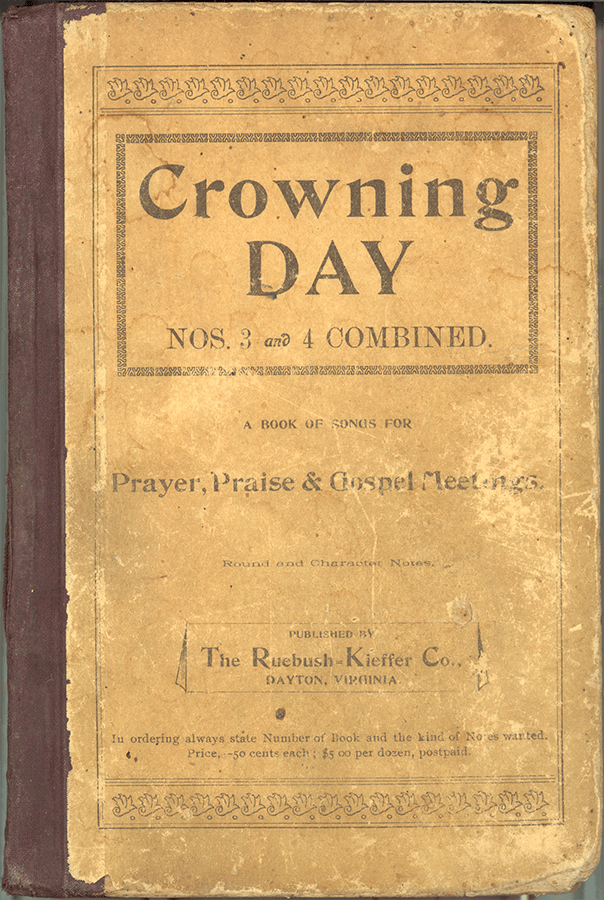
Front cover of Crowning Day (Dayton, VA: Ruebush-Kieffer, 1900). Courtesy of Douglas Harrison. At the end of the nineteenth century and into the first three decades of the twentieth century, southern white gospel was dominated by convention singings that relied on the regular release of small octavo shape-note songbooks such as Crowning Day. |
Yet it is a mistake to treat southern gospel as wholly synonymous with white gospel. Nor is its cultural function exclusively or even primarily of scholarly interest for what it may tell us about southern whiteness in an ever more racially diverse and pluralistic world. Although southern gospel is undoubtedly white, not all white gospel is southern, and not all gospel of the US South is white.11Following Harry Eskew’s lead in the Grove Music entry for Gospel Music, Stephen Shearon uses “northern urban” gospel to designate commercial Christian music of and for primarily white Protestants that emerged in the late-nineteenth- and early-twentieth-century revivalism in urban areas outside the South. Key figures include Ira Sankey (the evangelist Dwight Moody’s song leader), Homer Rodeheaver (Billy Sunday’s music director), and George Beverly Shea (Billy Graham’s most famous soloist). “Northern urban” gospel is the historical forerunner of today’s Contemporary Christian Music (CCM). Even though I do not have a better name for it, I remain deeply ambivalent about “northern urban gospel.” (See Harrison, Then Sings My Soul, 182–183).
“Southern” gospel has its own difficulties, not least the fact that not all gospel from, of, or appealing to people in the South is a white enterprise. “Gospel,” as Heilbut has noted, is “the favored term for what working-class black congregations [do,] often to the exclusion to white traditions.” See Heilbut, “Black Urban Hymnody.” Black gospel draws heavily on southern lifeways, many of its biggest stars have been from the South, and it has always found a good portion of its audience there. Still, the cultivation and creation of twentieth-century commercial black gospel’s golden age (1945–1960) was largely rooted in Chicago, Philadelphia, and other urban centers in the Midwest and Northeast where many black southerners moved during the Great Migration. See Shearon et al., “Gospel Music,” and Heilbut, The Gospel Sound: Good News in Bad Times (Milwaukee, WI: Hal Leonard, 2001 [1979]) and Harrison, “Why Southern Gospel Music Matters,” Religion and American Culture 18, no. 1 (2008): 27–58.
“Southern gospel” remains the preferred term in the study of white gospel music of the South. Unlike “northern urban” gospel (a phrase with no currency outside academe), it is the preferred way to self-identify within the culture and the most widely recognized way to describe the music to outsiders. The rise of “southern” gospel emerged in response to a network of cultural tensions, social conflicts, and religious instabilities.12These longstanding conflicts precede the twentieth century. Southern gospel’s negotiation of them has often manifested in overt racism or a way of thinking, talking, and singing that renders whiteness falsely normative. Southern gospel has found itself in alliances with black gospel traditions and the black church. As Stephen Shearon has noted, both white and black gospel have “liked aspects of what the other was doing” ever since blacks and whites began singing sacred music near one another in North America. And both black and white gospel have “borrowed those aspects, reinterpreting them for their own cultures” and purposes. See Shearon, email to H-Southern Music Network mailing list, March 27, 2009. Of course, race is never far from any discussion of southern cultures, but it is also true that, in southern gospel, “overmuch emphasis on black-white polarities diminishes our understanding of cultural dynamics submerged beneath the surface of the music.”13Harrison, Then Sings My Soul, 103. Consequently, in what follows, “southern gospel” stands as shorthand for professional, commercialized white gospel from, or culturally aligned with, the evangelical fundamentalist South. North American gospel history and the cultural realities of contemporary southern gospel defy further generalization.
Evoking Arkansas as a state encompassed by the southern gospel tradition signals my interest in exploring ways that large-scale changes in conceptions of religion, geographical identity, and social status play out and are revoiced in subcultural and local registers. The Arkansas imaginary explored here is not a totalizing way of understanding the vernacular music of white fundamentalists. Rather, I aim to map a specific hot spot within the psychosocial terrain of contemporary professional southern gospel as an instance of a broader phenomenon that could be explored in US southern and rural imaginaries.
This essay is interested in how the imagining of a place shapes and is shaped by understandings of vernacular sacred music and the shifting identities this music contains. “Place” signifies a physical location, a material culture, a set of affiliated social relations, and more nebulous meanings associated with place as a concept. The interplay of praxis and imagination is crucial. In cultural geography, “sense of place” refers to the feelings and emotions a place evokes and that help constitute it.14Tim Cresswell, Place: A Short Introduction (London: Wiley-Blackwell, 2004), 169. More than just feelings or emotions, such sense of place encompasses perceptions, assumptions, and habits of thought and behavior of people who are part of a place. The collective effect forms the social imaginary, a way to understand self- and group-concepts in postmodern life.15Charles Taylor, Modern Social Imaginaries (Durham: Duke University Press, 2003), 3. For more on cultural-geographic conceptualizations of place, see John Agnew, The United States in the World Economy: A Regional Geography (London: Cambridge University Press, 1987), and Cresswell, Place. Taylor’s development of the social imaginary builds on (but also departs from) Benedict Anderson, Imagined Communities (London: Verso, 2006). In addition to these sources, my own use of social imaginary theory is indebted as well to Cornelius Castoriadis, The Imaginary Institution of Society (Cambridge: MIT Press, 1998).
Arkansas has undergone considerable stereotyping in the US imagination.16Brooks Blevins, Arkansas/Arkansaw: How Bear Hunters, Hillbillies, and Good Ole Boys Defined a State (Fayetteville: University of Arkansas Press, 2009), 4. To speak of an “Arkansas imaginary” in this essay is to conceptualize Arkansas as a site—particularly among poor and working-class white evangelicals and fundamentalists—for the practice of religious life, or “lived religion.”17On “lived religion,” see David D. Hall, Lived Religion: Toward a History of Practice (Princeton: Princeton University Press, 1997), 3–21. Such an approach asks how southern gospel artists (most from beyond the state) use Arkansas’s status as an imaginative resource to make sense of themselves and their music in late twentieth and early twenty-first century fundamentalist Protestantism.18I have in mind the period in American conservative and fundamentalist evangelicalism inaugurated by Richard Nixon’s conjuring of the “silent majority” of cultural traditionalists who opposed the advance of liberal policies and social practices in the US. This period was followed by the mobilization of right-leaning Protestants (and many conservative Catholics) into a political base for the Republican Party in the Reagan Era and a power base for evangelical leaders (including Jerry Falwell‘s Moral Majority, Pat Robertson‘s—and later Ralph Reed‘s—Christian Coalition, and, more recently, Donald Wildmon‘s American Family Association, and Tony Perkins‘s Family Research Council); and the not-entirely unrelated realignments within conservative and fundamentalist Protestantism wrought by the rise of non-denominational evangelical mega-churches and the Tea Party. Representative scholarly studies include Nancy Ammerman, Baptist Battles: Social Change and Religious Conflict in the Southern Baptist Convention (New Brunswick: Rutgers University Press, 2001); Susan Friend Harding, The Book of Jerry Falwell: Fundamentalist Politics and Language (Princeton: Princeton University Press, 2001); Darren Dochuk, From Bible Belt to Sunbelt: Plain-Folk Religion, Grassroots Politics, and the Rise of Evangelical Conservatism (New York: W.W. Norton, 2011); Mark Hulsether, Religion, Culture and Politics in the Twentieth Century United States (New York: Columbia University Press, 2007).
I explore the Arkansas imaginary through the state’s most famous southern gospel sibling trio, The Martins, their music, and their reception since approximately 1990.191990 coincides roughly with the emergence of what would become the Bill and Gloria Gaither Homecoming Friends video (later concert) series. In addition to being the vehicle through which The Martins received fame, Homecoming marked an epochal shift in the reception and self-concept of southern gospel. My focus on professional southern gospel music is distinct from the avocational or amateur tradition, known as convention singing. Southern gospel denotes “an overlapping, commercialized national network of musical products, professionals, and their fans, commonly referred to as ‘the industry'” (Harrison, Then Sings My Soul, 4–5). For an overview of southern gospel’s history and development within the wider domain of American gospel music, see Shearon et al., “Gospel Music,” and Don Cusic, The Sound of Light: A History of Gospel Music (Madison: Popular Press, 1990). The emergence of The Martins as a national touring group relied strategically on their Arkansas roots. Their continuing appeal has involved a narrative about their Arkansas identity as proof of authenticity as individual performers and for the genre of southern gospel. Explored through the Martins, how do non-musical categories of knowledge, patterns of affiliation, and cultural values—such as sense of place—help clarify, sustain, or revalue religious music traditions, identities, subject positions, and the ideological commitments those traditions encompass?
Southern Gospel’s Decline and the Sister-Bertha-Better-Than-You Effect
Southern gospel’s cultural sustainability turns out to be an urgent matter of concern, even if southern gospel people themselves do not tend to speak about it that way. Since at least the late 1970s, southern gospel’s fortunes, measured by market standards, have trended downward, a decline attributed to broader trends within commercial Christian music entertainment and more broadly within fundamentalist and evangelical Protestantism.As the fortunes of southern gospel have declined, those of Contemporary Christian Music (CCM) have risen. CCM is a broad category built around religious songs that, to the uninitiated, can sound virtually indistinguishable from a cross-section of mainstream American adult contemporary and Top 40.20Within southern gospel, “CCM” designates nearly all other forms of commercial Christian music deemed insufficiently pious or overly commercialized (marketed in ways different from southern gospel). Sometimes this includes black gospel, particularly the performers who take inspiration from the mainstream music industry (pop, rock, R&B, and hip-hop). More conventional black gospel singers (such as Angie Primm and the late Jessy Dixon, both of whom have appeared on Gaither Homecoming videos) and black gospel choirs are generally held in high regard in southern gospel. The Gospel Music Association (GMA), Christian music’s umbrella professional organization that administers the Dove Awards (Christian Music’s Grammys), classifies this type of black Christian music as “traditional gospel,” as distinct from “contemporary gospel,” which encompasses black gospel in the style of mainstream R&B. Many southern gospel performers and groups incorporate covers of traditional black gospel songs and spirituals into their repertoire. Southern gospel performers often emulate black gospel style—including arrangements, vocal techniques, and use of choirs as backing voices. See Goff, Close Harmony, 233–236, 269–274. For an analysis of the cultural and religious tensions between southern gospel traditionalists, who founded the GMA, and the CCM fans and performers whose tastes have dominated the GMA for nearly forty years, see Harrison, Then Sings My Soul, 91–96. In its early decades, CCM’s creative and cultural home was Nashville and many performers and professionals still work there. Its fans and participants aspire to transcend or dissolve regional expectations, theological boundaries, and denominational classifications. The music remains popular among white evangelicals and many African American Protestants, though its market share—like that of most sectors of the music industry—has declined considerably.21Sales of “Christian/Gospel” (which consists overwhelmingly of CCM and black gospel music, but also includes some southern gospel) reached a high point in 1998, totaling $836 million; in 2012, total sales in the same category were $24.2 million. See “Music Album Sales in the United States in 2012, by Genre,”Statistica.com, 2012, accessed January 28, 2014, http://www.statista.com/statistics/188910/us-music-album-sales-by-genre-2010/; Natalie Gillespie, “Gospel Music Sees Record-Setting RIAA Numbers,” CCM Update, March 29, 1999; and Lindy Warren, “Top 15 Impact-Makers in 1997,” CCM Update, December 22, 1997. The only subgenre of white Christian music that remains relatively strong is Praise and Worship music, whose fortunes have been buoyed by the demand for choruses in non-denominational evangelical churches. The precipitous decline in “Christian/Gospel” has devastated most sectors of the market. Professional black gospel, which has a historically longstanding relationship with African American worship traditions to a much greater extent than commercial white Christian music has with white Protestant churches, has remained creatively vibrant. Heilbut notes that this vibrancy is driven by the rise of name-it-and-claim-it prosperity gospel in the black church, which is intensely homophobic and discourages its members from thinking in “broad sociological” categories in favor of a self-aggrandizing theology that links spiritual well-being with personal wealth (See “The Gospel Church and the Ruining of Gay Lives: An Interview with Anthony Heilbut,” interview by Douglas Harrison, ReligionDispatches.com, July 30, 2013, accessed January 28, 2014, http://www.religiondispatches.org/books/culture/6221/the_gospel_church_and_the_ruining_of_gay_lives%3 A_an_interview_with_anthony_heilbut/; and Heilbut, The Fan Who Knew Too Much: Aretha Franklin, the Rise of the Soap Opera, Children of the Gospel Church, and Other Meditations [New York: Knopf, 2012]). GMA has drastically shifted its outreach and marketing emphasis toward black gospel artists and groups, going so far in 2011 as to move the Dove Awards from Nashville’s Grand Ole Opry to Atlanta, the unofficial capital of black gospel music. In 2013, the Doves moved back to Nashville, not to the Grand Ole Opry House but to the auditorium of a small religious college in the suburbs (Dave Paulson, “Dove Awards Fly Back to Nashville,” USAToday.com, October 14, 2013, accessed January 28, 2014, http://www.usatoday.com/story/life/music/2013/10/14/dove-awards-nashville/2984327/).
The rise of CCM participated in the transformation of conservative and fundamentalist Christian culture in the United States beginning in the 1970s and intensifying in the 1980s and 1990s. In commercial Christian music, this transformation foregrounded oft-blurred distinctions between “evangelicals” and “fundamentalists.” My use of “evangelical” follows George Marsden’s, denoting Protestant thought and action shaped by Reformed theology. Today it designates right-leaning North American Protestantism defined in large part by its opposition to cultural, theological, and political liberalism. “Fundamentalism” indicates evangelicals for whom militancy in resistance to liberalism is the defining feature of lived religion.22George Marsden, Understanding Fundamentalism and Evangelicalism (Grand Rapids: Eerdmans, 1991), 1–5. Randall Balmer, My Eyes of Have Seen the Glory: A Journey Into the Evangelical Subculture in America (New York: Oxford University Press, 2006); and Donald Dayton and Robert Johnson, eds., The Variety of Evangelicalism, (Knoxville: University of Tennessee Press, 2001). Dayton offers an alternative account of “evangelicalism,” emphasizing the rise of Pentecostalism and holiness traditions, which, as Jonathan Dodrill notes, “do not seem so bent to ward off liberalism.” Dayton, The Theological Roots of Pentecostalism (Grand Rapids: Francis Asbury Press, 1987); and Dodrill, “Evangelicalism Examined . . . Again: Continuing the Debate between Donald Dayton and George Marsden,” in The Continued Relevance of Wesleyan Theology: Essays in Honor of Laurence Wood, ed. Nathaniel Crawford (Eugene: Wifp and Stock, 2011), 84. Southern gospel is overwhelmingly a product of evangelical fundamentalism. But it also resonates with less militant but hardly less conservative evangelicals—mostly white—who respond powerfully to its organizing themes: proud piety, traditionalist notions of family, and unapologetic sentimentality about evangelistic faith and religious community.
During the last three decades of the twentieth century, these conservative evangelicals and fundamentalists ceased perceiving themselves in the Nixonian paradigm as a silent majority existing voicelessly and invisibly within mainstream US politics and culture. Consequently, much of conservative Christian culture challenged secular narratives and norms. Evangelicals and fundamentalists have never agreed on how best to live out the scriptural directive that Christians be in the world, but not of it. In the final decades of the twentieth century, these disagreements opened up a fault line between southern gospel and CCM, with each camp pursuing styles of music that implied divergent theories of musical evangelism.
CCM emerged as the musical avatar of those conservative evangelicals who believed it was a mistake for Christians to concede entire swaths of popular culture to secular tastes and values in the name of resisting worldliness and impiety. Instead, CCM performers and fans came together around a common commitment to reclaim the devil’s music for God. At first, this meant reclaiming (or sonically imitating) mainly rock ‘n’ roll, but ultimately it came to encompass almost any kind of popular mainstream American music heard on commercial radio, especially among teen and youth audiences. The hottest acts in Christian music appropriated the musical conventions and performance styles of rock, pop, adult contemporary, heavy metal, and later, jazz, R&B, rap, hip-hop, and punk. In this way, CCM musicalized the desires of many conservative Christians to perceive themselves as culturally relevant.23David Stowe, No Sympathy For the Devil: Christian Pop Music and the Transformation of American Evangelicalism (Chapel Hill: University of North Carolina Press, 2011) notes that the poly-generic style that defined the emergence of CCM in the 1980s was linked with the politicization of Christian music as part of the broader mobilization of evangelicals and social conservatives (246–248). And see José Casanova, Public Religions in the Modern World (Chicago: University of Chicago Press, 1994).
Within commercial Christian music, most white fundamentalist fans and professionals left cold by CCM—and committed to traditional modes of evangelistic outreach—coalesced around “southern” gospel. Although the male quartet continued to dominate southern gospel’s self-image, the genre as a commercial enterprise became home for strains of more traditional white evangelical vernacular sacred musics, including explicitly pietistic bluegrass and country gospel. More deeply, southern gospel functioned as a figurative space of cultural retrenchment against the music’s loss of reputational capital within white evangelical popular culture.24For more on southern gospel’s shift within Christian entertainment from a “dominant” to a “residual” status, see Harrison, Then Sings My Soul, 103–109.
If much of CCM musically enciphers the aspirations of evangelicalism’s dominant demographic—suburban, white, seeker-centered25”Seeker” sensitive models of congregational development and worship emerged in the 1970s and 1980s as part of the so-called church-growth movement, an organized effort to expand church membership and participation beyond traditional populations. This movement was popular among (though not exclusive to) non-denominational evangelical megachurches. The Willow Creek megachurch, under the leadership of Bill Hybels, is the most prominent example of a seeker-sensitive church. These congregations structured worship, congregational culture, and church outreach to target “those who had never established a relationship with Christ and the Church, and those trying to reconnect” (Lester Ruth, “Lex Agendi, Lex Orandi: Toward an Understanding of Seeker Services as a New Kind of Liturgy,” Worship 70, no. 5 [September, 1996]: 386–405). This model “avoided conventional church approaches, using . . . Sunday services to reach the unchurched through polished music, multimedia, and sermons referencing popular culture and other familiar themes. The church’s leadership believed the approach would attract people searching for answers, bring them into a relationship with Christ, and then capitalize on their contagious fervor to evangelize others” (Matt Branaugh, “Willow Creek’s ‘Huge Shift,’” ChristianityToday.com, May 15, 2008, accessed May 15, 2014, http://www.christianitytoday.com/ct/2008/june/5.13.html). Interestingly, Willow Creek leaders published a study conducted by the church in 2008 that indicated the seeker-sensitive model did not reliably lead to consistently reported levels of spiritual development or maturity among those who were attracted to the church by its seeker sensitivity (Greg Hawkins and Cally Parkinson, Reveal: Where Are You? [South Barrington, IL: Willow Creek Association, 2007]). conservatives primarily in denominationally unaffiliated megachurches—southern gospel has come to voice the revanchist critique of non-denominational evangelicalism offered by old-line denominational fundamentalists (namely, Southern Baptists, General Baptists, Free Will Baptists, and Independent Baptists; Nazarenes; Church of God; Church of Christ; Assemblies of God; and the more fundamentalist strains of Methodism).26These denominations were most frequently represented in original ethnographic research I have conducted into the contemporary culture of southern gospel. See Harrison, Then Sings My Soul, 75–180. From this traditionalist perspective, CCM’s project of reclaiming the devil’s music for the Lord amounts to little more than evangelical apologia set to music in “Jesus is my boyfriend” songs: notionally Christian tunes that overlay the stylistic trends and tastes of secular music with lyrics about a love beyond all measure, directed toward a pronominally vague beloved who could be divine, or more sublunary.
 |
| Amy Grant, Nashville, Tennessee, 2009. Photograph by Bob Muller. Courtesy of Bob Muller. |
Within southern gospel, perhaps the most polarizing figure thought to embody this accommodationist dynamic is Amy Grant, who began as a CCM ingénue (“Father’s Eyes,” “El Shaddai” and “Angels”) and subsequently landed crossover hits in American pop during the 1980s (her debut outside of CCM came in a duet with Peter Cetera, “The Next Time I Fall In Love”). There was no love lost between southern gospel and the “Queen of Christian Pop” to begin with, but after Grant’s rise to fame, she became a galvanizing symbol for southern gospel of cultural accommodation run amok in doctrinally compromised music. After Grant’s divorce from Gary Chapman, her symbolic function in southern gospel expanded to include the corrupting effect of musical compromises on personal morality and the heternormative family.Southern gospel’s disdain of CCM can come off as a kind of “Sister Bertha Better Than You” self-righteousness.27Here, I am borrowing an image first popularized by Ray Stevens in “Mississippi Squirrel Revival,” on He Thinks He’s Ray Stevens (Universal, 1987, MCAC-5517).And it is that, to a certain extent. But this rejection of CCM also bespeaks the stance toward modernity that defines southern gospel culture and fundamentalism. The southern gospel condemnation of CCM has long and deep roots.28Although CCM borrows heavily from mainstream secular music and performance styles, it does so to cultivate a canon of popular music that signifies Christianity’s cultural relevance and the music’s evangelistic savvy, while claiming a special status derived from CCM’s pious commitments to conservative evangelical values and theological positions. This dynamic was captured in the 2014 Grammys. Nominated in the “Gospel/Contemporary Christian Music” category, CCM soloist Natalie Grant attended the ceremony, only to leave before the show ended. “I’ve many thoughts about the show tonight,” she tweeted, “most of which are probably better left inside my head. But I’ll say this: I’ve never been more honored to sing about Jesus and for Jesus. And I’ve never been more sure of the path I’ve chosen.” Many fans and most observers interpreted her actions and words as a rebuke of a mass wedding of gay and straight couples performed during the broadcast. (Jennifer Jones, “Natalie Grant Responds after Leaving Grammys Early,” Christianitytoday.com, January 29, 2014, accessed January 31, 2014, http://www.christiantoday.com/article/mass.wedding.at.
2014.grammys.criticized.as.political.stunt.to.push.gay.marriage.agenda.natalie.grant.responds.after.early.exit/35586.htm). While CCM is less fundamentalist than southern gospel, it participates in the long drift of conservative evangelicalism toward separating itself from the wider world of American life and culture. Professional southern gospel emerged from a Reconstruction-era subculture of poor and working-class white southerners. Teaching, learning, and singing gospel to fashion a meaningful identity shares in the reconstitutive ambitions of the New South movement more generally.29For a cogent analysis of how shape-note gospel from the South mediated cultural conflicts and status instabilities of white, southern farmers, see Gavin James Campbell, “‘Old Can Be Used Instead of New’: Shape Note Singing and the Crisis of Modernity in the South, 1880–1920,” Journal of American Folklore 110, no. 436 (1997): 169–188. But the development of professional gospel resonates most powerfully as part of white fundamentalist evangelical withdrawal from mainstream secular society over the long twentieth century. Mark Noll has described this process as one focused on the formation of a parallel but separate evangelical culture meant to preserve pietistic thought and action perceived to be under attack and threat of extinction by secularization. With the dissolution of the “Christian-cultural synthesis,” fundamentalists, Noll concludes, “made a virtue of their alienation.”30Mark Noll, The Scandal of the Evangelical Mind (Grand Rapids: Eerdmans, 1994), 67, 211. Molly Worthen has mapped contemporary evangelicalism’s uneasy relationship with post-modernity and religious self concept. See Apostles of Reason: The Crisis of Authority in American Evangelicalism (New York: Oxford, 2013). Indeed, the style of four-part male harmony for which professional southern gospel is most well-known has been historically linked to the practice of piety and lived religious devotion in the premillennial dispensationalist tradition.31Premillennial dispensationalism has been the dominant theological paradigm for fundamentalist evangelicals in the United States since the mid-nineteenth century. It emphasizes the unfolding of God’s dealings with humanity in phases or eras (“dispensations”). Premillenialists espouse a literalist interpretation of scripture that foresees the imminent return of Christ to earth. Most fundamentalists and many conservative evangelicals believe this return will be presaged by certain historical events, including cataclysmic conflict between Arabs and Jews in the Holy Land, the rise of Anti-Christ, and the emergence of a one-world order. Christ’s return coincides with the rapture of living Christians and the raising of the righteous dead to heaven. Following the rapture is Tribulation, a seven-year period during which Anti-Christ reigns on earth, Millennium (during which time Satan is bound), and ultimately the establishment and eternal reign of Christ’s kingdom. See Robert K. Whalen, “Premillennialism,” The Encyclopedia of Millennialism and Millennial Movements, ed. Richard A. Landes (New York: Routledge, 2000).
It is in this tradition of pietistic, blood-bought, soul-saving, life-giving harmony of the one true way to Christ that The Martins were raised and trained.32For more on The Martins’s biography, see the following section and note 41. Their success in the late 1980s and early 1990s coincided with the resurgence of cultural separatism that has come to dominate southern gospel discourse.33This element of cultural separatism has reemerged in the past generation within southern gospel. In its resurgence, one hears from the gospel stage and in other acts of self-representation an intensification of emphasis on social resentment and cultural grievance. See Harrison, Then Sings My Soul, 1–3. Southern gospel product sales also experienced what now appears to be a last-gasp micro-surge of popularity, with market shares reaching an inflection point somewhere in the mid–1990s, followed by a precipitous sales decline by as much as 90 percent in the decade between 2000 and 2010.34Goff’s remains the most extensive and influential account of southern gospel’s market decline. Researched in the 1990s and published in 2002, Close Harmony traces the music’s development from the nineteenth century. However, in light of the subsequent collapse of most of the southern gospel industry not affiliated with the Homecoming Series, Close Harmony offers an overly optimistic view of southern gospel prospects in the twenty-first century (283–287). For the past fifteen years or so, professional southern gospel groups, including The Martins, regularly dissolved and re-formed, or disbanded outright under the constant pecuniary strain of small crowds and even smaller free-will love offerings, and the upheavals these instabilities introduce into private life. Marquee ensemble singers who once would have driven a group’s fame and success today leave ensemble work and go solo to cut costs and stay viable.35Examples of changes and shifts within professional southern gospel since 1990 include the disbanding of numerous groups as well as the retirements and deaths of many of the mid-twentieth century singers who anchored the genre’s golden era. Recording companies experienced similar contractions. The National Quartet Convention, southern gospel’s annual flagship event that at its height in the mid-1990s drew crowds approaching 25,000 for four or five nights in a row, no longer attracts audiences or interest to warrant multiyear leases with the Kentucky Fair and Expo Center in Louisville. NQC’s leadership recently announced that the event will take up residence in a regional conference center at Pigeon Forge, Tennessee.36Sheldon Shafer, “National Quartet Convention Ending Long Run in Louisville,” Louisville Courier-Journal.com, September 3, 2013, accessed October 1, 2013, http://www.courier-journal.com/article/20130903/SCENE04/309030069/. This retreat from metropolis to outpost acknowledges that southern gospel is no longer a national phenomenon.37 Douglas Harrison, “Slouching Toward Pigeon Forge.” Averyfineline.com, September 24, 2012, accessed October 1, 2013, http://averyfineline.com/2012/09/24/slouching-toward-pigeon-forge/.
On the surface, these indicators suggest the clear shift in tastes within Christian music entertainment away from southern gospel’s preference for close harmony sung in the ensemble. More deeply, the decline in market share and cultural capital has eroded southern gospel’s self-concept and induced a crisis of authenticity. Pamela Fox has noted that “while academia has for the most part abandoned the authentic as any kind of meaningful analytic category,” the vernacular music of southern, white, rustic life and experience has “tended to preserve it.”38Pamela Fox, Natural Acts: Gender, Race, and Rusticity in Country Music (Ann Arbor: University of Michigan Press, 2009), 7. For more on links between country and gospel, see Douglas Harrison, “Grace to Catch a Falling Soul: Country, Gospel, and Evangelical Populism in the Music of Dottie Rambo,” in Walking the Line: Country Music Lyricists and the American Culture, edited by Roxanne Harde and Thomas Alan Holmes (Lanham: Rowman and Littlefield, 2013), 77–96. Certainly this is true of southern gospel. Fox’s work on rusticity and identity suggests that any crisis of authenticity in popular music from the South will register across a range of cultural texts and products. Jennifer Lena has exhorted scholars of music culture to deemphasize sounds and instead examine “social structures and collective actions.”39Jennifer Lena, Banding Together: How Communities Create Genres in Popular Music (Princeton: Princeton University Press, 2012), 2. My approach attends to southern gospel as a musical style,40Lower compositional sophistication, more uneven production quality, and rougher cuts by commercial standards—all defining features of the southern gospel sound of the past twenty years—can function for many evangelicals and fundamentalists as indices of a more real music and catalysts for a more authentic experience of the religious self. while emphasizing cultural texts and discourses. My sources include celebrity interviews of performers, DVD bonus features, album covers, and online press coverage. From these materials emerge patterns of description, allusive gestures, cultural maneuvers, and possibilities for self-concept through which southern gospel identities are constructed and reimagined.
From Arkansas With Love
In the early 1990s, two sisters and their brother, Judy, Joyce, and Jonathan, then in their late teens and performing as The Martins, began appearing with the Gaither Homecoming Friends. Comparatively little has been published about The Martins’s biography beyond birth, marriages, and professional accomplishments.41The basic details provided here derive largely from The Martins’s disclosures on stage, press coverage, conservations I have had with industry professionals, and my experience. The siblings all lived most of their formative years in Arkansas, where they learned to sing and with which their comments in public indicate a strong identification. Judy Martin is married to Jake Hess, Jr., the son of the legendary southern gospel lead singer Jake Hess. They live in Columbus, Georgia, and have five children. Joyce Martin is married to Paul Michael Sanders, who has had periodic jobs as a southern gospel singer. They live in Nashville and have two children (Martin Sanders was married previously to Harrie McCullough, with whom he had a child). Jonathan Martin and his wife, Dara, live in Des Moines with their six children (Craig Harris, “Martins Storm Back onto the Scene,” sgnscoops.com, December 17, 2013 [accessed January 31, 2014)]. This dearth conforms to a tendency in southern gospel to celebrate those performers who seem to embody orthodox cultural values, religious beliefs, and pietistic practices, as opposed to those who provide rich and particularized details about their personal lives. Indeed, specific aspects of a performer’s biography usually only come into play for southern gospel when an instance of individual characteristics, crisis, or great fortune serve to point audiences toward notionally transcendent truths of fundamentalist theology. Absence of biographical detail about The Martins clears space for the Arkansas imaginary to operate.
 |
|
Bill Gaither, Tallahassee, Florida, 2006. Photograph by Judy Baxter. Courtesy of Judy Baxter. |
In the late 1980s and early 1990s, The Martins performed mostly in the southern half of the Mississippi Delta region and recorded self-financed albums. However, a 1993 appearance on the Gaither Homecoming series helped transform The Martins from an avocational regional trio into a professional act with a national following in fundamentalist Christian entertainment.
Gaither Homecoming is a popular series built on themed video recordings, live concerts, and a host of related residuals-generating merchandise.42In the 1990s and early 2000s, Gaither Homecoming was popular on the now-defunct TNN cable channel. The videos still air regularly on many local-access religious television channels, but sales today are largely driven through merchandizing at concerts, the Gaither Homecoming Magazine, syndicated radio shows on terrestrial and satellite radio, and not least of all through the Gaither online store. Each video or concert is a variation on a format: Bill and Gloria Gaither invite many of the aging stars of southern gospel’s mid-twentieth-century golden age to join them and their musical friends, peers, and rising stars from southern gospel and a range of subgenres on the more traditional and conventional sides of North American Christian music—country gospel, bluegrass, inspirational, and choral and hymnody. Everyone sits on risers around a piano and sings: old songs, new songs, gospel songs, hymns, inspirational ballads, spiritual anthems, praise and worship choruses, even a few secular tunes now and then (Bill Withers‘s “Lean on Me,” or an arrangement of Barry Manilow‘s “One Voice“).
The popularity of Homecoming derives from its emergence during—and its response to—the declension crisis in southern gospel. Rooted in the professional identity crisis Bill Gaither experienced in the late 1980s and early 1990s as an éminence grise in Christian entertainment who was struggling to figure out what to do next, Homecoming “has succeeded and thrived by using religious music entertainment to address a wider crisis of relevance afflicting” southern gospel and contemporary evangelicalism. By leveraging anxieties about cultural authenticity and relevance roiling conservative evangelical and fundamentalist culture, Homecoming creates “a musical screen onto which people from a wide range of Christian cultural traditions within the American middle class can project their own religious concerns and spiritual aspirations.”43Harrison, Then Sings My Soul, 124. For more on Gaither Homecomings and their role and appeal in southern gospel and beyond, see ibid., 110–136.
The Martins first appeared in 1993 on an early Gaither Homecoming video, Precious Memories. The trio performed an a capella arrangement of the 1862 gospel hymn, “He Leadeth Me,” a standby in the culture of Homecoming’s fan base.44”Gospel hymns” refer to a repertoire of American sacred songs that “first appeared in religious revivals during the 1850s, but which flourished with the urban revivalism that arose in the English-speaking world in the last third of the nineteenth century and continued into the twentieth century.” Though the publication of “He Leadeth Me” predates the popularization of the term of “gospel hymns” (which is most commonly sourced to Philip P. Bliss’s Gospel Songs [1874] and Bliss and Ira D. Sankey’s Gospel Hymns and Sacred Songs [1875]), the song’s style anticipates the dominant features of the gospel hymn and is customarily treated by gospel singers and fans as part of the corpus of gospel hymns that remain popular in southern gospel. See Shearon et al., “Gospel Music.”
This performance is important not just because the group’s knack for reimagining southern gospel harmonies in dazzling vocal arabesques led in short order to celebrity. Beyond the style it captures, this clip points to the structures of thought and feeling that underlie The Martins’s appeal and southern gospel music more generally. In the broadest sense, The Martins here evince how “the interaction of lyrics, music, and religious experience in southern gospel functions as a way for evangelicals to cultivate the social tools and emotional intelligence necessary for modern living.” Through southern gospel, participants “develop the capacity to think and act as modern pluralists or situational relativists when necessary, while retaining their identification with antimodern religious traditions that notionally believe in timeless, unchanging absolutes.”45Harrison, Then Sings My Soul, 3. For an extended discussion of the psychodynamics of southern gospel, see ibid., 1–49. In this light, and flowing from this initial performance of “He Leadeth Me,” The Martins established a reputation as the pure-hearted “songbirds” of southern gospel, to borrow a description that Bill Gaither offers on a Homecoming video, The Best of the Martins.
This reputation is curious, because most of the music the group has written, recorded, and performed outside Homecoming merrily mixes and merges stylistic features from adjacent genres and traditions: most notably, CCM, country, southern and urban gospel, choral music, inspirational, light rock, pop, and classic hymnody. Media releases promoting The Martins tout this diversity and eclecticism. They have won several Dove Awards (Christian music’s Grammy) in the southern gospel, inspirational, and Christian country categories, and received a Grammy nomination in the Best Southern, Country, or Bluegrass Gospel Album category.
 |
| The Martins, From Arkansas With Love, early 1990s. Cassette tape cover. © The Martins. |
This pan-stylistic hybridity was apparent in the group’s repertoire before their Gaither affiliation. The Martins recorded five independent albums prior to their breakout. The most prominent, From Arkansas With Love, is full of original material, almost all written by Joyce Martin. The songs are structurally derivative and lyrically conventional, but this music is interesting for what it suggests about The Martins’s cultural temperament and expressive style, best described in these early years as one of rustic post-teen southern evangelical angsty spiritual wonderment. From Arkansas With Love demonstrates southern gospel’s influence. At the same time, the group evinces no interest in stylistic purity or generic fealty to a specific tradition, even as the album title—including the florid and flowing cover typography—frames their music as a filiopietistic missive from the old home place that is a staple of the southern gospel imagination.46While David Fillingim argues that “home” as a concept in southern gospel allows its participants to imagine and explore a flight from material hardship and social marginalization in this world (in favor of an eternal home of magnificence in heaven), my research suggests that in southern gospel “home” serves to give concrete, graspable shape to abstract theological concepts and spiritual experiences for ordinary Christians in the here and now. “Home” functions primarily in southern gospel as a meaning-making tool for experience in this life, not the next. See David Fillingim, “A Flight From Liminality: ‘Home’ in Country and Gospel Music,” Studies in Popular Culture 20, no. 1 (1997): 75–82; and Harrison, “Grace To Catch a Falling Soul.” For “homecoming” as a practice and concept in southern fundamentalism, see Jeff Todd Titon, Powerhouse for God: Speech, Chant, and Song in Appalachian Baptist Church (Austin: University of Texas Press, 1988).
The paradox of The Martins’s Homecoming reputation as masters of classic gospel hymnody and their much wider stylistic reach and renown before and beyond the Homecoming stage suggests that there is more to their appeal to southern gospel audiences than can be accounted for by their music. At face value, much of The Martins’s stylistically hybridized and contemporary music would seem to commit many of the very musical sins that southern gospel culture has long cited as justification for disparaging most other major forms of Christian music entertainment (except, perhaps, bluegrass).47The history and role of bluegrass, old-time, and mountain musics, particularly songs with pietistic lyrics that have found a home in southern gospel, is understudied. Several prominent bluegrass and old time families have been mainstays of southern gospel since family acts began to emerge in the 1930s and 1940s: most prominently, The Lewis Family and The Chuck Wagon Gang, and later the Primitive Quartet, The Easters, and The Isaacs. Goff, Close Harmony, 264–282, traces these and other important bluegrass groups in southern history. Stephen Marini has provided the most sustained interpretive examination of bluegrass families in southern gospel: Sacred Song in America: Religion, Music, and Public Culture (Urbana–Champaign: University of Illinois Press, 2003), 296–320. Yet The Martins remain beloved members of the Homecoming cast and reputational avatars of gospel traditionalism carried on in the music of a new generation of songbirds.
Not least of all, The Martins’s success has relied on the popularity within southern gospel of what I have referred to as backwoods virtuosi—up-from-nothing children of the white US South able to create and perform distinctive arrangements of gospel songs and hymns whose lyrics are, as most southern gospel is, suffused with first-person struggles of ordinary Christians, striving after, struggling for, and faithfully pressing on toward greater assurance of belief and affirmative experience of the divine in their lives.48On backwoods virtuosi, see Harrison, “Grace to Catch a Falling Soul.” What continues to distinguish The Martins is their acoustic style full of complex harmonies, modulations, and voicings that reflect influences of country, bluegrass, folk, old-time, choral, black gospel, and vocal jazz styles and arrangements.
The Martins’s arrival on the national gospel scene participates in a familiar narrative of the country kids from Nowheresville, USA, making it big. Roger Bennett played piano for the Cathedral Quartet for nearly twenty years, and throughout his career, he was introduced as a child prodigy at the keyboard from Strawberry, Arkansas. Similarly, Gerald Wolfe, also originally a pianist for the Cathedral Quartet and subsequently the owner and emcee of his own professional trio, Greater Vision, was famously plucked from obscurity (or so the story went onstage in his early years as a performer) while singing with the Dumplin’ Valley Boys.49References to Bennett’s birthplace in Strawberry, Arkansas, were staples of Cathedrals concerts, several of which I attended, in the 1980s and 1990s. For a recording of the set piece associated with Gerald Wolfe’s time with the Dumplin’ Valley Boys, see This is Your Life George Younce, directed by Charlie Waller (n.d., Louisville, KY: National Quartet Convention), DVD. Even if The Andy Griffith Show had not made small, rural towns with earthy-sounding names synonymous with culturally unsophisticated, plainspoken provincialism,50Toward the end of his life, Andy Griffith recorded multiple southern gospel albums. I Love to the Tell the Story: 25 Timeless Hymns, won a 1996 Grammy for Best Southern Gospel, Country Gospel, or Bluegrass Gospel Album. Just as I Am: 30 Favorite Old Time Hymns, was nominated for a 1998 Grammy in the same category. “Andy Griffith Dies.” Grammy.com, July 3, 2013, accessed October 1, 2013, http://www.grammy.com/blogs/andy-griffith-dies. southern gospel audiences have historically bonded with performers who come to fame through place-based narratives of discovery. These bonds seem heavily predicated on shared assumptions that performers’ professional legitimacy and artistic authenticity arise from a God-given prodigiousness untainted by the artifice of formal education or the contrivance of worldliness, which in southern gospel culture is associated with urban(e) or cosmopolitan ways of life.
From the start, the case of The Martins is linked to the state of their birth. The Martins’s music signals that what makes this trio a southern gospel group is its commitment to a worldview and way of life that is place-based, class-bound, and consistent with values and assumptions that prevail in white, fundamentalist evangelicalism. There is an associational—as opposed to primarily musical—logic to this appeal that tracks with broader “patterns of cultural experience and affiliation.” In its current, commercial form, this tradition “is most powerfully defined by common historical, economic, social, and cultural connections among professionals and fans to a constellation of corporate and professional organizations that anchor the creation, consumption, and commemoration of the music,” Gaither Homecoming among them. Rather than denoting a style or sound of vernacular sacred musicmaking, “southern gospel” as a term and a set of at-best partially unexamined social practices and religious beliefs “indicate the music and culture of those people who choose to associate themselves with this tradition.”51Harrison, Then Sings My Soul, 5. As The Martins achieved fame and renown, they did so less because of what and how they sang, and more because of the way in which they have presented themselves and their music, and the way the Gaither Homecoming appropriated them as children of traditional gospel values at a moment when the viability of these values was perceived to be in question.
The Cultural Consolations of the Hillbilly
The Martins’s performance of pious authenticity plays out in public in ways that take common celebrity narratives (the underdog or, as in the story below, the innocent) and recodes them within the logic of the Arkansas imaginary. Take, for instance, Joyce and Judy’s 2001 telling of how The Martins scored the chance to sing “He Leadeth Me” on the Homecoming stage.
Joyce: We went to Indianapolis [in 1992] with Michael English and Mark Lowry [of the Gaither Vocal Band and the Gaithers’ inner circle]. Michael actually took us there and Mark and Mike tried to figure out a way for Bill [Gaither] to hear us sing. He was very busy and was getting ready for the next day’s video. So, we’re in the little church in Anderson, Indiana, and they are rehearsing for the next day and we’re in the foyer. Bill never comes out into the foyer but Gloria does. When she came out, Mark grabbed her arm and said, “You have to hear these kids sing!” Except [we didn’t] know where to go, all the rooms were locked, too much going on in the auditorium, so Mark suggests we go into the bathroom.
Judy: Into the ladies room!
Joyce: So we went into the bathroom. It was Mark, Mike, of course the three Martins, Gloria and two or three other people. We sang “He Leadeth Me” a cappella for Gloria Gaither, in the ladies bathroom, in Anderson, Ind. She tells Bill, “you have to hear these kids sing.” So we sang next day on the video [Precious Memories], “He Leadeth Me” . . . And that was actually the first time Bill heard us sing. After that we did a few Gaither dates, then [we] were signed to Spring Hill Records [a recording company in which Gaither Music had substantial holdings at the time]. . .52The Martins, interview by J. Man, Crosswalk.com. November 13, 2001, accessed September 23, 2013, http://www.crosswalk.com/1108828/. The Martins initially auditioned for Gaither in 1992; the video on which they appeared was not officially released until 1993.
The Martins’s insistence upon their childlike wonderment—then and now—at the improbability of the audition’s circumstances is overlaid with the immediately recognizable nature of The Martins’s talent by music industry veterans. These two tropes—innocence and prodigious talent—interacting with the publically retold stories of their backcountry upbringing, suggest an authenticity that speaks across generations, professional accomplishment, and even the cynicizing forces of the entertainment business.53A notable elision in this story—and it points to more general (mis)understandings about the Gaithers’s personae—is the role of Gloria Gaither. Clearly this story of The Martins’s beginning as Homecoming Friends is important to them because they are depicted in the narrative as so natively talented that Bill Gaither purportedly allows them to perform without ever having himself auditioned them. It is difficult to lend much credence to this account unless Gloria Gaither’s opinion and judgment plays a much more determinative role in the Gaither image and Homecoming productions than is generally allowed or assumed. Fortunately, new and forthcoming work in the study of southern gospel is beginning to scrutinize Gloria Gaither’s role as a Christian entrepreneur, thinker, and writer much more closely. Such work is as welcome as it is needed.
If The Martins’s Arkansas origins are not revealed in this story, their roots surface in a 2011 Gaither Homecoming video, The Best of The Martins, a collection of performances over the preceding nineteen years. Between highlights, Bill Gaither interviews Joyce, Judy, and Jonathan,54The interviews are actually excerpts taken from long conversations filmed in a homey setting in which The Martins sit side-by-side on a large couch facing the camera and Bill Gaither sits in an overstuffed armchair to the right of the frame. The camera cuts back and forth between The Martins and Gaither, occasionally taking in the four of them in a wide shot. connecting their identities, the group’s history, and their Arkansas roots with the force of southern gospel music.
Here the Arkansas imaginary is in operation. The Martins’s family narrative emphasizes anti-modern, unsophisticated, and materially modest childhoods, reinforced with a washed-out photo of the family’s ramshackle cabin. Its primitive construction and the faded color photo intensify the contrast between rustic lifeways and the warmly lit, generously appointed, and contemporarily decorated set in which The Martins appear comfortable, coiffed, and professionally poised. Gaither’s questions establish Jonathan’s lifelong love of “huntin'” as linked to his Arkansas adolescence. The conversation encourages audiences to understand The Martins’s music as a cultural practice connected to the Arkansas backcountry.
The values implied by customs and conditions are elemental in stereotypes of “Arkansas” as hillbilly territory. Arkansas has long been defined by poverty and isolation born of the cashless frontier societies of the state’s uplands and the agrarian barter economies that prevailed in the lowlands.55Morris Arnold, “The Significance of the Arkansas Colonial Experience,” Arkansas Historical Quarterly 51 (Spring 1992): 78–80. That legacy of subsistence and pervasive poverty persists. Arkansas ranks forty-fifth in median income in the United States and, by official self-description since the 1970s, is culturally “the natural state.” Recreational tourism is a cornerstone of Arkansas’s economy and reputation.56For income distributions by state, see “Per Capita Income by State,” Bureau of Business and Economic Research. April 13, 2013, accessed October 15, 2013, http://bber.unm.edu/. For branding of the natural state, see Arkansas.com, Arkansas Department of Parks and Tourism, accessed October 15, 2013, http://www.arkansas.com.
A particular Arkansas primitivism merits attention here. Arkansas, writes Brooks Blevins, “has become in many ways indistinguishable from concurrent stereotypes of backwoods southerners or of southern mountaineers and hillbillies,” despite the geographical, cultural, and social differences between the Ozark and Ouachita hill country to the north of the state, the Mississippi River alluvial region to the east, and the “primeval swampland” in the state’s southern half. Any Arkansas setting becomes synonymous with the Ozark hillbilly. In addition, “many of the characteristics and stereotypes considered [representative of Arkansas as a whole],” Blevins concludes, are “extensions of broader regional and cultural images” applied by others to Arkansans.57Blevins, Arkansas/Arkansaw, 39, 9.
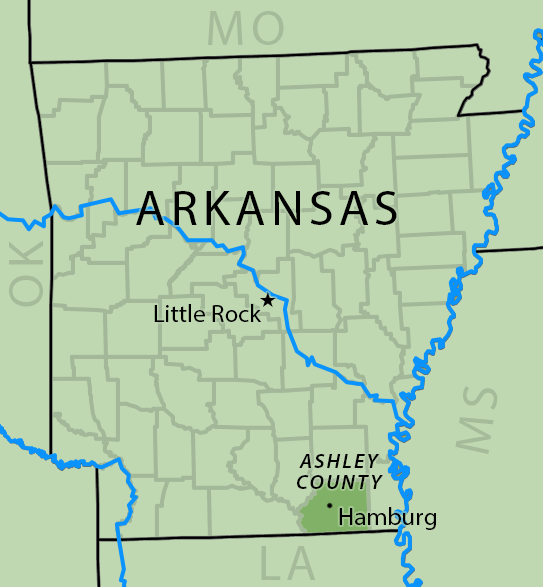 |
| Map of the Ark-La-Miss Borders. The Martins grew up in the town of Hamburg in Ashley County, Arkansas. Map by Southern Spaces. |
Arkansas is not unique in being treated as the home of the benighted white southerner, redneck, or hillbilly, and the Arkansas imaginary is but one sort of white, working class, rurality. The Arkansas imaginary has explanatory power for The Martins inasmuch as southern gospel music revoices and revalues the distortions and elisions of religious identity and cultural history central to the self-concept of many white fundamentalists and evangelicals. These distortions and elisions are at work in the Gaither video biography of The Martins that points to aspects of the Arkansas imaginary distinct from generalized assumptions about white trash and hillbillies.
The Martins hail from Hamburg near the Louisiana border in Ashley County, in the southeast quadrant of the state, where the west Gulf coastal plain meets the Mississippi Delta. The Gaither interview invites viewers to imagine them as representing a set of hill-country values—a love of hunting, closeness to nature, self-sufficiency, and cultural isolation—that Blevins argues have over the course of two centuries come to stand in for all (white) Arkansans.58The cultural difference between the Ozark/Ouachita and Mississippi Delta regions of Arkansas is aptly captured by/in two recent films. Winter’s Bone, set in the rural Ozarks, vividly portrays the psychosocial costs of geographical isolation, lack of economic and educational opportunity, and sense of cultural confinement associated with life in the deep woods of Ozark hill country. Mud, set in the Arkansas Mississippi River Delta, powerfully evokes the fluidity of class, ethnicity, and geography as defining features of identity in a region where the flux of life is so heavily dependent on, shaped by, and intertwined with the flow of the river. The noticeable absence of non-whites in these films, like the assumptions at work in Blevins’s account and Gaither video, suggests to the degree to which whiteness remains largely unelucidated as a structuring category of identity, ideology, and religious belief in southern gospel. Blevins links the emergence of the Ozark image to the cultivation of cotton, which transformed the lowlands and delta of Arkansas’s east, middle, and south into vast mechanized agricultural zones. This transformation left untouched only the Ozarks and Ouachita to the north and west. These were “places so divorced from the frenzied modernization of twentieth-century America” that they presented an easily caricatured type from which to generalize about the state as a whole.59Ibid., 5–16, 67.
The conflation of The Martins’s southern Arkansas bayou background with upstate Ozark hillbillyism emerges through the rhetoric of Bill Gaither as host and interlocutor. Gaither uses a repertoire of leading questions, strategic glosses of the singers’ responses, folksy asides, and improvised amplifications to cultivate the image of The Martins as hill-country kids made good as gospel celebrities. His interview enacts a modern gospel version of the venerable Arkansas Traveler colloquy in which a high-born southerner (the Traveler) engages an Arkansas Squatter in a dialogue about the differences of class and geography.60Bill Clinton’s presidential campaign used the Traveler name and image as a way to strengthen his populist appeal running against a Washington insider. For discussions of the Traveler trope see “The Arkansas Traveler” entries in the online resources of the Historic Arkansas Museum, accessed October 1, 2013, http://www.arkansas-traveler.org, and on Arkansas.com, Arkansas Department of Parks and Tourism.
![Arkansas squatter's home, along Route 70, 1935. Photograph by Ben Shahn. Courtesy of the Library of Congress, Prints and Photographs Division, LC-USF33- 006029-M1 [P&P]. Despite the geographical and cultural variety found in the state, many common stereotypes about Arkansas treat all Arkansas natives as derivatives of the squatter.](https://ssredesign.ecdsdev.org/wp-content/uploads/2019/07/harrison-010-squatter-lg.jpg "Arkansas squatter's home, along Route 70, 1935. Photograph by Ben Shahn. Courtesy of the Library of Congress, Prints and Photographs Division, LC-USF33- 006029-M1 [P&P]. Despite the geographical and cultural variety found in the state, many common stereotypes about Arkansas treat all Arkansas natives as derivatives of the squatter.") |
| Arkansas squatter’s home, along Route 70, 1935. Photograph by Ben Shahn. Courtesy of the Library of Congress, Prints and Photographs Division, LC-USF33- 006029-M1 [P&P]. Despite the geographical and cultural variety found in the state, many common stereotypes about Arkansas treat all Arkansas natives as derivatives of the squatter. |
What emerges in The Martins’s interview echoes Anthony Harkins’s observations about constructed hillbilly rusticity: “Middle-class white Americans [can] see these people [hillbillies] as a fascinating and exotic ‘other’ akin to Native Americans or Blacks, while at the same time sympathize with them as poorer and less modern versions of themselves.”61Anthony Harkins, Hillbilly: A Cultural History of an American Icon (New York: Oxford University Press, 2003), 7. Yet many of the white, conservative, and fundamentalist Christian consumers who are the target audience for this kind of Christian entertainment merchandise may well see something quite different. For them, Gaither’s interview effectively constructs and encourages audiences to see in The Martins representative, unifying figures of white, evangelical populism whose home is, as Bethany Moreton has shown in her study of Wal-Mart and evangelicalism, the Ozarks of northern Arkansas and south-central Missouri—the literal geographic location in which Gaither’s colloquy imaginatively relocates The Martins. In the process, The Martins’s music and cultural valence become revalued and highly desirable within the network of associations and commitments merging at the intersection of white conservative Christianity, right-wing cultural politics, and a “global service economy.”62 Bethany Moreton, To Serve God and Wal-Mart (Cambridge: Harvard University Press, 2009), 5.
Tradition, Progress, and Cultural Instability
The gestalt of Arkansas rusticity associated with The Martins serves to understand their sophisticated harmonies. At one point in the interview with The Martins, Gaither describes their music as “sophisticated,” and Judy Martin Hess jokes that Gaither was not saying The Martins themselves are sophisticated, only their music. Her reply offers quick-witted banter and comic reinforcement of the widespread assumption—abetted by the Gaither Music Company—that The Martins’s southern gospel is an artistically and spiritually serious form of sacred song from people who are proud of their pietistic primitivism. In this context, gospel music functions as a style of vernacular religious entertainment and a form of evangelical cultural experience transcending denominations or confessional traditions. When Gaither says, “You can take them anywhere,” he seems to mean that in his role as producer and impresario he can rely on The Martins to stand and deliver whatever the show demands. There is also the sense that The Martins’s appeal reaches across the spectrum of religious beliefs and musical tastes that form the conservative end of the white Christian music entertainment market. Gaither’s remark associates a universality to The Martins, who are legitimated by the origins their music is purported to transcend.
The notion of The Martins’s music as culturally transcendent—not despite but because of its particularized rusticity—is reinforced in another clip from The Best of The Martins in which the trio sings on the 1998 Hawaiian Homecoming.
The Martins’s singing by the sea resonates with the disjunction of three “kids” from a cold-water backwoods shack harmonizing in an exotic locale with an international gospel touring company. The video cuts from the Hawaiian excerpt back to the homey interview setting. Bill Gaither sighs contentedly, then adopts an avuncular, lightheartedly admonishing tone, commenting that The Martins had only sung the first verse and indicating, as if unplanned, that the trio should “finish it” on the couch at that moment. You can take them anywhere.
What started in Hawaii more than a decade earlier ends in Studio A in Andersonville, Indiana, with Gaither presiding as witness to The Martins’s musical authenticity—by sea, in the studio, (notionally) on command, at home among southern gospel’s Homecoming Friends or in faraway lands. The Martins appear to possess an unadorned, God-given popularity that abides in their embodiment of white tradition and progress. Their mix of rustic piety and sophisticated harmonizing (in The Best of video, much is made of their performance with the Homecoming Friends at Carnegie Hall) gives audiences powerful, palpable reassurance that despite shifts in taste, technology, and demographics of Christian entertainment during the past three decades, southern gospel music and values are thriving and persevering in the youthful artistry and rustic ethos of normatively white, middle class, evangelical traditionalism embodied in artists such as The Martins.
Geography and biography merge in the Arkansas imaginary to redefine and authenticate The Martins’s musical personae and southern gospel as a mode of fundamentalist and conservative evangelical experience. The southern gospel tradition carries on primarily through the cultivation of a musical sensibility connected to an underlying set of cultural affiliations. The Martins sing—and their fans enjoy—a fairly broad range of musical styles and an innovative pastiche of old and new that is often indistinguishable from some of the very CCM sounds southern gospel has long denounced as immoral and worldly. A fan’s review of The Best of The Martins video on Amazon.com captures this dynamic succinctly: “I wouldn’t consider the Martins southern gospel,” the reviewer writes, “as their sound is more contemporary but they have a love of the Lord and that comes across strong in their work and their lives. I recommend this DVD highly.”63Emphasis added. John F. Mooney, review of The Best of The Martins, directed by Bill Gaither, Amazon.com, July 29, 2013, accessed October 15, 2013, http://www.amazon.com/review/R399G8O3TFUQHH/.
In considering The Martins’s arrival “From Arkansas With Love,” I have demonstrated how a network of religious, geographic, and cultural associations merge in the construction of imagined place. Certainly there are southern and rural imaginaries writ large and available for scholarly scrutiny. But so too are there imaginaries rooted in the history, mores, and culture of more particular geographies requiring study to understand their cultural formations and uses.
With respect to The Martins, the same music on an album titled From Hyde Park With Love, or even From Hilton Head With Love, would likely not be considered southern gospel by most of its intended audiences. Just as significantly, while From Kentucky With Love, or From the Smoky Mountains With Love, would probably be received with the same warmth and enthusiasm that greeted The Martins’s music, the precise structure of a Kentucky imaginary or a Smoky Mountain imaginary would be located in the meaning-making of those places. Claiming a home in southern gospel grounds The Martins in an imagined identity that they in turn hold out for fans seeking models of stability and reassurance in an extended moment of great cultural change and instability for white evangelical fundamentalist religious culture. 
About the Author
Douglas Harrison is Associate Professor of English and Assistant Director of the Center for Faculty Innovation at James Madison University. His book Then Sings My Soul: The Culture of Southern Gospel Music was published by the University of Illinois Press in 2012.
Acknowledgements
The core of this essay began as a conference paper for the 2013 conference of the Society for American Music. Kevin Kehrberg generously included me on a panel he organized on shape-note gospel and its half lives in Arkansas and beyond, and Meredith Doster encouraged me to expand the paper into a submission for Southern Spaces. The peer reviewers for Southern Spaces provided generous feedback that sharpened my thinking and refined the essay’s argument considerably. Finally, I’m grateful to The Martins and so many other southern gospel performers for making music that has held me in thrall and demanded to be taken seriously.