Essay
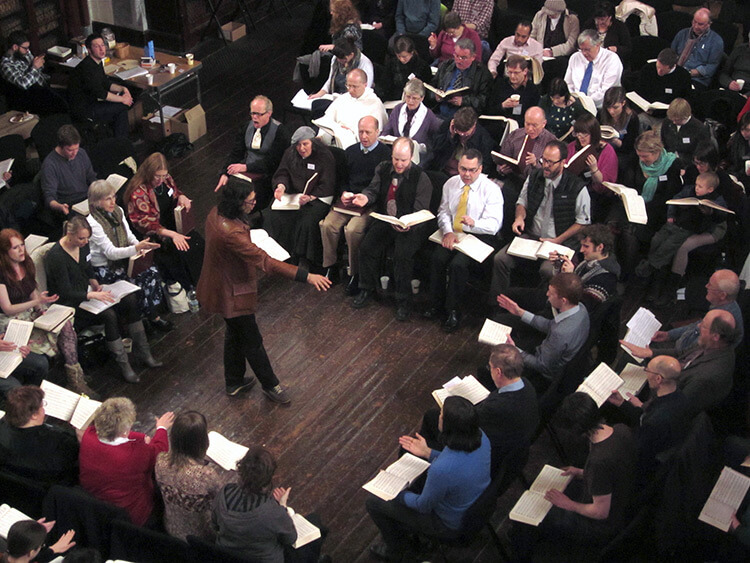 |
| Jesse P. Karlsberg, Aaron Kahn of Paris, France, leads a song at the first Ireland Sacred Harp Convention, Cork, Ireland, March 6, 2011. |
On March 3–6, 2011, 150 people gathered at University College Cork in Cork, Ireland, for the first Ireland Sacred Harp Singing Convention. A sacred, non-denominational, group singing tradition associated with the rural southeastern United States, Sacred Harp singing features day- or weekend-long gatherings, where participants sing without an audience from a songbook called The Sacred Harp. The convention in Cork drew a crowd unprecedented among European Sacred Harp singings for its geographic range and provided a group of fifty Irish college students with their first exposure to the emphatic style and spiritual energy that characterizes large Sacred Harp singings.
That Sacred Harp music came to be sung in Ireland in 2011 is both surprising and characteristic. While hundreds of Sacred Harp singings and conventions are held every year in Alabama, Georgia, Mississippi, Texas, and Florida—states where this musical form has existed since the mid-nineteenth century—new singings have been held in other areas of the United States since the 1970s, spreading to the United Kingdom and Canada in the mid-1990s, and then to Poland, Ireland, France, Germany, Italy, and the Czech Republic since 2008.
Many participants in the new singings in the United States have viewed them as a revival of earlier, locally lapsed practices. This view ties contemporary Sacred Harp singings in New England, the mid-Atlantic, and the Midwest to a history beginning with a movement to revitalize congregational singing in New England around 1700. This campaign led to a wave of singing schools teaching musical sight-reading that spread westward from Boston through the northeastern United States. A pair of New York-based songbook compilers introduced the use of shape-notes in 1801.1The title itself of William Little and William Smith’s 1801 songbook, The Easy Instructor, makes a case for the utility of shape notes in the singing school context. This innovation, designed to simplify sight-reading, was widely adopted by singing masters as other shape note songbooks appeared in the mid-Atlantic, midwestern, and southern states in the first decades of the nineteenth century. Singing schools and shape note singing ended in most areas of the country during the nineteenth century, though songbooks such as The Sacred Harp remained in use in a handful of southeastern states. As individuals from places where singing schools thrived in the eighteenth and nineteenth centuries have come into contact with Sacred Harp music and begun to hold events modeled on southeastern singings, they have imagined their new singings as revivals of these lapsed earlier practices.2See John Bealle, Public Worship, Private Faith: Sacred Harp and American Folksong (Athens: University of Georgia Press, 1997), 188–244 for an overview of what some singers have regarded as the “Sacred Harp revival.”
For many, however, participation in Sacred Harp singing is a choice that has nothing to do with family tradition or geographical history. Devotees sing Sacred Harp because they enjoy the music, food, and fellowship; because they find spiritual or religious meaning in the music and the singing context; because they are interested in early American song; or because they seek a social activity that can serve as a meaningful emotional outlet.3See Bealle, Public Worship, Private Faith; Kiri Miller, Traveling Home: Sacred Harp Singing and American Pluralism (Urbana: University of Illinois Press, 2008); and Laura Clawson, I Belong to this Band Hallelujah!: Community, Spirituality, and Tradition Among Sacred Harp Singers (Chicago: University of Chicago Press, 2011) for extended treatments of these ways of thinking about the spread of Sacred Harp singing beyond the southeastern United States.
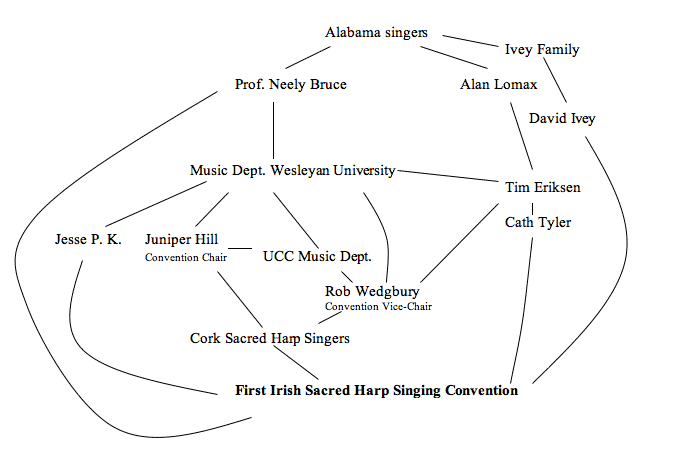 |
| Alice Maggio, Why there is Sacred Harp singing in Cork, March 13, 2011. Maggio, a singer from Massachusetts who helped introduce Sacred Harp singing to France, represented the hybrid academic and traditional genealogy of Sacred Harp singing in Cork in an illustration for her blog post reporting on the convention. |
As Sacred Harp singings have sprung up outside of where the music was long practiced, questions of “tradition” and “authenticity” have become pervasive. Many new singers locate authenticity with prominent singing families from Alabama, Georgia, and Texas who have long histories of Sacred Harp participation.4Miller, in Traveling Home, and Clawson, in I Belong to this Band, are particularly focused on Sacred Harp singers’ notions of “tradition” and “authenticity.” In imagining this locus of tradition, ubiquitously referred to as “southern,” new singers extrapolate from their knowledge of particular families and locations to imagine Sacred Harp singing as emanating from a white, rural South, excluding other populations and environs.5Early scholarship on Sacred Harp singing, beginning with George Pullen Jackson’s White Spirituals in the Southern Uplands: The Story of the Fasola Folk, Their Songs, Singings, and “Buckwheat Notes” (Chapel Hill: University of North Carolina Press, 1933), ascribed white and rural characteristics to the practice. However, black and white singers have long sung Sacred Harp music in both urban and rural areas across the US South. Though predominantly black singings have been held from The Sacred Harp since before the Civil War, participation has declined since the 1930s. Most contact that newcomers to the tradition have had with long-time southern singers has been with white singers. For more information on black Sacred Harp singing in the Wiregrass region of southeastern Alabama, see Joe Dan Boyd, Judge Jackson and the Colored Sacred Harp (Montgomery, AL: Alabama Folklife Association, 2002) and “Many Harps” in James B. Wallace, “Stormy Banks and Sweet Rivers: A Sacred Harp Geography,” Southern Spaces, June 4, 2007. Other singers in these new areas evince an academic lineage, tracing their singing’s founding to a college course or singing group established by a professor.6Buell Cobb noted the prominence of universities in the resurgence of interest in Sacred Harp singing outside the “traditional” areas in his introduction to the Brown Thrasher edition of his book Sacred Harp: A Tradition and its Music (Athens: University of Georgia Press, 1989 [1978]), vii–xiv; see also 154, 159. Stephen A. Marini drew attention to the role of academia in the spread of Sacred Harp singing in his review of Miller’s Traveling Home in the Journal of Southern History 76 (2010), 795.
The first Sacred Harp singing founded in a “non-traditional” area was the New England Convention held in Middletown, Connecticut, in 1976, co-organized by Georgia Sacred Harp singer Hugh McGraw, then head of the organization that publishes The Sacred Harp, and Neely Bruce, a professor at Wesleyan University. Bruce, who was born in Alabama, but first encountered Sacred Harp singing while in graduate school at the University of Illinois, attended a number of singings in his home state in the late 1960s and early 1970s. Encountering Wesleyan’s strong ethnomusicology program, Bruce began teaching Sacred Harp to students. The success of the first New England Convention7Initially envisioned by Bruce as a one-time occurrence, the New England Convention celebrated its thirty-sixth year in 2011. The convention also established a model for Sacred Harp singings held outside the South, yet patterned on the southern singings. See Annie Grieshop, ed., “Annual Sacred Harp Singings: 2011 Directory,” http://home.olemiss.edu/~mudws/annual.html, accessed September 28, 2011. was partly due to the presence of a busload of singers from Alabama, Georgia, and Florida (recruited by McGraw) who ensured that the Wesleyan convention ran according to the practices associated with southern singings.8Practices are outlined at the beginning of The Sacred Harp, ed. Hugh McGraw et al. (Carrollton, GA: Sacred Harp Publishing Company, 1991), 25. McGraw (personal communication; see also Miller, Traveling Home, 52) offers the five most important elements of a Sacred Harp singing: (1) sitting in a hollow square, (2) rotation of song leaders, (3) singing on the note names before the words, (4) breaking for dinner on the grounds at noon, and (5) opening and closing the singing with a song and a prayer. Bruce introduced Sacred Harp music to generations of Wesleyan students, leaving many with an appreciation for songs he favored.9Among the songs I learned as a student of Bruce in 2000 were selections he had chosen for an ensemble recording thirty years earlier at the University of Illinois. See Neely Bruce, dir. The American Music Group Volume 4: Hymns, Fuguing Tunes and Anthems from the Original Sacred Harp (Champaign, IL: American Music Group Publishing Company, 1972), 33 ⅓ rpm record.
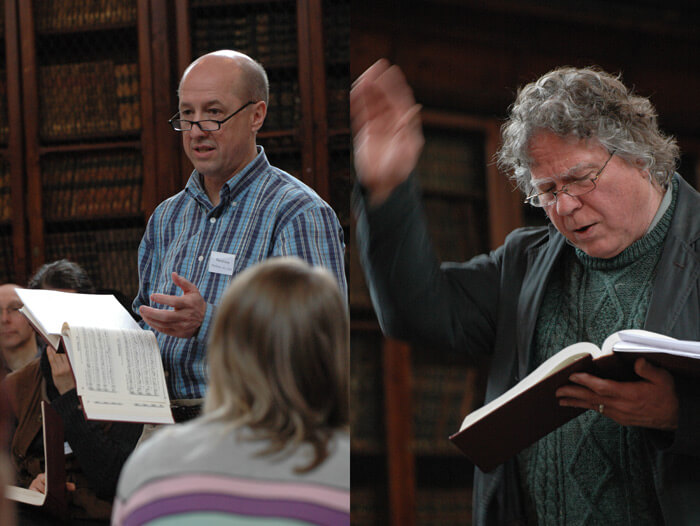 |
| Lisa Canny, Grit Glass, and John Hough, Neely Bruce of Middletown, Connecticut, and David Ivey of Madison, Alabama, teach a singing school the morning of the first Ireland Sacred Harp Convention, Cork, Ireland, March 5, 2011. |
Sacred Harp singing was introduced to Ireland in 2009 with the founding of a music ensemble at University College Cork (UCC) led by ethnomusicologist Juniper Hill, a former Bruce student. Hill’s students soon established a singing at a community art space in downtown Cork called Camden Palace, which quickly attracted non-student participants, some of whom then began attending the UCC singing.10Founded by Robert Wedgbury and Barry Twomey, this singing was initially held at the Spailpín Fánach pub in Cork, before moving to Camden Palace. See Robert Wedgbury, “Exploring Voice, Fellowship, and Tradition: The Institutionalised Development of American Sacred Harp Singing in Cork, Ireland and the Emergence of a Grassroots Singing Community” (master’s thesis, University College Cork, 2011), 37–39. These singers sought connection with Sacred Harp traditions, peppering Aldo Ceresa, a visiting New York City-based Sacred Harp singer and teacher, in the fall of 2010 with questions about southern singing practices. Hill and her students began planning a Sacred Harp convention, publicizing it through Facebook and the online “Fasola Discussions” Sacred Harp group.
The mixture of academic and traditional narratives and genealogies was evident at the Ireland Convention. Neely Bruce and David Ivey (a renowned Alabama singing master from a prominent singing family) were invited as co-teachers of a singing school. Between seventy-five and one hundred Irish singers attended the Ireland Convention, joined by sizable groups of singers from the United States, the United Kingdom, and Poland, as well as a pair of Americans living in France.11Sacred Harp singing began in Poland in 2008 in the wake of a singing school taught by Tim Eriksen, assisted by me, and organized by his wife Magdalena Zapędowska-Eriksen at an early music festival in the southeastern city of Jarosław.
The Ireland Convention—the first large Sacred Harp singing for more than half of the participants—was an exceptionally emotional experience for visiting and Irish singers alike. The visiting singers felt the power of their role in introducing the music they loved so much to this enthusiastic and eager group; this enabled the visitors to rediscover their own love of the style. In the wake of the convention, US singer Alice Maggio wrote of a “constant stream of songs flowing through [her] head” in describing what she called her “worst-ever-post-Sacred-Harp-convention syndrome.”12Alice Maggio, “Shout On!” Adventures of Aleece (blog) March 13, 2011, http://adventuresofaleece.wordpress.com/2011/03/13/shout-on/. See also Maggio’s “Regional Report: First Ireland Sacred Harp Convention,” The Trumpet 1, no. 2 (2011), vi.
For many Irish singers, the revelatory experience of the convention had a spiritual dimension. What they at first described as a feeling of unease—that the formal and overtly religious Sacred Harp convention seemed “alien” to or “unnatural” in the Cork context—by the weekend’s end had become an experience in which the “overwhelming power” of the music joined with a feeling of being welcomed into an international “family” or “incredible community” of singers.13See the “Sacred Harp Singers of Cork” group on Facebook, accessed March 8, 2011, https://www.facebook.com/groups/110889371183/ and the Facebook wall, accessed March 8, 2011, http://facebook.com/.
The first instance of pan-European participation in a Sacred Harp convention, the Ireland Convention has catalyzed reciprocal travel among fledgling Sacred Harp singing groups in Europe. Reciprocal travel, which helped sustain a plethora of rural southern singings in the wake of massive out-migration during the mid-twentieth century, also came to characterize Sacred Harp singings throughout the United States following the southern bus trip to the New England Convention in 1976. In the months following the Ireland Convention, travel brought sizable numbers of European singers to each other’s singings for the first time.14A handful of Irish singers visited the United Kingdom in April, 2011, for the East Midlands Convention, returning the favor of the English singers who had flocked to Cork in March. While Sacred Harp singings have been held in Poland since 2008, 2011 marked the first year that a sizable group of Polish singers traveled to England for the U.K. Convention. Reciprocal travel between the United States and Europe has also increased.15Several of the American singers who visited the Ireland Convention have since returned to attend singings in Ireland, Poland, and the United Kingdom. Five singers from Poland traveled to the United States in July 2011 to attend Camp Fasola, a weeklong Sacred Harp singing school and summer camp in Alabama, traveling on to Oregon to visit singers whom they had met at the Ireland Convention. Two Irish singers made a similar trip in September of 2011. Singers from the United States joined a large United Kingdom contingent in introducing Sacred Harp singing to interested Germans at a pair of singing schools held in Germany in October of 2011. In Cork, the convention cemented the commitment of a core group of singers to the tradition, provided a burst of activity that drew in a new group of participants, and spurred Irish singers to work hard to promote Sacred Harp singing elsewhere in Ireland and to maintain their singing at home.16Wedgbury, “Exploring Voice, Fellowship, and Tradition,” 49.
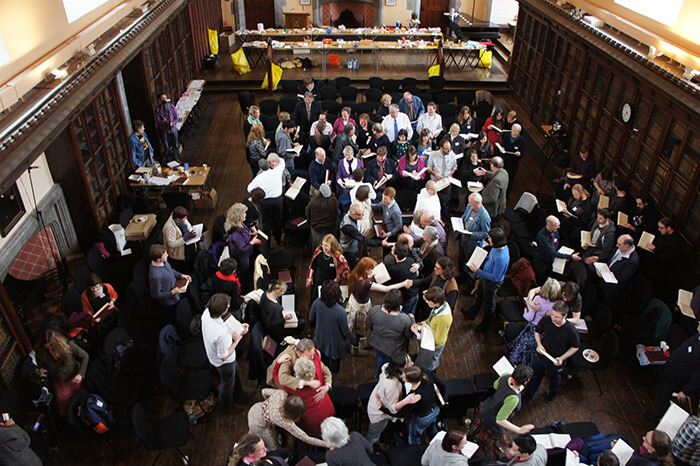 |
| Jakub Lipski, Singers take the parting hand at the close of the first Ireland Sacred Harp Convention, Cork, Ireland, March 6, 2011. |
As Sacred Harp singing spreads beyond its mid-twentieth century boundaries, it remains associated with southern singing practices, locations, and families in the minds of participants, even as they adopt the tradition. As singers from the convention in Cork now express their participation in Sacred Harp singing through communication, travel, organizing, and music-making, they model their expression on “traditional” practices that they learned in academic and informal situations. A “joyful” and “fulfilling experience,” the first Ireland Convention seems to have catalyzed a new flow of mutual support and reciprocal travel among Sacred Harp singers from across Europe and the United States. 
Acknowledgments
Research for this essay was supported by Emory University’s Laney Graduate School. The University College Cork Music Department generously granted permission to include photographs of the convention taken by Lisa Canny, Grit Glass, and John Hough and video and audio recordings of the convention by John Hough and John Prendergast in this piece. Jakub Lipski graciously allowed me to include a photograph of his in this essay as well. My sincere thanks go to Neely Bruce, Aldo Ceresa, Alice Maggio, Michael Walker, and Robert Wedgbury for stimulating conversations about the experience of attending the first Ireland Sacred Harp Convention. Thanks as well to Lauren Bock, Shelley Bock, Michael Moon, Allen Tullos, the staff of Southern Spaces, and two anonymous reviewers for reading and commenting on versions of this piece. Thanks, most of all, to the Sacred Harp singers of Cork, Ireland, for their enthusiasm and warm hospitality, and to the visiting singers who traveled to Cork this March to join in song with their new Sacred Harp singing friends.