Interview
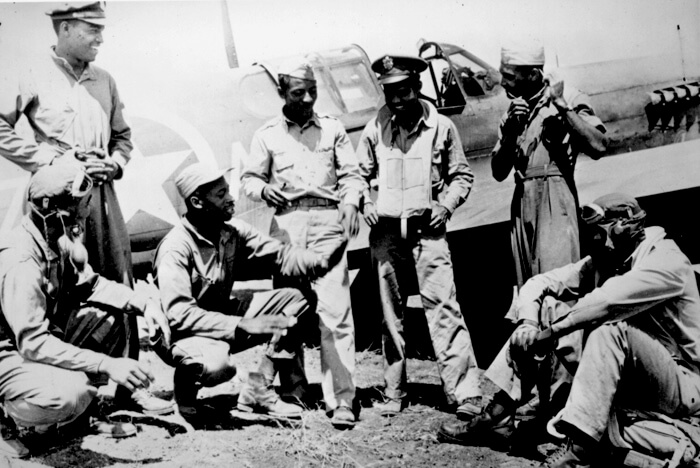 |
| Photographer unknown, Tuskegee Airmen gathered at a U.S. base after a mission in the Mediterranean theater, February 1944. Courtesy of the United States National Archives and Records Administration. |
Part 2: Gadsen discusses segregation and the Tuskegee Airmen as well as the NAACP’s efforts to desegregate the military
Part 3: Gadsen explores the significance of Tuskegee as the location for the War Department’s program to train black pilots
 |
 |
 |
||
 |
 |
 |
||
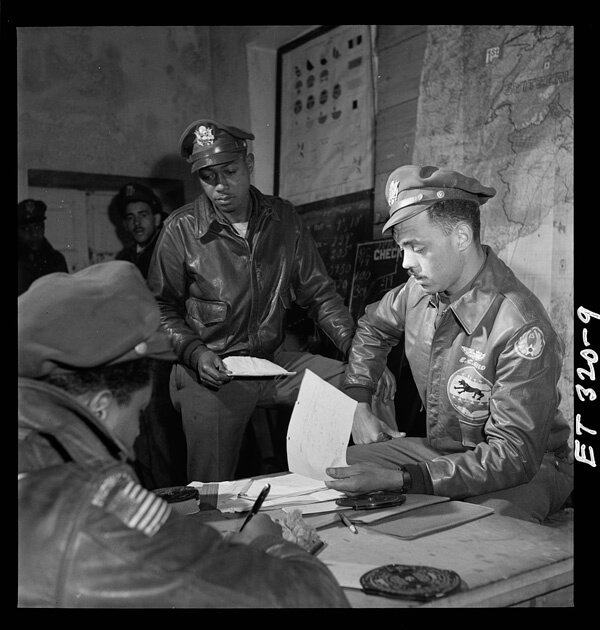
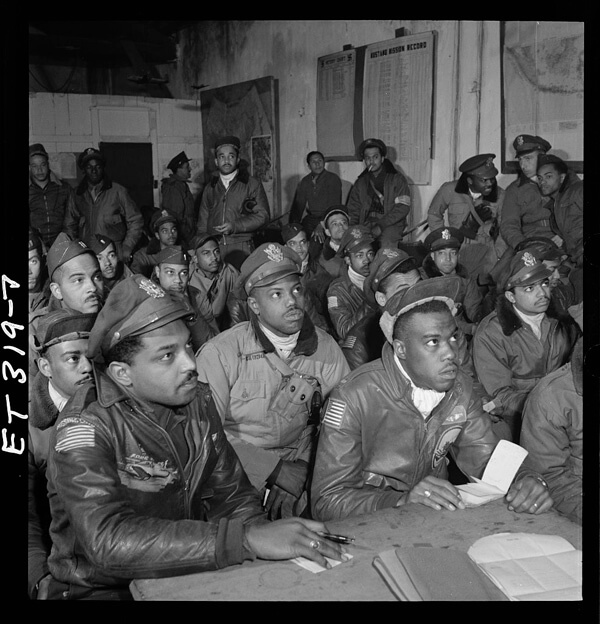
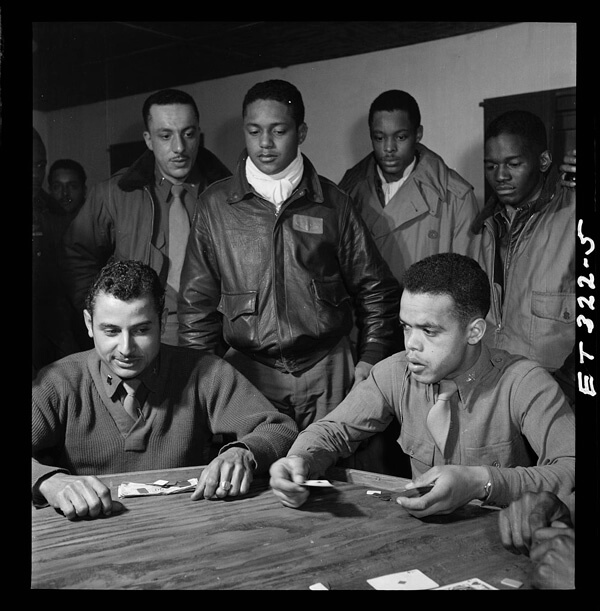
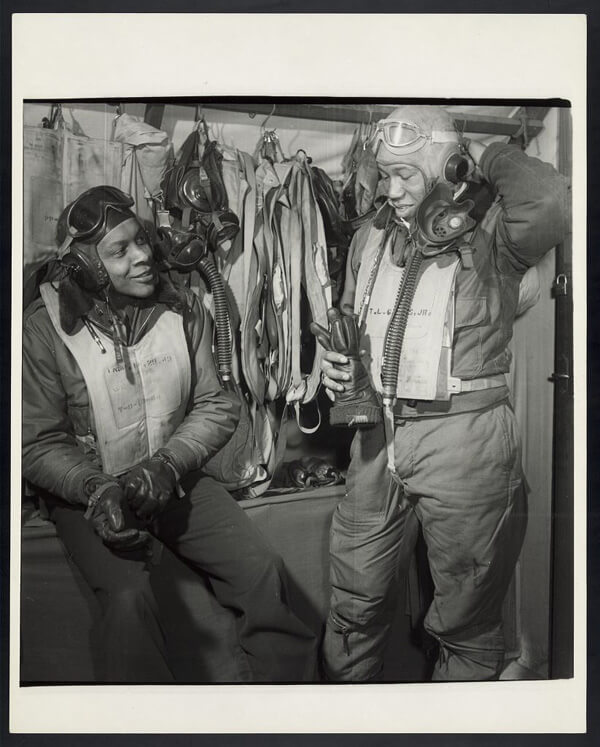
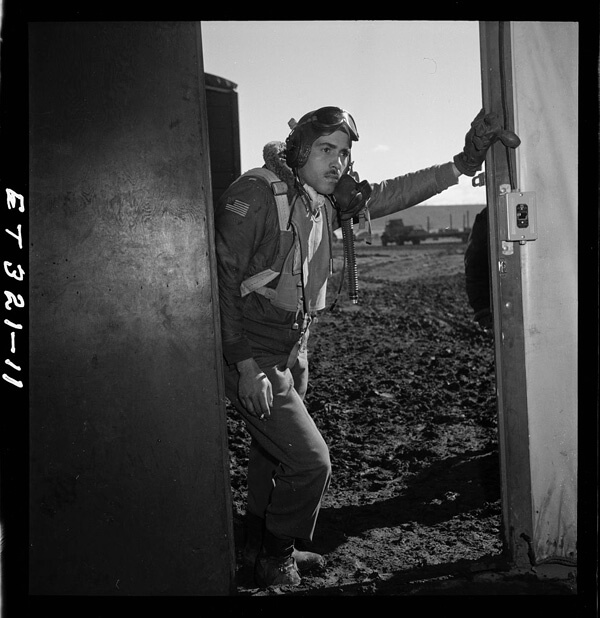
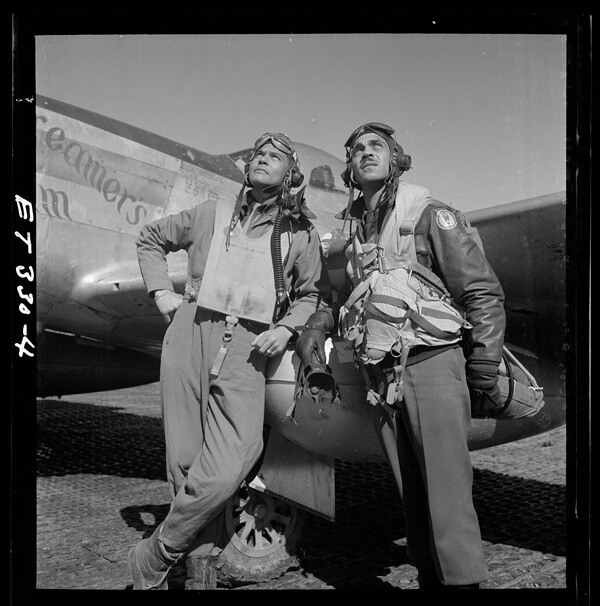
| Toni Frissell, Tuskegee airmen Woodrow W. Crockett and Edward C. Gleed (top left), Photograph of several Tuskegee airmen attending a briefing (top center), Tuskegee airmen playing cards in the officers’ club in the evening (top right), Members of the 332nd Fighter Group (bottom left), Portrait of Tuskegee airman Edward M. Thomas, standing (bottom center), Col. Benjamin O. Davis, full-length portrait, and Edward C. Gleed, wearing flight gear, standing next to airplane, and looking upward (bottom right), Air base at Ramitelli, Italy, March 1945. Courtesy of the Library of Congress. | ||||
Recommended Resources
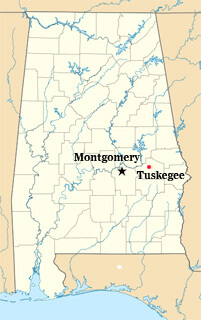
Map
 |
Astor, Gerald. The Right to Fight: A History of African Americans in the Military. New York: DeCapo Press, 2001.
Brooks, Jennifer E. Defining the Peace: World War II Veterans, Race, and the Remaking of Southern Political Tradition. Chapel Hill: University of North Carolina Press, 2004.
Davis, Benjamin O. Jr. Benjamin O. Davis Jr., American: An Autobiography. Washington, DC: Smithsonian Institution Press, 1991.
Dryden, Charles W. A-Train: Memoirs of a Tuskegee Airman. Tuscaloosa: University of Alabama Press, 1997.
Gilmore, Glenda. Defying Dixie: The Radical Roots of Civil Rights, 1919-1950. New York: Norton, 2008.
Gropman, Alan L. The Air Force Integrates, 1945-1964, 2d ed. Washington, DC: Smithsonian Institution Press, 1998.
Jakeman, Robert J. The Divided Skies: Establishing Segregated Flight Training at Tuskegee, Alabama, 1934-1942. Tuscaloosa, Ala.: University of Alabama Press, 1992.
Moye, J. Todd. Freedom Flyers: The Tuskegee Airmen of World War II. New York: Oxford University Press, 2010.
———. Let the People Decide: Black Freedom and White Resistance Movements in Sunflower County, Mississippi, 1945-1986. Chapel Hill: University of North Carolina Press, 2003.
Norrell, Robert J. Up from History: The Life of Booker T. Washington. Cambridge: Harvard University Press, 2009.
Scott, Lawrence P., and William M. Womack Sr. Double V: The Civil Rights Struggle of the Tuskegee Airmen. East Lansing: Michigan State University Press, 1998.
Links
Tuskegee Airmen National Historic Site – U.S. National Park Service
http://www.nps.gov/tuai/.
Tuskegee Airmen website
http://www.tuskegeeairmen.org/.