Introduction
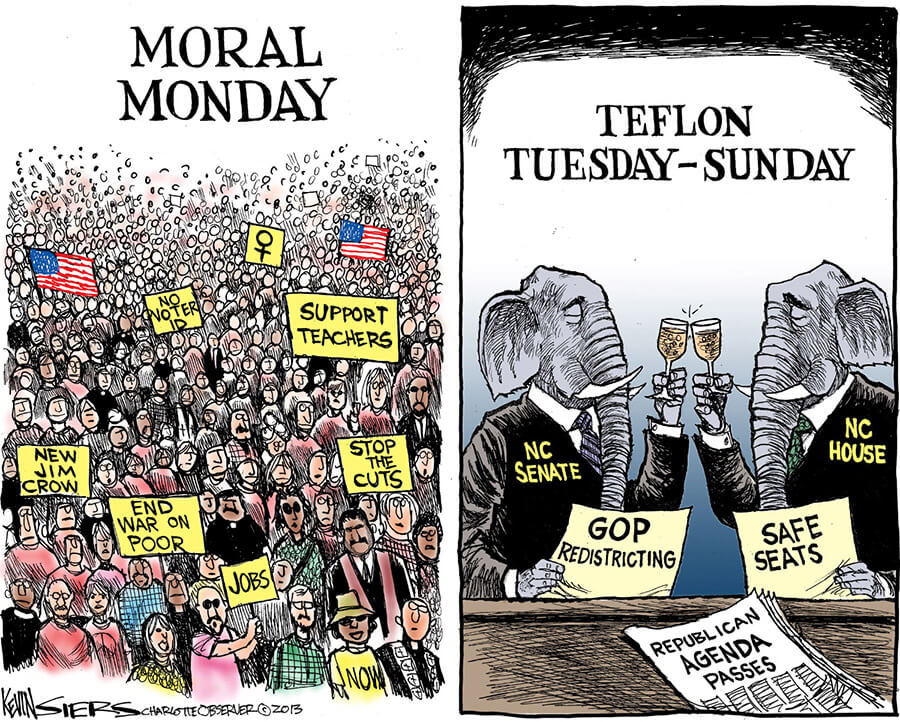 |
| Moral Monday, July 30, 2013. Cartoon by Kevin Siers. Reprinted with permission, Kevin Siers, The Charlotte Observer. |
What is happening in North Carolina? It’s a question I’ve been asked by friends and colleagues around the country as they read the list of far-right legislation that has been coming out of Raleigh over the last six months. Is it as bad as it looks, they want to know?
My answer is always the same: It’s worse—a lot worse—than you think it is.
North Carolina’s reputation as a “progressive” state has always been exaggerated; the leadership style has tended toward what V. O. Key called “progressive plutocracy,” or, as the late George Tindall more tactfully described it, “business progressivism.” Governors Luther Hodges and Terry Sanford in the 1950s and early 1960s set the tone for the last half of the twentieth century, emphasizing racial moderation and new models of business and industrial development linked to infrastructure development and improved education from K–12 through university. It was an approach shared by moderate Republican governors like James Holshouser, Jr. and James Martin. Compared to most of the old Confederacy, the state’s leadership made North Carolina seem an oasis of moderation in a desert of reactionary politics.1V. O. Key, Southern Politics in State and Nation (New York: Alfred A. Knopf, 1949), 205; George Brown Tindall, “Business Progressivism: Southern Politics in the Twenties,” South Atlantic Quarterly 62 (1963): 92–106; Rob Christensen, The Paradox of Tar Heel Politics (Chapel Hill: University of North Carolina Press, 2008), 310. More than thirty five years ago in The Transformation of Southern Politics, Jack Bass and Walter DeVries labeled their chapter on the state “North Carolina: The Progressive Myth,” (New York: Basic Books, 1976), 218–247.
Naked Partisanship
All that has changed. With a Republican governor and Republican controlled legislature, legislation enacted this year reads like a wish list ripped from the fulminations of Rush Limbaugh, Ralph Reed‘s right-wing Faith and Freedom Coalition and the editorial pages of the Wall Street Journal.
For the gun lobby, there were new laws sealing public records that identified handgun permit holders while allowing those gun owners to carry their revolvers and semi-automatic pistols into restaurants, bars, parks, playgrounds, athletic events, parades, funerals, and into the parking lots of public schools and universities.2Amend Various Firearm Laws, North Carolina Session Law 2013-369 (passed July 29, 2013), http://www.ncleg.net/gascripts/BillLookUp/BillLookUp.pl?Session=2013&BillID=H937.
There was also red meat for religious conservatives. During his 2012 campaign for governor, former Charlotte mayor Pat McCrory had promised to concentrate on promoting jobs while avoiding divisive issues like abortion. During the last days of the session, however, GOP leaders tacked a lengthy amendment onto an unrelated bill that mandated many hospital-level standards for the state’s abortion clinics. If fully implemented, these requirements will leave only one North Carolina clinic in operation.3Craig Jarvis, “North Carolina Abortion Bill Headed to McCrory,” Raleigh News and Observer, July 25, 2013, http://www.newsobserver.com/2013/07/25/3056922/senate-will-take-up-abortion-bill.html. Governor McCrory dutifully signed the measure.
Hatred for “Obamacare” was the other rallying cry for both social and economic conservatives. Early in the session, the GOP-dominated legislature barred the state from participating in the Patient Protection and Affordable Care Act or increasing eligibility for Medicaid, even though Medicaid expansion—fully paid by the federal government for three years and ninety percent thereafter—would have expanded health care to 500,000 uninsured North Carolinians.4No North Carolina Exchange/No Medicaid Expansion, North Carolina Session Law 2013-5, (passed March 6, 2013), http://www.ncleg.net/gascripts/BillLookUp/BillLookUp.pl?Session=2013&BillID=s4.
For the religious right, there were symbolic victories. One proposal would have made Christianity the official religion of North Carolina.5Rowan County Defense of Religion Act of 2013, House Joint Resolution 2013-494 (in committee), http://www.ncleg.net/gascripts/BillLookUp/BillLookUp.pl?Session=2013&BillID=h+494. That measure failed to reach a final vote, but another bill outlawing Sharia law in North Carolina barreled through the legislature.6Foreign Laws/Protect Constitutional Rights, North Carolina Session Law 2013-416 (passed August 26, 2013), http://www.ncleg.net/gascripts/BillLookUp/BillLookUp.pl?Session=2013&BillID=h522. (Muslims make up less than one quarter of one percent of the state’s population.)
But it was money that really talked under the new regime. Republicans had promised that they would make North Carolina “business friendly” and they were as good as their word. In a state that once prided itself on protecting its environment, the legislature barred local governments from adopting stricter environmental regulations, reduced the budgets of regulatory agencies, and replaced members of the state’s key environmental commissions, allowing the governor and the GOP legislature to appoint more “business friendly” members.
In contrast to their concern for what GOP lawmakers called “job creators,” there was little interest in the problems of workers. By the height of the recession, North Carolina had the fifth highest unemployment rate in the country. For years, however, North Carolina companies had paid into the state’s unemployment compensation fund at some of the lowest rates in the nation. As the recession deepened, the state was forced to borrow $2.5 billion from the federal government to maintain the program’s solvency.7”State Unemployment Rates in July 2013,” National Conference of State Legislatures, August 20, 2013, http://www.ncsl.org/issues-research/labor/state-unemployment-update.aspx; Robbie Brown, “North Carolina Approves Steep Benefit Cuts for Jobless in Bid to Reduce Debt,” The New York Times, February 13, 2013, http://www.nytimes.com/2013/02/14/us/north-carolina-approves-benefit-cuts-for-unemployed.html.
With almost no consultation from other groups, the North Carolina Chamber of Commerce wrote the bill “reforming” the state’s unemployment insurance program. While employers saw a modest increase in payments to the reserve fund ($3.40 per worker per month), three-fourths of the cost of restoring solvency came from cuts to the unemployed. In a series of measures eliminating or reducing benefits for 170,000 workers, the legislature slashed unemployment eligibility standards, cut benefit payments by more than a third, and reduced the length of eligibility to twelve weeks, the shortest time period in the nation. These measures caused North Carolina to become the only state in the nation to lose assistance from the federal Emergency Relief Program, payments that would have poured $780 million federal dollars into the hands of the unemployed and from there into the state economy.8Julie Adams and Jade C. Murray, “Sweeping Changes to North Carolina’s Unemployment Insurance Laws Take Effect on July 1, 2013,” Mondaq, July 9, 2013, http://www.mondaq.com/unitedstates/x/249382/; Dan Burley, “North Carolina Will Become First State to Forfeit Federal Long-term Unemployment Benefits,” Charlotte Observer, June 30, 2013, http://www.charlotteobserver.com/2013/06/30/4137390/north-carolina-will-become-first.html.
But the centerpiece of the GOP’s program was a tax cut that the North Carolina Budget and Tax Center estimated would eventually cost one billion dollars per year with seventy five percent of the tax cut going to the top five percent of taxpayers. The legislature accomplished this feat by eliminating the state’s inheritance tax (which already exempted all estates under $5.1 million) and reducing the state income tax rate paid by anyone making more than $250,000 to the same level as those making $25,000 a year. Under the new tax code, a family of four earning one quarter million dollars will receive a $2,434 tax cut while a working family of four earning $20,000 a year will see a reduction of three dollars in their income tax bill. Legislative leaders originally hoped to abolish corporate taxes in North Carolina, but had to be satisfied with a twenty eight percent reduction and a timetable for full elimination.9For the North Carolina Budget and Tax Center’s analysis of the tax cut see: Tazra Mitchell, “Senate Budget Is Wrong Path for North Carolina: Plan Includes Tax Cuts for the Wealthy, Shorts Investments in Vital Services,” BTC Reports 19, no. 3 (May 2013), http://itep.org/reports_using_itep_data/2013/06/north-carolina-budget-tax-center-gambling-away-our-future.php; Patrick Gannon, John Frank and Rob Christensen, “Dome: In other news, NC Senate gives final approval to tax bill,” Raleigh News and Observer, July 3, 2013, http://www.newsobserver.com/2013/07/03/3009073/dome-in-other-news-nc-senate-gives.html; John Frank, “Impact of Proposed Tax Bill Outlined,” Raleigh News and Observer, July 3, 2013, http://www.newsobserver.com/2013/06/06/2944494/impact-of-proposed-tax-bill-outlined.html.
The money had to come from somewhere. Reducing appropriations to key health assistance programs and regulatory agencies saved a few million and eliminating the state’s Earned Income Tax Credit Program for North Carolina’s poorest residents brought in another $110 million. In North Carolina, however, as in most states, the real money was in the state’s education budget. While higher education faced reduced appropriations, the real plundering took place in the public school education budget.
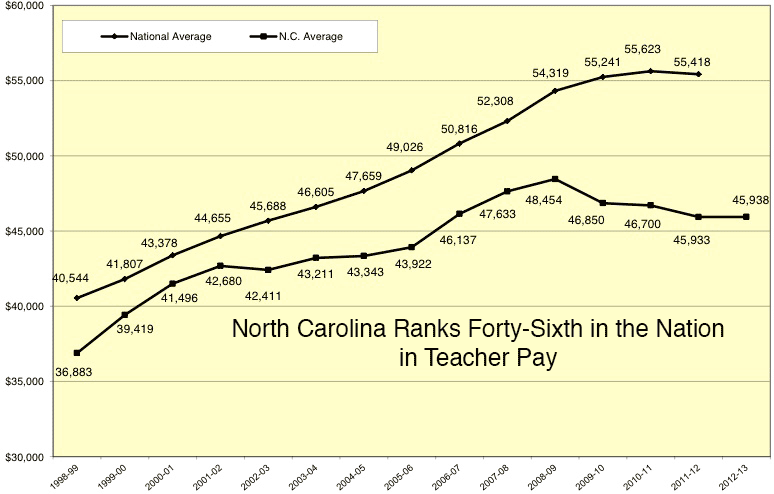 |
| North Carolina ranks forty-sixth in the nation in teacher pay, 2013. Chart from the North Carolina State Board of Education and Southern Spaces. Data from the National Education Association Ranking and Estimates for North Carolina, 2011–2012 and 2012–2013. |
Even as GOP lawmakers found the funds to create a voucher system for private schools, they reduced the number of openings in the state’s highly successful pre-K program for at-risk children, ended tenure for public school teachers, abolished teachers’ supplemental pay for advanced degrees, eliminated thousands of teachers and teachers assistants and failed to include even a token pay raise for teachers. (Since 2008, teachers have received a 1.2 percent raise.) Adjusted for inflation and a growing state population, 2014 education appropriations are more than a half billion dollars less than in 2008. By the end of the coming year, North Carolina will drop to forty-seventh or forty-eighth in pupil expenditures and teacher pay.10Rankings and Estimates: Rankings of the States 2012 and Estimates of School Statistics 2013, National Education Association, December 2012, accessed September 9, 2013, http://www.nea.org/home/54597.htm.
How did all this come to pass in a state that gave its electoral votes to Barack Obama in 2008 and fell just short of a Democratic victory in 2012?
The short answer: by hijacking the state’s political system. And no individual is more responsible for this takeover than James Arthur (“Art”) Pope. Jane Mayer profiled the wealthy chain store owner in her 2011 New Yorker article, “State for Sale,” describing how Pope had used his fortune to reshape the Republican Party into a reflection of his anti-government, pro-corporate policies. While supporters insist that his success is a triumph of ideas, Mac McCorkle, who lectures at Duke University School of Public Policy, dismissed such claims. Pope “never comes out except where you think he will. He’ll say he cares about the poor, but there’s a puerile Ayn Randism to him. . . . Deep down he’s an ideologue, a zealot.”
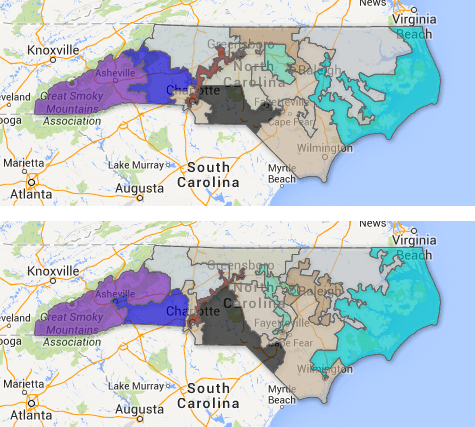 |
| 2001 (top) and 2011 (bottom) North Carolina congressional district maps. Map by the North Carolina State Board of Elections and Google Maps. |
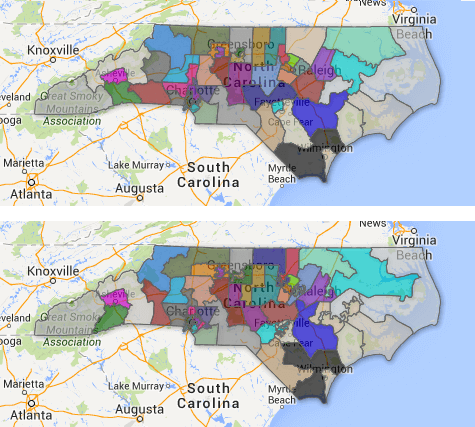 |
| 2003 (top) and 2011 (bottom) North Carolina Senate district maps. Map by the North Carolina State Board of Elections and Google Maps. |
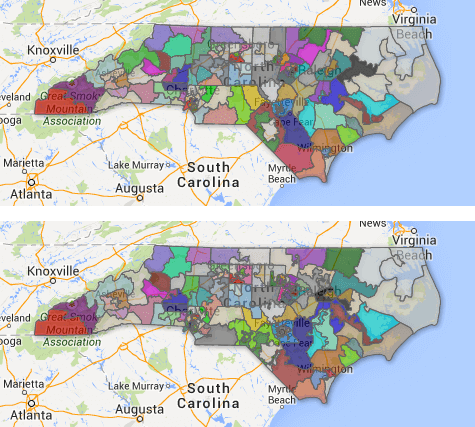 |
| 2009 (top) and 2011 (bottom) North Carolina House district maps. Map by the North Carolina State Board of Elections and Google Maps. |
Pope’s influence is directly attributable to his wealth, the foundations of which he inherited. Over the years he expanded his father’s “bargain” stores into a chain of four hundred low-wage discount stores scattered over thirteen states. With vast wealth concealed from public view (“Variety Wholesalers” is a privately owned corporation), Pope invested more than $40 million in building an infrastructure of tax-exempt right-wing think tanks and “public interest” propaganda outlets.
After crushing a number of moderate North Carolina Republicans over the last ten years by funding their more conservative opponents, he gained the upper hand in the state’s GOP. As Marc Farinella, who ran President Obama’s 2008 campaign in North Carolina noted, the “Republican agenda in North Carolina is really Art Pope’s agenda. He sets it, he funds it, and he directs the efforts to achieve it. The candidates are just fronting for him.”11Quotes on Pope drawn from Jane Mayer, “State for Sale: A Conservative Multimillionaire Has Taken Control in North Carolina, One of 2012’s Top Battlegrounds,” The New Yorker, October 10, 2011, http://www.newyorker.com/reporting/2011/10/10/111010fa_fact_mayer. Other information on Pope, including his early biography and current wealth, is taken from Chris Kromm, “The Art Pope Empire,” Raleigh Indyweek, March 9, 2011, http://www.indyweek.com/indyweek/the-art-pope-empire-media-outlets-think-tanks-and-election-machines; and Chris Kromm and Sue Sturgis, “North Carolina’s Tug of War,” The American Prospect, June 6, 2013, http://prospect.org/article/north-carolinas-tug-war.
The payoff to Pope’s long-range plans came in the off-year 2010 election when he and other wealthy donors spent $2.2 million targeting twenty-two Democratic incumbents in the state legislature. A modest sum in today’s high-rolling political sweepstakes, these funds financed a barrage of slick, negative mass mailings that distorted and frequently misrepresented the positions of the targeted lawmakers. At least two were flagrantly racist. Only four of the incumbents survived and the Republicans, aided by a fired up Tea Party base and a lethargic Democratic turnout, took control of the legislature.12The mass mailings proved to be critical in the absence of even minimal coverage of state and local elections. They received little attention from the media and the accused Democratic Senate and Legislative candidates lacked the resources to mount a sustained response.
Gerrymandering is a bipartisan sport, but the 2011 North Carolina legislature outdid itself and, with the help of the Republican National Committee’s redistricting director, created one of the most partisan redistricting plans in the nation. The bizarrely drawn congressional, state senate, and legislative districts divided heavily Democratic areas into two or three new districts, allowing the GOP to elect two-thirds of the state legislature and nine of the state’s thirteen congressmen and women in 2012 even though the voters split their ballots evenly between Republican and Democratic candidates.13Robert Draper, “The League of Dangerous Mapmakers,” The Atlantic, September, 19 2012, http://www.theatlantic.com/magazine/archive/2012/10/the-league-of/309084.
That same year, the GOP took the governorship when Pat McCrory, a former mayor of Charlotte, defeated a weak Democratic candidate. McCrory cultivated a reputation as a “moderate” Republican during the 2012 campaign, emphasizing his success in bringing people together during his tenure as Charlotte’s Mayor. What most people failed to understand was that McCrory had little choice except to take a moderate position. The Charlotte he governed had a Democratic majority city council and a business class that epitomized the state’s “progressive” tradition. Once elected with a heavily Republican legislature, he smoothly pivoted toward the far right, appointing Art Pope as budget director.14Mark Binker, “McCrory Has Promises to Keep,” WRAL News, January 5, 2013, http://www.wral.com/mccrory-faces-promises-and-expectations-/11897511; Rob Christensen, “The Evolution of Pat McCrory,” Charlotte Observer, July 14, 2013.
Not satisfied with the 2011 redistricting plan that made it almost impossible for the opposition party to regain power, the GOP majority enacted a fifty-seven-page revision of the state’s election laws, measures which amounted to the nation’s most extensive effort at voter suppression. Faced with overwhelming evidence that fraud was almost non-existent in North Carolina, Governor McCrory and the state’s house speaker acknowledged that voter impersonation was not a problem, but they insisted that the new election laws were necessary to restore confidence—”confidence” that they and other Republicans had earlier undermined by falsely spreading charges of voter impersonation.15Laura Leslie, “Tillis: Fraud ‘not the primary reason for voter id push,'” WRAL News, March 17, 2013, http://www.wral.com/tillis-actual-voter-fraud-not-the-primary-reason-for-voter-id-push-/12231514.
North Carolina’s new voter laws have their greatest impact on African American voters who are far less likely to have official state approved identification and this racially disparate effect inevitably raised the charge of racism. Undoubtedly, racism exists in the state. One of the GOP’s top priorities was to repeal the North Carolina’s “Racial Justice Act” which allowed convicted murders to have their death sentences reduced to life in prison if they could prove racial bias influenced their conviction.16Associated Press, “McCrory signs repeal of Racial Justice Act,” News Observer, June 19, 2013.
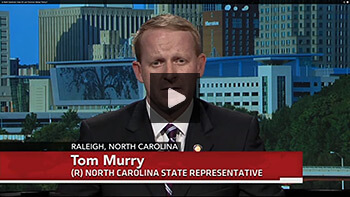 |
| Is North Carolina’s Voter ID Law ‘Common Sense’ Policy or Discrimination?, PBS Newshour, August 13, 2013. View segment on the PBS Newshour website. |
But the primary motivation for changes in the state’s election laws has been naked partisanship. Every change in North Carolina’s new election code was targeted at reducing potential Democratic voters regardless of race, creed, color or national origin. The state’s VIVA/Election Reform law, passed on a straight party line vote, now requires a government-issued photo ID card to vote, but rejects student IDs, public-employee IDs, or photo IDs issued by public assistance agencies. Other provisions end Sunday voting (African Americans have a tradition on voting after church) and straight-party ticket voting (fifty seven percent of straight ticket votes are by Democrats), shorten the early voting calendar, (Democratic voters are thirty percent more likely to vote early than Republicans), ban same-day registration during early voting, (a majority of same day registrants are Democrats), and prohibit paid voter registration drives since such organized efforts are more likely to register Democrats and empower any individual—not just official poll watchers—to challenge potential voters. Local officials will no longer be able to extend voting hours in cases of long lines, or allow provisional voting if someone arrives at the wrong precinct. University of California at Irvine law professor Rick Hasen, author of The Voting Wars, and one of the nation’s leading voting rights experts told the Charlotte Observer that he had “never seen a package of what I would call suppressive voting measures like this.” “I can’t for the life of me see how it’s justified on voter ID grounds.”17Lynn Bonner, David Perlmutt and Anne Blythe, “Elections Bill Headed to McCrory,” Charlotte Observer, July 26, 2013, http://www.charlotteobserver.com/2013/07/25/4190990/changes-to-election-laws-move.html; Jim Morrill, “Voting Bill Signed; Legal Challenges Start,” Charlotte Observer, August 12, 2013, http://www.charlotteobserver.com/2013/08/12/4232398/gov-mccrory-signs-voter-id-bill.html.
“There is no moral issue. It is wrong—deadly wrong—to deny any of your fellow Americans the right to vote in this country,” Lyndon Johnson said to members of Congress in his call for the passage of the 1965 Voting Rights Act.18Lyndon Baines Johnson, “Speech Before Congress on Voting Rights,” March 15, 1965, transcript, Miller Center of Public Affairs, University of Virginia, https://millercenter.org/the-presidency/presidential-speeches/march-15-1965-speech-congress-voting-rights. The voter repression efforts of the current North Carolina legislature are far less pervasive than the Jim Crow laws of the past. But they are just as immoral. And given the US Justice Department’s decision to fight the Texas voter ID bill—which is less restrictive than North Carolina’s—the laws will likely be challenged in the courts.
Bankrolling the Infrastructure
North Carolina GOP’s policies reflect many of the same ideological forces that have strengthened the new conservatism across the nation. Evangelicals and social conservatives contribute the shock troops for this conservative political movement, and Fox News, the Wall Street Journal, talk radio hosts, and the religious broadcasting networks furnish the most strident megaphones. Right wing billionaires supply the financial muscle and the patina of intellectual respectability that allows them access to mainstream media. Intent on a laissez-faire utopia, the super-rich in the United States have concluded that their wealth may be more effective in capturing state governments than winning national elections.
If Art Pope is the godfather of North Carolina’s conservative movement and William, David and Charles Koch are the most prominent faces of today’s wealthy conservative activists, they are all part of a longer tradition. Beginning in the 1970s and 1980s, individuals such as Colorado beer brewer Joseph Coors, financiers Lynde and Harry Bradley and John Olin, and Pittsburgh billionaire, Richard Mellon Scaife bankrolled an emerging right-wing legal, media, and “think-tank” infrastructure: the Heritage Foundation; the American Enterprise, Cato, Hudson, and Manhattan Institutes; as well as dozens of other, lesser known organizations. An investment fund manager who examined the financial reports of some five hundred conservative tax-free foundations, think-tanks, and funding agencies concluded that these organizations had spent between $2.5 and $3 billion from 1970 to 2003 in order to promote their ideas.19The National Committee for Responsive Philanthropy estimated that the top 20 of the more than than 500 conservative, tax-free foundations alone spent $1.1 billion between 1990 and 2000. National Committee for Responsive Philanthropy, $1 Billion for Ideas: Conservative Think Tanks in the 1990s (New York: NCRP, 1999). Literature on these new conservative advocacy foundations is surprisingly thin. Jean Stefanicic and Richard Delgado’s No Mercy: How Conservative Think Tanks and Foundations Changed America’s Social Agenda (Philadelphia: Temple University Press, 1996) offers a useful summary of the interlocking relationship of these groups and a summary of their policy positions, but it breaks little ground. In his excellent study, The Idea Brokers: Think Tanks and the Rise of the New Policy Elite (New York: The Free Press, 1991), James Allen Smith seeks to put them in a larger historical context, but one of his more important conclusions—that these conservative policy research organizations would survive only by moving toward the center and away from strong advocacy positions—has been proven wrong in the 17 years since he published his work.
These groups have been joined by more tax-free conservative foundations and political action groups like those in North Carolina created or funded by Art Pope: the John William Pope Civitas Institute, the John Locke Foundation, Real Jobs NC, and the N.C. Institute for Constitutional Law.20Chris Kromm, “The Art Pope Empire,” Raleigh Indyweek, March 9, 2011, http://www.indyweek.com/indyweek/the-art-pope-empire-media-outlets-think-tanks-and-election-machines. And now the Citizens United decision has liberated Pope and other wealthy conservatives from any legal restraints (and public disclosure).21Michael S. Kang, “After Citizens United,” Indiana Law Review 44, no. 243 (2010): 243–255.
Whatever their differences, these corporate-funded groups are united by two interlocking principles. Nearly a decade ago, Harper’s Magazine editor Lewis Lapham identified the first: the unbending conviction that the word “public” in “all its uses and declensions (public service, citizenship, public health, community, public park, commonwealth, public school, etc.,) connotes inefficiency and waste,” a condition that could only be corrected by relying upon the unrestrained market, freed from the stultifying and unnecessary burdens imposed by government bureaucrats, labor unions and assorted liberal busy-bodies.22Lewis H. Lapham, “Tentacles of Rage: the Republican Propaganda Mill, a Brief History,” Harper’s Magazine, September 2004, http://harpers.org/archive/2004/09/tentacles-of-rage.
The second is the belief that money corrupts the poor but elevates the moral character of the rich. By making the lives of the poor, the working class, and the marginal middle class more precarious and insecure, the poor will respond by becoming productive and resourceful workers. Giving the rich more money and making their already prosperous lives even more secure will lead them to be more productive and resourceful in returning benefits to society.
As the “Church Lady” Dana Carvey often said at the conclusion of one of his Saturday Night Live skits: “How convenient.”
What is unnerving is the willingness of large numbers of voters in North Carolina and across the nation to embrace the very policies which cause them so much pain. If there is any lesson to be learned from the last thirty years, it is the failure of trickle-down economic policies that benefit only the wealthiest Americans. Over the last twelve years, median income, a key indicator of middle class well-being, has declined seven percent.23”US Income has Declined by 7.2% since 2000: Report,” Press TV, August 22, 2013, http://www.presstv.ir/detail/2013/08/22/319897/us-median-income-declined-report/. That growing inequality and insecurity seems to have strengthened the forces of hyperindividualism while weakening any sense of the possibility for collective action. But not entirely.
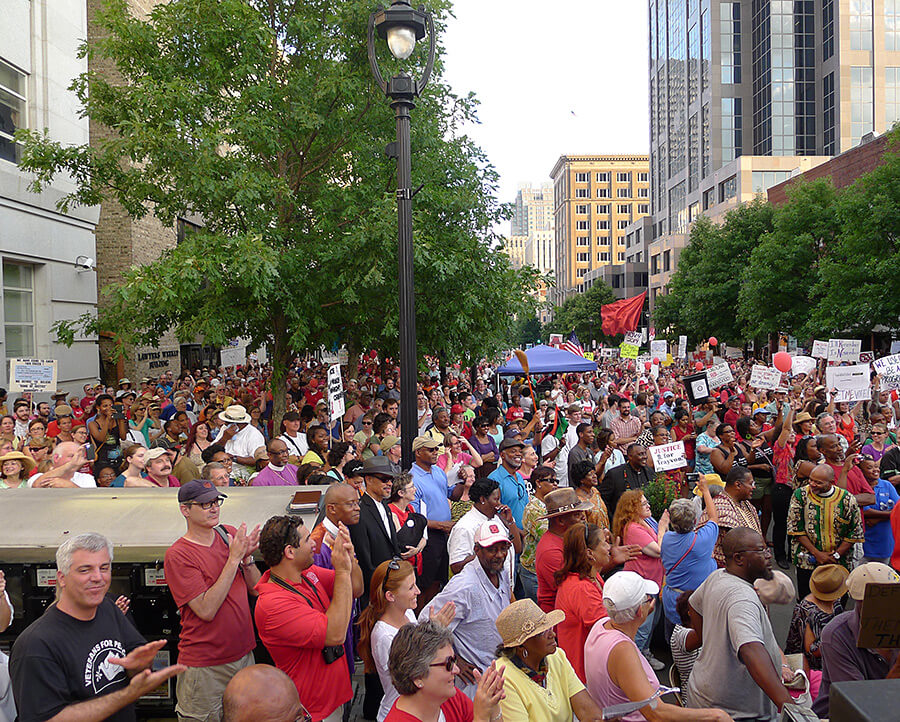 |
| Moral Monday demonstration, Raleigh, North Carolina, July 29, 2013. Photograph by Cristóbal Palmer. Courtesy of Cristóbal Palmer. |
On April 29, the North Carolina NAACP organized the first of a series of “Moral Monday” demonstrations outside the legislature in Raleigh. Beginning with a handful of participants, they grew steadily through the summer drawing as many as five thousand protestors and leading to 930 arrests. One prominent Republican legislator sneered that the rallies should be renamed “Moron Mondays,” while Governor McCrory and other GOP leaders dismissed the demonstrators as “outsiders,” “aging hippies,” and “Loony Liberals.”24Thom Goolsby, “Moron Monday shows radical Left just doesn’t get it,” Chatham Journal, June 7, 2013, http://www.chathamjournal.com/weekly/opinion/myopinion/moron-monday-shows-radical-left-just-does-not-get-it-130607.shtml. Despite assertions from the right that protestors were “outsiders” from other states, ninety-eight percent of those arrested were natives of North Carolina. See Mark Binker and Amanda Lamb, “Most Arrested in ‘Moral Monday’ Protets from NC,” WRAL News, June 11, 2013, http://www.wral.com/most-moral-monday-arrestees-from-north-carolina/12540006/.
As the legislative session came to a close, however, the movement moved from Raleigh to other cities and showed no sign of weakening. On August fifth, six thousand demonstrators packed Asheville’s town center and organizers promised future rallies throughout the state. If the outpouring of opposition did not derail major GOP legislation, these protests had an impact on public opinion. Governor McCrory’s approval ratings have fallen from sixty two to thirty nine percent with fifty one percent of voters disapproving and only twenty percent of voters expressing confidence in the GOP-led general assembly. In late July, a ballot poll conducted by Public Policy Polling showed Democrats leading Republicans fifty one to forty two.25Romando Dixson and Casey Blake, “Protest Packs Asheville,” Asheville Citizen-Times, August 6, 2013, http://www.citizen-times.com/article/20130806/NEWS/308060023/Protest-packs-Asheville; “McCrory Image Plummets,” Public Policy Polling, July 16, 2013, http://www.publicpolicypolling.com/main/pat-mccrory/; and John Frank, “Under the Dome,” Raleigh News and Observer, August 14, 2013, http://projects.newsobserver.com/node/28201.
No one can predict whether the passionate opposition will extend to next year’s fall elections. Groups like “Scholars for North Carolina Future“—over one hundred academics across the state—have joined other grass roots organizations in coordinating informational and action-oriented gatherings to make the case that the current leadership in North Carolina has embarked on a course that is destructive to the state and its people. Activists face a daunting series of obstacles. The Democratic Party leadership has been marked by scandals and bitter infighting; Art Pope and friends will have deep cash reserves for the upcoming campaigns; and the 2011 gerrymandering has given most GOP incumbents a six to twelve percent protective cushion. The next two elections will determine whether the movement reflected in “Moral Mondays” builds a successful political coalition to overthrow the current Republican dominance or falters, leaving North Carolina as another link in the GOP’s domination of much of the political geography of the old South.