Review
The Virginia Historical Society (VHS) in Richmond, Virginia, has mounted an ambitious, highly original, and innovative exhibition on the history of the Civil War, “An American Turning Point: The Civil War in Virginia.” The exhibit was organized with the partnership of the Virginia Sesquicentennial of the American Civil War Commission and supported with funding from the National Endowment for the Humanities and numerous private foundations. The VHS consulted with a roster of well-known historians.1The consulting historians include Stephen V. Ash, Charles F. Bryan, Jr., Catherine Clinton, Joseph T. Glatthaar, Ervin L. Jordan, Jr., James C. Kelly, and Chandra Manning. Informed and enriched by the latest scholarship on the Civil War, this exhibition brings together the soldiers’ and the civilians’ experiences and interconnects the battlefield and the home front, with one section on “Waging War (The Battlefront)” and another on “Surviving War (The Home Front).”
The result is sometimes refreshingly blunt, sometimes opaque, but deeply moving, reinterpretation of the experience of the war in Virginia. The highlight for any visitor is likely to be the first-person, three-dimensional visual simulation of a runaway slave, called “The Journey to Freedom.” Taken as a whole, the exhibition succeeds in introducing important new themes in Civil War scholarship to the public. Perhaps nowhere has this been more necessary during the Civil War sesquicentennial than in Richmond, where the monuments to the past loom large.
 |
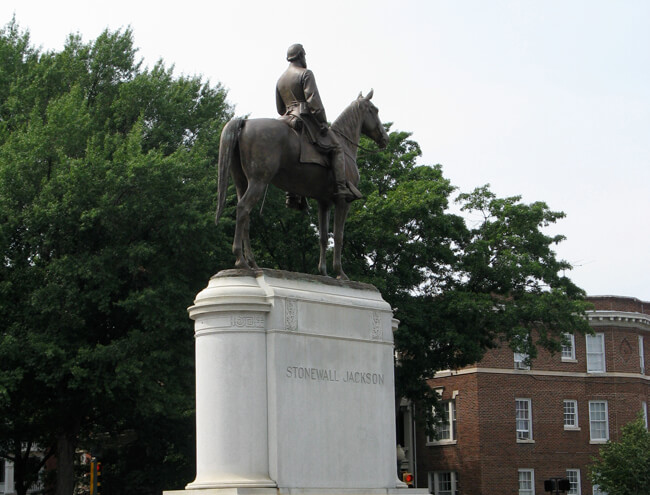 |
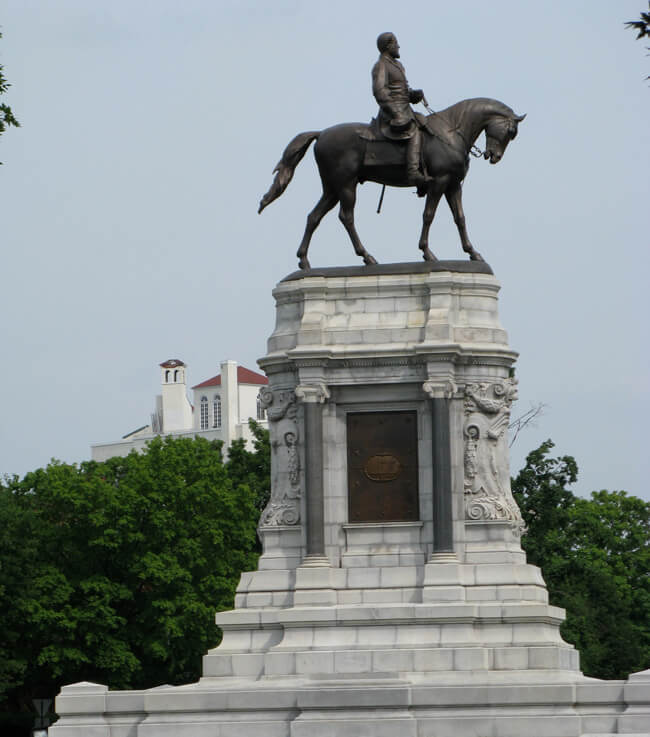
| William G. Thomas III, Statue of Robert E. Lee, Monument Avenue, Richmond, Virginia, 2011. | William G. Thomas III, Statue of Stonewall Jackson, Monument Avenue, Richmond, Virginia, 2011. |
Indeed, one hundred and fifty years ago in 1861, Richmond became the capital of the Confederacy. This was a city whose white residents were supremely confident in the future of slavery and in the prospects for the new nation they were forming. Generations after the defeat of the Confederate States of America, however, Richmond stubbornly clung to its “lost cause.” Led by its veterans and ladies associations, the city put up a massive monument to Robert E. Lee unveiled in 1890 and sculpted by Jean Antonin Mercié. Monuments to Thomas J. “Stonewall” Jackson and other Confederates followed. Decades later in the 1920s and 1930s Lee’s biographer and the editor of the Richmond News Leader, Douglas Southall Freeman, lived just a few blocks from the monument. Freeman placed Lee at the center of his histories of the Civil War and indeed at the core of Virginia identity: “Their stock had produced Lee; they had seen him, had known him, had obeyed his orders and at his behest, had challenged Cemetery Ridge and had starved in the Petersburg trenches. Association with him was the glory of their generation.”2Douglas Southall Freeman, The South to Posterity: An Introduction to the Writings of Confederate History (New York: Charles Scribner’s Sons, 1939, reprinted 1998), 59.
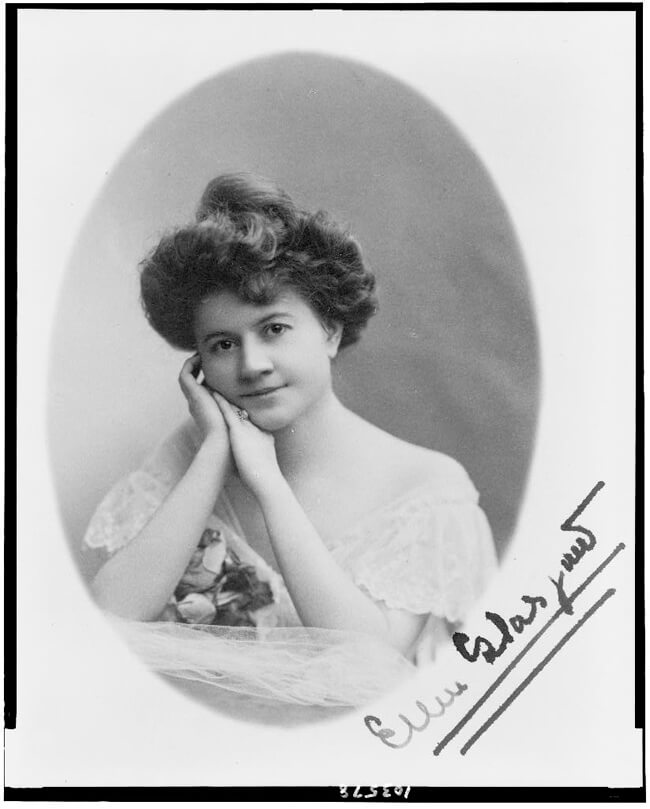 |
| Ellen Glasgow, c. 1890. Image courtesy of the Library of Congress. |
Writer Ellen Glasgow, born in Richmond in 1873, tried in her own way to break this spell, attempting to expose “all the harsher realities beneath manners, beneath social customs, beneath the poetry of the past, and the romantic nostalgia of the present.” In 1921 she told the Richmond Women’s Club: “Here in Virginia, we need liberation not from the past, but from our old moorings which have held the past and ourselves anchored in stagnant waters.” Despite her privileged upbringing, Glasgow urged Virginians to embrace the “dynamic past” and to move beyond “discarded theories,” reject tradition, and look to the future. “We are most like Jefferson,” she explained, “not when we repeat parrot-like the principles he enunciated, but when we apply these great principles to ever changing conditions.” The implications of Glasgow’s comments should not be underestimated, because Jefferson’s idea of state’s rights, expressed in the Virginia and Kentucky Resolutions, had such outsized prominence among lost cause writers. Glasgow was recovering a different legacy of Jefferson, one distinctly out of favor among her peers in Richmond. Glasgow went so far as to claim that Jefferson “has been used as an anchor to keep us moored for generations in the backwaters of history.” Still, even Glasgow made a place for Lee in her pantheon of Virginia’s forward-looking heroes, claiming that Lee “marched onward, not backward.” Glasgow’s Lee was quickly forgotten, as was her larger quest to see the past as a dynamic force, not for holding back, but enabling change.3Ellen Glasgow, “The Dynamic Past,” in Emily Clark and Paul Green, eds., The Reviewer 1:3 (March 15, 1921), 73-80. In a remarkable statement Glasgow explained Jefferson as a “progressive statesman” who “almost one hundred years ahead of his time, proclaimed the principle upon which Abraham Lincoln was elected to the Presidency.” Mary Johnston in the inaugural edition of The Reviewer wrote evocatively of the rise of a Richmond literary scene: “And all around Richmond move the ghosts of battles long ago. . . Action and reaction are here, aromatic, pungent, old and new, and the old and new blended into one what is both old and new. This is not a city of one aspect.” See also Edward L. Ayers, The Promise of the New South: Life after Reconstruction (Oxford: Oxford University Press, 1993), 359. And Daniel Singal, The War Within: from Victorian to Modernist Thought in the South, 1919-1945 (Chapel Hill: University of North Carolina Press, 1983), 90-114.
The past looms especially large in Richmond in part because Douglas Southall Freeman’s voluminous histories mesmerized his and later generations with the idea “that there was historical logic in the right of secession . . . that the South fought its fight gallantly . . . with fairness and decency.” To say the least, these sentiments glossed over the war’s complicated history, especially the centrality of slavery but also the war’s unremitting violence, ruthless guerrilla conflict, poor medical care, and dismal prisoner-of-war treatment.4Freeman, The South to Posterity: An Introduction to the Writings of Confederate History, 204. The recent Civil War histories stress the complexity, ambiguity, fluidity, and contingency of the war by focusing on broader themes. A useful overview is Drew Gilpin Faust, “We Should Grow Too Fond of It: Why We Love the Civil War,” Civil War History 50:4 (2004): 368-383; along similar lines see Edward L. Ayers, “Worry About the Civil War,” in What Caused the Civil War: Reflections on the South and Southern History (New York: W. W. Norton, 2005), 103-130. In 2011 alone dozens of new Civil War histories appeared and to provide an exhaustive list here would not be possible. The following recent works are especially indicative of the new Civil War history: Daniel Sutherland, A Savage Conflict: The Decisive Role of Guerrillas in the American Civil War (Chapel Hill: University of North Carolina Press, 2009); Gary Gallagher, The Union War (Cambridge: Harvard University Press, 2011); Drew Gilpin Faust, This Republic of Suffering: Death and the American Civil War (New York: Knopf, 2008); Stephanie McCurry, Confederate Reckoning: Power and Politics in the Civil War South (Cambridge: Harvard University Press, 2010); Stephen Ash, A Year in the South 1865: The True Story of Four Ordinary People Who Lived Through the Most Tumultuous Twelve Months in American History (New York: Perennial, 2004); and Edward L. Ayers, In the Presence of Mine Enemies: War in the Heart of America, 1859-1863 (New York: W. W. Norton, 2003).
Today, Richmond appears to be revising these views and heading toward a more realistic, and complete, history of the Civil War. Indeed, Richmond is finally embracing its dynamic past. The Tredegar Civil War Center opened an exhibit ten years ago featuring the experience of the war from Northern, Southern, and African American perspectives, marking one of the city’s first efforts at a more inclusive history of the war. More recently, Edward L. Ayers, president of the University of Richmond, has led a citywide re-examination of the war and its legacies by sponsoring a series of community conversations about “The Future of Richmond’s Past.”
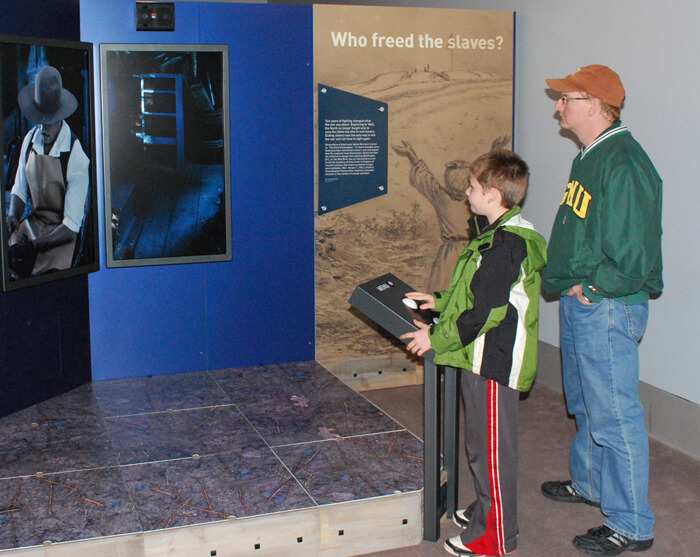
Slavery’s relationship to the Civil War has been the most contested terrain of the war’s history, and the VHS presents visitors with a clear, unvarnished explanation right away: “Slavery caused the war, but the war was not begun to free the slaves.” Not much elaboration follows this forthright assessment. Instead, visitors can turn to two multimedia installations on the subject: the first-person “Journey to Freedom,” and, second, a sequence of voice-over quotes about the secession crisis and slavery. I found the latter confusing and difficult to follow. Against a background of crowd noises and political banter, we hear quotes from a Southerner then a Northerner, i.e. Harriet Beecher Stowe, Robert Toombs, Abraham Lincoln, Lydia Maria Child, Jefferson Davis, Stephen Douglas, Frederick Douglass, and various competing editors, ministers, and public figures. The multimedia display includes animated images, newspaper graphics, lithographs, and photographs, each swirling on the screen as the quotes are performed. All of the animation makes it difficult to keep track of who is who and what “perspective” they represent. This somewhat disorienting effect left me uncertain, at first, if the editor of The Charleston Mercury was speaking for or against of all things, emancipation.
The “Journey to Freedom,” on the other hand, is one of the most evocative and effective museum installations I have seen recently. The first-person viewing stage is nearly fifteen square feet and includes three seven foot high screens. The immersive visual effect comes from standing in a rotating 360 degree panoramic perspective. The visitor chooses a persona—either a thirty-five year old male shoemaker or a twenty-six year old female field hand. You are given instructions by an older enslaved character before choosing a direction and setting out to escape. The landscapes through which you navigate are beautifully rendered films, accompanied by sounds from the Virginia fields, forests, swamps, and woods. You feel like a runaway and you are surrounded by the 360 degree landscape. At key points you have to make decisions about whether to stop to gather food, tools, or information. For example, when you reach a railroad track or a river, several enslaved (or possibly free black) characters are on scene and you can choose to ask them questions or to slip past them unnoticed. All of your decisions lead ultimately either to recapture by Confederates or to freedom by reaching the Union army lines. At the end of your “journey” the narrator summarizes your decisions and explains the consequences, risks, and odds of escape. This historical simulation was so captivating that I had to play it four times and each sequence was slightly different. In addition, I watched as several high school students played the game. They spent more time on this interactive simulation than any other part of the exhibition. One cannot “play” this game without understanding slavery’s terrifying choices more fully and realistically.5For a useful account of this exhibit’s development, see Lauranett Lee’s excellent post “Field Notes: Journey to Freedom,” December 10, 2010 (https://vahistorical.wordpress.com/2010/12/10/field-notes-journey-to-freedom/). The VHS opened the blog to public comment but it has drawn few outside contributions.
 |
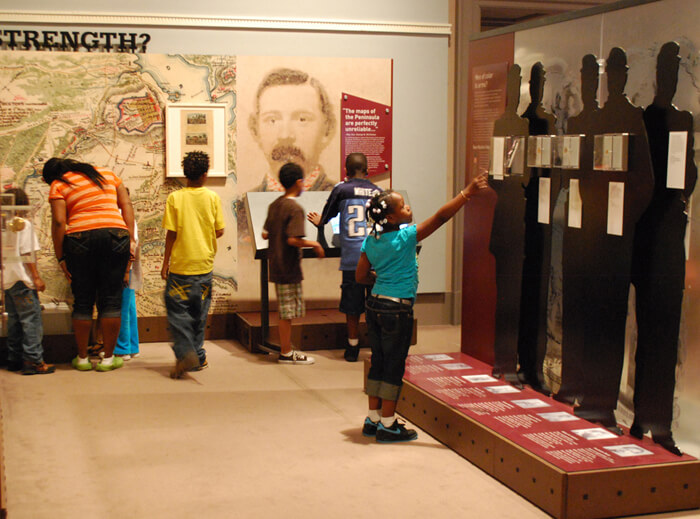 |
| Virginia Historical Society, Who Freed the Slaves? display, Richmond, Virginia, March 2011. Courtesy of the Virginia Historical Society. | Virginia Historical Society, Group in An American Turning Point exhibit, Richmond, Virginia, April 2011. Courtesy of the Virginia Historical Society. |
Unfortunately, the VHS chose to include a section in this exhibition titled “How did Slaves Support the Confederacy?” The question itself suggests that slaves actually supported the Confederacy, and we will learn how they did so. One wonders if this section was meant to appease the foaming “black Confederate” myth-makers who wish to rewrite history textbooks to depict the Confederacy as racially egalitarian. Upon closer examination, however, the VHS clearly indicates in this section that slave labor was forced to work in settings that aided the Confederacy, including, for example, at Tredegar Iron Works, on railroads, in mines, and on plantations. But the distinction could easily be lost on a visitor who could not be blamed for leaving with the idea that blacks supported the Confederacy.6Washington Post, October 20, 2010 (http://www.washingtonpost.com/wp-dyn/content/article/2010/10/19/AR2010101907974.html) and October 24, 2010 (http://www.washingtonpost.com/wp-dyn/content/article/2010/10/22/AR2010102203429.html). Various Sons of Confederate Veterans sites have suggested that tens of thousands of African Americans fought for the Confederacy—as an example, see the “Black Confederate” site at http://www.scvcamp469-nbf.com/theblackconfederatesoldier.htm. See also Kevin Levin’s excellent blog: Civil War Memory on “Black Confederates in Virginia Textbooks” (http://cwmemory.com/2010/10/20/black-confederates-in-virginia-textbooks/). See also Ta-Nehisi Coates, “Understanding Virginia’s Textbook Lie,” The Atlantic, October 20, 2010 (http://www.theatlantic.com/national/archive/2010/10/understanding-virginias-history-textbook-lie/64859/)
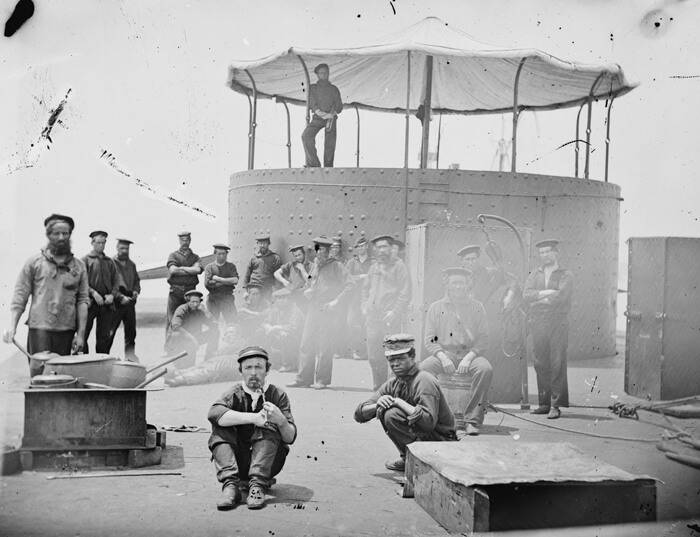 |
| Detail of Siah Carter on the USS Monitor, James River, Virginia, 1862. Courtesy of the Library of Congress. |
On the other hand, the VHS exhibit includes some surprising and powerfully rendered stories. There is a full section on Dr. Alexander T. Augusta, the highest ranking black officer in the war, a surgeon born into slavery in Norfolk, Virginia, who became a leading figure advocating for black civil rights in the war and after. The story of Siah Carter, a twenty-two year old enslaved African American, who rowed out to the U.S.S. Monitor to freedom in 1862. A series of interactive maps describe in rich, horrifying detail the guerrilla warfare that engulfed parts of western Virginia, and the formation of West Virginia is carefully explained.
To its credit, the VHS invested considerable effort in the quality and quantity of its multimedia interactive exhibits. Some succeed in conveying the vast sweep of the conflict in ways impossible otherwise. “A Landscape Turned Red” charts the major battles in Virginia (thirty six in all) and allows visitors to choose a battle and see all of the highlighted counties whose men fought there. In a battle such as Fredericksburg, with over 72,000 Confederate and over 100,000 Union men engaged, the map highlights nearly all of the counties in the North and South except those in southern Ohio, Indiana, Illinois, Missouri, Iowa, and Tennessee. At first, this deluge of information does not seem very useful, and the map takes a long time to load the data. When one begins to compare battles, however, a broader and deeper sense of the conflict begins to be revealed. The composition of the battles changes—who fought at each place and from where they originated. No single print map could show this dynamic flow of the war, as soldiers are pulled into conflicts far from home to meet adversaries from equally distant places. The Civil War is so often considered a local war of brothers versus brothers but this map indicates is vast and impersonal scale and scope. In this way and others, the modern nature of the conflict is laid bare for visitors.
Anyone who goes to this exhibition should be prepared for the nearly constant, and occasionally distracting, soundscape. Select the Battle of Cloyd’s Mountain on May 9, 1864 on the interactive map and you will see miniature regimental units charge across the screen and turn red as they suffer casualties. Much screaming of men and neighing of horses accompany the gory display; however, the effect on visitors may be less troubling than dissonant. The game seems to reduce the death and dying that took place on Civil War battlefields to something like Pac-Man. On the other hand, in “The Face of Battle” exhibit, visitors can walk into a 360 degree virtual battlefield, in this case Kernstown, and stand in a panoramic mural of its reenactment. Overhead, the sound of battle rages with shots, screams, and whinnies. The effect is sobering and depressing, a melancholy reminder that war is indeed hell and murder and suffering.
No review of this exhibition is complete without mentioning the medical “sick call” interactive game, a feature enormously popular with younger audiences. The visitor plays doctor and is presented with a series of symptoms and complaints. Rheumatic fever? Choose Dover’s Powder. Sores? It’s syphilis, so prescribe mercury rub.
At the entrance to the VHS’s exhibition, visitors can record their reactions to the exhibit in a comment book, and dozens of school children took the opportunity to write enthusiastic compliments. A few comments, unsurprisingly, complain that the exhibition is “pro Union” and unbefitting of the “Virginia” Historical Society. One mocks Martin Luther King, asking “when will the white boys be free at last.” More than a few criticize the staff of the VHS as condescending and unfriendly.
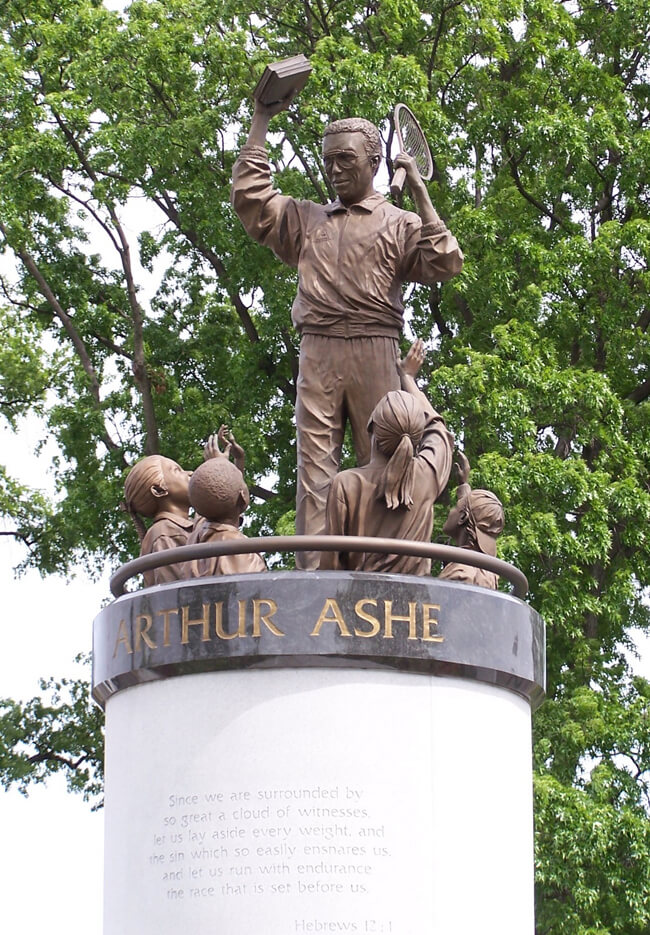 |
| Jim Belfield, Arthur Ashe monument, Richmond, Virginia, 2006. |
Despite its sometimes stuffy reputation, the VHS deserves recognition for bringing this exhibition forward. The path to a more complete and inclusive history in Richmond has not been easy. In the 1990s the battles over history in Richmond became loud, public, and heated. First, in 1994 some Richmonders wanted a monument to native son and tennis great Arthur Ashe. Controversy erupted over where to place the Ashe monument. In a city with almost no statues to commemorate leading black figures, such as John Mitchell, editor of the Richmond Planet, or Oliver Hill, civil rights attorney, the Ashe monument seemed long overdue. Yet, The Richmond Times Dispatch argued that putting Ashe on Monument Avenue, with Lee, Jackson, Stuart, and Maury, “would strip Ashe’s memory of context and deprive it of meaning.” The city newspaper took a traditionalist stance, arguing further that Ashe’s proponents were out to “settle a racial score.” When some who opposed the Ashe monument began advocating, disingenuously, for a monument to blacks who supported the Confederacy, The Richmond Times Dispatch gave the idea serious consideration, even suggesting that a monument commemorate blacks who fought “for both sides.”7Richmond Times Dispatch, December 15, 1994 and October 10, 1995.
In 1995 the city council of Richmond decided to place Ashe’s monument on Monument Avenue. Protests by so-called heritage associations followed, and for years afterward KKK fliers opposing the monument could be found on car windshields nearby. Controversy erupted yet again in 1999 surrounding the city’s plan to decorate the downtown Canal Walk with murals of important Virginians, including Robert E. Lee in his Confederate uniform and Nat Turner, who led one of the largest slave revolts in American history.8For a brief account, see Richmond Times Dispatch, July 27, 1999.
In the last decade, however, Richmond’s city leaders and institutions have begun taking a fresh approach to their histories. In 2007 the Richmond Slavery Reconciliation Statue, prominently placed in Shockoe Bottom, recognized the city’s role in the transatlantic and interstate slave trades, and the city opened a “slave trail” series of historical markers.9See “Slave Trail Seeks to Free City History,” VCUInSight, May 10, 2009, (https://vcuinsight.wordpress.com/2009/05/10/slave-trail-seeks-to-free-citys-history/) and “Is $22,000 too much to pay for 17 slave trail markers?” April 14, 2011, (http://wtvr.com/wtvr-slave-trail-bought-by-city-of-richmond-20110413,0,3094068.story)
The VHS exhibition marks a turning point for the Society. Long associated with the history of its collections, including for example the papers of Robert E. Lee and other Confederate leaders, the Society has patiently worked to broaden its interpretations and present the public with exhibitions deeply informed by current scholarship. They are succeeding. This first-rate exhibition on the war in Virginia offers visitors to the Virginia Historical Society a new dynamic look at the past, one that will be sure to leave them more deeply engaged with their history.